
F7 chord
Root position: The most common shape: the lowest note is the root named in the chord, with the other chord tones stacked above it.
Notes: F · A · C · Eb
Voicing: 1 / 7
Fingering
Left hand: 5-3-2-1
Right hand: 1-2-3-5
Root
Chord type
Root position & inversions
Alternate bass
F7 chord piano — F, A, C, and the E♭ that keeps the door swinging
An F7 chord piano grip is four notes: F, A, C, and E♭. The first three build an F major triad; the E♭ on top (or tucked inside) is a minor seventh above the root. That flat seventh is the plot twist. Without it you are parked in plain F major. With it the harmony leans hard toward B♭ and refuses to sound finished. Blues in F hangs on this colour for whole choruses. Rock shuffles, country turnarounds, gospel walks, and jazz charts write F7 when the bass moves and the melody wants bite instead of a polished Fmaj7. This page stays on that one dominant colour so you can hear the E♭ pull against A, place all four tones under both hands, break the stack into an arpeggio, and move the bass through the inversions and alternate-bass shapes real sheets actually print.
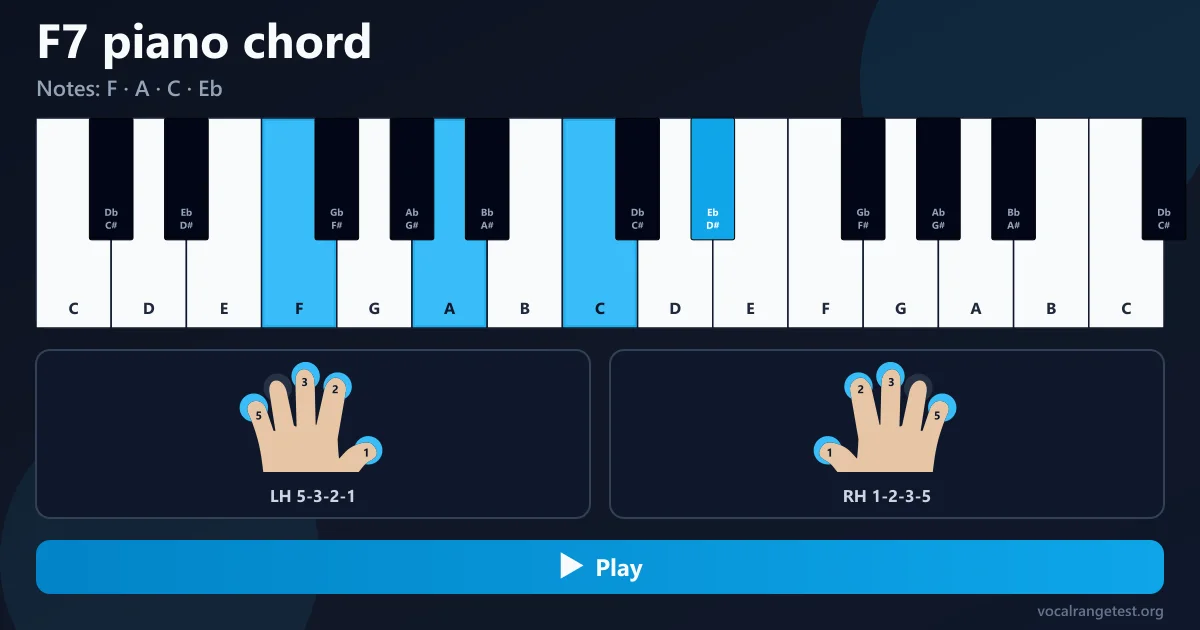
How to play F7 chord piano
Start in root position with F, A, C, and E♭ under one hand. Right hand often sits 1–2–3–5; left hand often sits 5–3–2–1. Those numbers are a starting map, not a law — swap if the stretch feels tight or if the next chord needs a different thumb. The useful habit is to press the stack once as a full chord, then switch to arpeggio and listen for E♭ on its own. If you can name that flat seventh by ear, you will stop swapping it for the E natural of Fmaj7 mid-song. F7 in piano writing is friendlier than it looks on paper: three of the four tones are white keys, and the black-key E♭ is the whole personality — rush past it and the chord loses its job.
Charts almost never freeze you in root position. F7/A piano chord writing puts the third in the bass; F7/C piano chord shapes put the fifth down low; F7/Eb piano chord forms put the seventh itself underneath — classic steps when a left-hand walk climbs or drops through the dominant. Alternate-bass marks such as F7/G show up when the bass line is doing its own job while the upper tones keep the F7 identity. On this page you can flip those shapes, hear each one on real piano samples, and match left- or right-hand fingering as the bass moves, so rehearsal does not start with a slash chord you have never sounded at the bench.
A against E♭ is the restless interval
F, A, and C already spell F major. E♭ is what turns the label into F7. Hear the stacked chord once, then arpeggiate until that flat seventh is as clear as the root — and notice the tritone between A and E♭. That interval is why Western ears expect motion instead of a closed landing.
Slash bass changes the story, not the chord tones
When a chart writes F7/A, F7/C, or F7/Eb, the chord tones stay F–A–C–E♭; only the lowest note changes. Songwriters and arrangers use those drops and climbs so the ear hears walking while the colour stays dominant. Preview them here before a rehearsal throws the slash at you cold.
Built to listen, not just label
Static posters stop at a mute picture. Here you click full chord or arpeggio, flip fingering, and step through inversions and alternate bass on one interactive diagram — practice time goes into ear and hand, not into decoding a frozen grid.
Where F7 shows up — and what “key of F7 chords piano” usually means
Players type that phrase when they want the neighbourhood around F7, not a theory-exam “key of F7.” Here is how the chord actually earns a place in charts.

Doorway in B♭, home colour in an F blues
In B♭ major, F7 is the classic V7: the doorway that wants to walk into B♭. In an F blues it can sit as the I7 home colour itself — rough and grinning instead of unresolved. In C minor it often appears as IV7 under lines that want lift without tipping into full major brightness. Jazz turnarounds, hymn cadences, country walks, and R&B grooves all lean on that same four-note engine. Outside strict Roman numerals you will also see it as a borrowed dominant inside brighter keys, as a stop-time hit under a vocal, or as the left-hand shove in a shuffle while the right hand frets a riff. When someone searches key of f7 chords piano ideas, they are usually hunting V7 / I7 neighbourhoods around B♭ and F — not a literal exam key signature named F7.
Three bench passes that make F7 stick

1. Lock the dominant colour first
Open the diagram and play F7 as a block chord. Pass one is only about recognising the major triad with E♭ on top — not memorising every inversion yet. If it suddenly sounds polished and “finished,” check that you did not grab E natural instead of E♭.

2. Arpeggiate until E♭ is unmistakable
Switch to arpeggio and let F, A, C, and E♭ speak in order. Slow down if the seventh blurs. That slow pass is how “how to play F7” stops being a finger puzzle and becomes a sound you can trust when a chart only writes the symbol.

3. Move the bass on purpose
Step through F7/A, F7/C, and F7/Eb, then try an alternate-bass shape such as F7/G if your sheet uses one. Left- and right-hand fingering update with the voicing, so you rehearse what arrangements actually ask for instead of freezing in root position.