
Fm9 chord
Root position: The most common shape: the lowest note is the root named in the chord, with the other chord tones stacked above it.
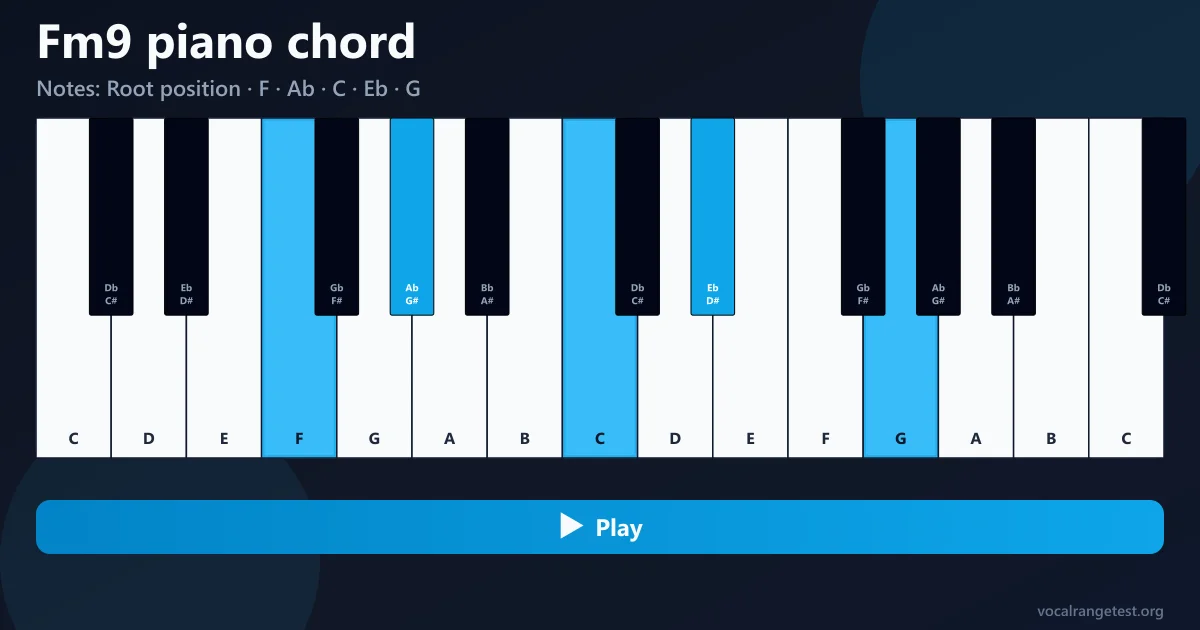
Notes: F · Ab · C · Eb · G
Voicing: 1 / 4
Root
Chord type
Root position & inversions
Two-hand voicing
Fm9 piano chord — five notes on the flat side that turn a minor triad into something you can sit on for a whole bar
Charts throw Fm9 at you when a plain Fm7 feels too thin but the writer still wants minor colour — not the brighter lift of F9 or Fmaj9. The stack is F, Ab, C, Eb, and G: a minor triad, a flat seventh, and a major ninth parked above. Two black keys (Ab and Eb) carry most of the identity; miss either one and you are in a different chord family. Five tones in one hand gets muddy fast, which is why most working players split the shape or move the bass. This page is built so you can hear the full colour, peel it note by note, check fingering, and step into Fm9/Eb or a practical two-hand layout before you lock in muscle memory at the bench.
What an Fm9 chord on piano actually is — and where you meet it
Think of Fm7 first: F, Ab, C, Eb. The ninth is G sitting above that seventh — not a random add-on, but the tone that opens the chord upward and softens the top edge. In Ab major, Fm9 often works as a richer vi chord under a vocal that has room to breathe. In F minor itself it can hang as i9 for bars while the melody floats. Neo-soul and quiet R&B on the flat side reach past Fm7 when they want that cushioned, slightly nostalgic minor without the dominant pull of F9. You will also see it where a progression already used Fm7 and the arranger wanted one more layer of air — same minor foundation, gentler ceiling.
Compared with neighbours: Fm7 stops at Eb and sounds leaner. F9 swaps Ab for A natural — major-third territory, brighter story. Fmaj9 keeps the major frame with E instead of Eb. Fm(add9) keeps G but drops the seventh, which reads sweeter and less functional. If your chart says Fm9 and you play A instead of Ab, or skip G entirely, the harmony tells a different tale than the arranger wrote. The interactive keyboard here ties to real piano samples so you can prove Ab and G by ear before you argue about spacing or which slash bass the lead sheet meant.
Ab and Eb are not optional colour
F and C are easy to find. Ab makes it minor; Eb makes it a seventh chord; G makes the symbol say nine instead of seven. Arpeggiate once and you will hear which flat actually matters when your hand rushes past it.
Fm9/Eb when the seventh owns the floor
Walking bass lines and synth pads often sit on Eb while the harmony still reads Fm9. Eb lowest, then F, G, Ab, C above — darker entry, ninth still floating on top. Preview that voicing here before a slash mark mid-chart catches you cold.
Built to listen, not to freeze a poster
A mute screenshot cannot tell you whether your G rang or whether Eb is functioning as the seventh. Click for chord or arpeggio, flip left/right fingering, and step through inversions on one page — practice time goes into ear and hand shape, not decoding a static grid.
What this Fm9 page adds that a static fingering chart leaves out
Most diagrams online show five keys and stop. They cannot prove whether your ninth spoke, whether Eb is the seventh, or how Fm9/Eb should sound when a slash appears. We tied the diagram to sampled piano audio, arpeggio playback that lights each key in order, left- and right-hand fingering that updates when you change voicing, and the inversions you will meet in real charts.

Hear the stack, then walk F–Ab–C–Eb–G
Chord mode plays the voicing you selected — root stack, Fm9/Eb, or the two-hand spread — so you know what finished sounds like before your fingers copy it. Arpeggio mode walks the tones in play order and lights each key as it sounds. That split is the fastest way to catch a missing G, a seventh that never spoke, or a hand shape that looks right but blends into grey noise.
How to play Fm9 chord on piano

1. Name the five tones before you stretch
Fm9 is F, Ab, C, Eb, and G — root, minor third, fifth, minor seventh, major ninth. Say each name while the page plays them in arpeggio. Ab must stay flat or you wander into F9 territory. Eb must read as the seventh, not an optional pad. G must ring for the symbol to mean nine, not seven. A phone screenshot will not tell you if your spacing hides the top — use the diagram as the map.

2. Hear root position, then try the two-hand spread
Select the two-hand voicing: left F and C, right Eb, G, Ab. Fingerings on the page run left 5–1, right 1–2–3. Slow arpeggio from bass to treble — low notes first, then the right-hand cluster — mirrors how you would voice this in quiet R&B or a film pad. The chord still reads Fm9 when the root lives in the left and the colour tones breathe in the right.

3. Learn Fm9/Eb when the chart shows a slash
Fm9/Eb puts Eb in the bass: Eb lowest, then F, G, Ab, C above. Bass players and inner voices often sit on the flat seventh while the chord name stays Fm9. It sounds slightly darker than root position with the ninth still on top. Run block and arpeggio here until your ear owns the new floor note — slash chords trip up players who only drilled root position.

4. Place Fm9 in a key so the colour makes sense
In Ab major, hang on Fm9 as vi9 under a melody, then resolve toward Db or back to Ab — you will hear why arrangers reach past plain Fm7 for one more shade of warmth. In F minor, sit on i9 for a few bars and notice how the ninth adds lift without the dominant brightness of F9. Context beats isolated drilling; return here whenever a new voicing appears on a chart you have not practised.

5. Match fingering to your span, not a poster
Open the fingering panel for each voicing and match it to your hands. Small hands should not force five notes into one cramped cluster — split across hands or use Fm9/Eb if the bass line allows. If block playback and your live attack disagree, trust the page first, adjust pressure second, speed last.