
C7 chord
Root position: The most common shape: the lowest note is the root named in the chord, with the other chord tones stacked above it.
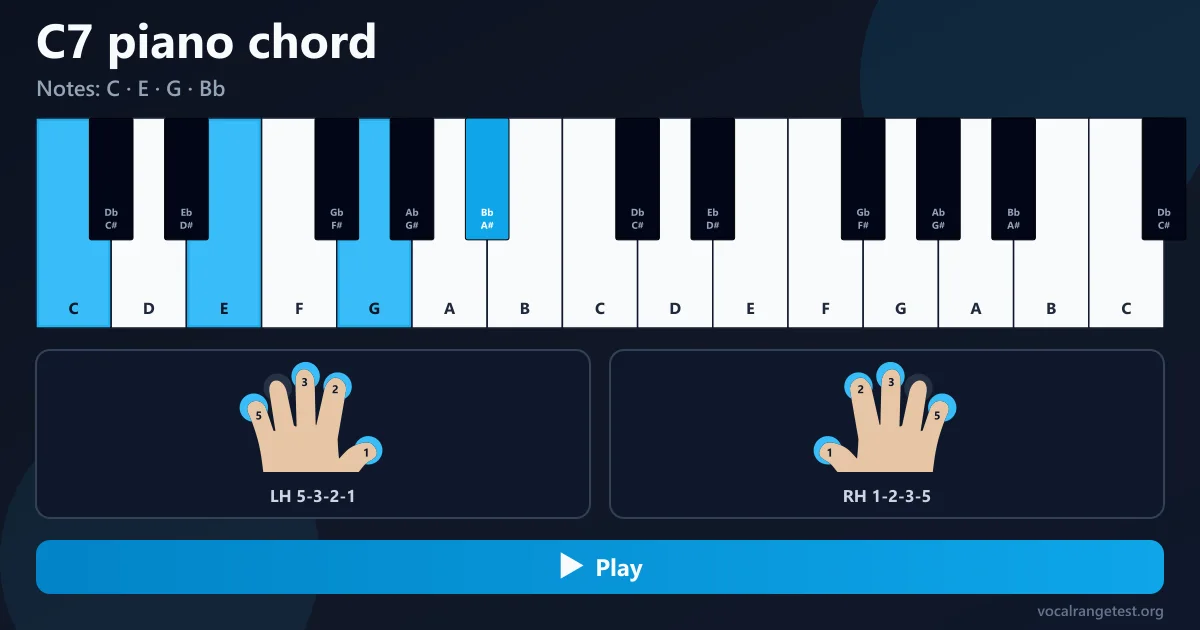
Notes: C · E · G · Bb
Voicing: 1 / 7
Fingering
Left hand: 5-3-2-1
Right hand: 1-2-3-5
Root
Chord type
Root position & inversions
Alternate bass
C7 chord piano — C, E, G, and the Bb that pulls the harmony forward
A C7 chord piano grip is four notes: C, E, G, and B♭. The first three build a C major triad; the Bb on top (or tucked inside the stack) turns the colour into a dominant seventh. That minor seventh is the whole plot. Without it you are sitting in polite major; with it the chord leans toward F and refuses to sound finished. Blues charts hang on this sound for whole choruses. Jazz lead sheets write C7 when the bass walks and the melody wants grit instead of a sunny Cmaj7. This page stays on that one dominant colour so you can hear the Bb pull, place the four tones under both hands, and move the bass through the inversions real sheets actually print.
Where C7 shows up — and what mood it carries
Think of C7 as unfinished business with swagger. In F major it is the classic V7: the chord that points hard at the tonic and makes the ear expect F next. In a blues in C it often sits as I7 — home base with a bluesy edge, cycling through F7 and G7 without ever needing a “pure” C major landing. Gospel turnarounds, R&B hooks, and rock shuffles use the same four tones when a chorus needs push rather than rest. Emotionally C7 reads as restless, funky, a little cheeky: major brightness in the triad, plus a Bb that says “we’re not done.” Pair that against Cmaj7 (which uses B♮) and you feel the difference immediately — maj7 floats; C7 digs in and wants to move.
Theory-wise the recipe is simple: major triad plus a minor seventh above the root. On the keyboard that means you must own Bb as deliberately as you own C. Miss the flat and the chart’s dominant function collapses into plain C. Real arrangements rarely leave you in root position forever. Walking bass asks for C7/E when the third is underneath, C7/G when the fifth is the floor, and C7/Bb when the seventh itself sits in the bass for a darker, stacked landing. Those slash labels are still C7 in piano harmony — same four pitch classes, different lowest note. Hearing the stacked chord and the broken arpeggio on this page turns those marks into sounds you can approve before your fingers copy them.
Bb is the note that makes it C7
C–E–G alone is major. Add Bb and the function flips to dominant. The diagram keeps that flat lit so you judge the stretch and the colour before you commit the hand.
Hear the pull before you memorize the shape
Chord playback stacks all four tones so the restless dominant colour is obvious. Arpeggio mode walks C–E–G–Bb in order — useful when a tired finger still wants a plain triad from muscle memory.
Bass moves; the label still reads C7
Root position is home. The same tools surface C7/E, C7/G, C7/Bb and alternate bass so the harmony still functions as C7 when the lowest note is not C — exactly what blues and jazz sheets throw at you early.
Practice C7 in piano with sound, breakdown, and movable bass
A printed four-note diagram cannot tell you whether Bb is actually speaking. Here the chart is wired to piano samples, left- and right-hand fingerings, inversions, and alternate bass — so practice time goes into listening and placement, not guessing from a mute picture.

Hear the full seventh, then break it into an arpeggio
One click gives you the stacked C7 — triad brightness plus that Bb bite. Switch to arpeggio when you need to confirm each tone is clean, especially the seventh, which soft fingers love to thin out or miss. Playback follows the inversion or slash you selected, so you hear the voicing on screen rather than a generic root-position loop. That listen-and-compare habit is what turns a four-note picture into a chord you trust under a blues vocal, a horn stab, or a walking bass line.
- Click to hear block chord or arpeggio on real piano samples
- Left- and right-hand fingerings update with the inversion
- Root position plus C7/E, C7/G, and C7/Bb
- Alternate bass shapes when the chart writes a slash outside the triad set
- Same dominant colour whether you searched “C7” or “dominant seventh on C”
How to play C7 chord piano

1. Plant C–E–G, then add Bb on purpose
Start near middle C if the span feels natural; a smaller hand can drop an octave without changing the chord’s identity. Build the C major triad first so the hand knows the bright skeleton, then add Bb — usually the next black key below B, a whole step under C if you are thinking from the root up an octave. Compact right-hand shapes often use 1–2–3–5 or 1–2–4–5 depending on stretch; left hand commonly 5–3–2–1 or 5–3–1–2. If the chord suddenly sounds like plain C major, you dropped the seventh. If it sounds oddly minor, check that E is still natural.

2. Balance the seventh so it bites without yelling
C7 lives on the relationship between the major third and the minor seventh. Aim for four even attacks: E should keep the major colour alive, Bb should colour the stack without drowning G. Ghosted neighbour notes under soft fingertips are the usual culprit when the chord turns muddy. When the shape is stable, play the block on this page and compare — you want restless dominant, not a slammed cluster and not a timid triad with a polite Bb afterthought.

3. Break it into an arpeggio until C–E–G–Bb is automatic
Arpeggio mode lights each key as the pitch rises. Watching C, E, G, then Bb in sequence is the fastest way to wire the dominant seventh into muscle memory — and to separate it from Cmaj7, which wants B♮ instead. If one finger lags, slow down until you match the page. This is where “C7 in piano” practice starts to sound musical: you hear the seventh as part of the colour, not as an awkward extra key.

4. When the bass has to walk — move into C7/E, C7/G, and C7/Bb
Use the inversion controls. C7/E puts E underneath — common when bass lines climb through the third or when a chart wants a lighter middle. C7/G parks G in the bass for an open floor that still reads as C7. C7/Bb puts the seventh on the bottom for a thicker, more stacked landing you hear in blues and stride-influenced left hands. Listen to both block and arpeggio so the new lowest note is obvious before you copy the hand. Searching those slash names is how many players arrive here; the sound is still one dominant chord.

5. Preview alternate bass when the chart writes an unexpected slash
Lead sheets sometimes keep C7 colour in the right hand while the bass walks outside the strict inversion set. Preview those alternate-bass options until your ear owns the new floor. Same four chord tones above, different gravity below — that mismatch is exactly what confuses players who only drilled root-position C7 from a static chart.
6. Drop C7 into a key so the tension has somewhere to go
When you study key of C7 chords piano in real progressions, start where charts use it most: as V7 resolving to F (or Fm), as I7 in a C blues cycling toward F7 and G7, or as a turnaround colour that refuses to sit still on plain C. Hold the chord, then walk a short line into F, Fm, or F7 and listen to why writers pick the Bb instead of B♮. Context beats isolated drilling; come back here for the large diagram, the inversion set, and the hear-and-break-down tools when the next sheet throws a new slash at you.