
F9 chord
Root position: The most common shape: the lowest note is the root named in the chord, with the other chord tones stacked above it.
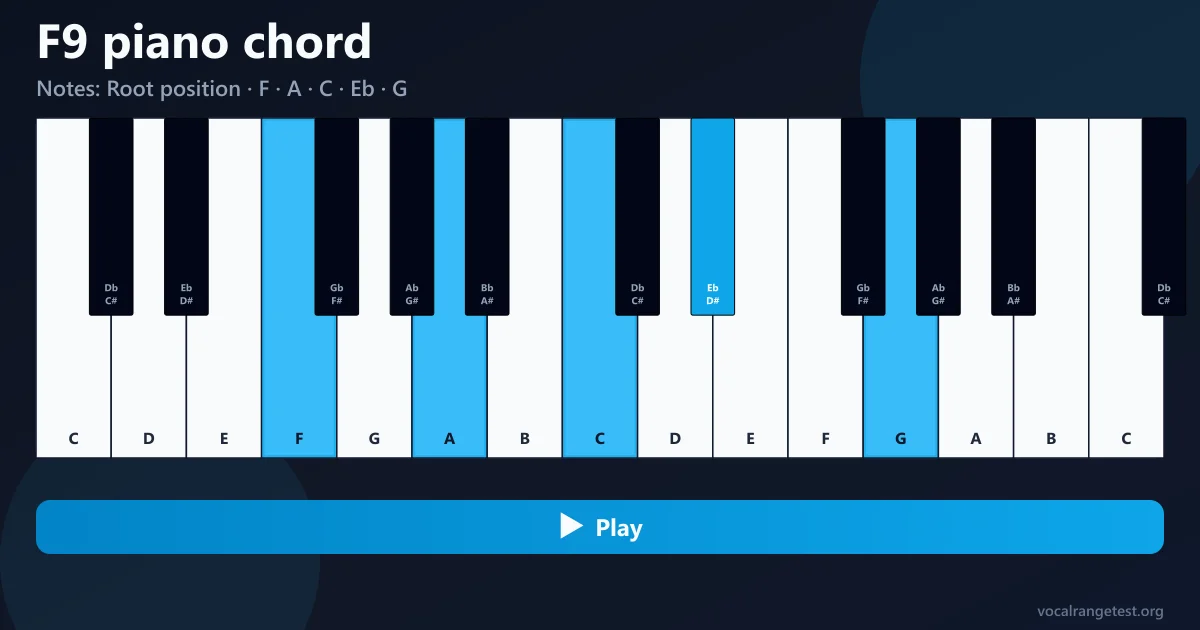
Notes: F · A · C · Eb · G
Voicing: 1 / 4
Root
Chord type
Root position & inversions
Two-hand voicing
F9 Piano Chord
An F9 chord on piano is the warm, slightly bluesy sound of an F7 with a G parked on top. The full stack is F–A–C–Eb–G. That G is the ninth—the difference between a plain dominant seventh and the rounder color written as F9—while Eb keeps the dominant bite so it never drifts into a major-ninth ballad. Hear it above before you stretch across five notes, then read on for how the tones fit together and how to voice them without forcing a painful reach.
How to Play F9 Chord on Piano
Start by finding F below middle C (or any F that feels comfortable). Build the chord in layers so your ear stays ahead of your hands: F and A first (root and major third), then C (the fifth), then Eb (the flat seventh—this is the note that makes it a dominant chord, not a major-seventh chord), and finally G (the ninth). When all five ring together, you have an F9. On a real keyboard, cramming F–A–C–Eb–G into one hand in close position is a wide stretch for many players. That is normal. You do not have to mash every note into one palm on day one. Try leaving out the C if you need the span, or split the chord: left hand takes F (and maybe C or Eb), right hand takes the upper color notes such as Eb–G–A or G–A–C. The harmony still reads as F9; you are just voicing it like a pianist instead of a chord chart printed in a textbook.
A practical practice loop looks like this. Play F7 alone (F–A–C–Eb) and listen. Add G and notice how the chord brightens without turning “major” in a classical sense—the Eb keeps the dominant bite. Then switch the player above to arpeggio mode and hear each tone in order; that is often the fastest way to catch a wrong black key. When the shape feels familiar, try the F9/Eb inversion on this page (seventh in the bass). It is the same five pitch classes with Eb on the bottom, and it shows up constantly in gospel walks, blues turnarounds, and soft rock ballads where the bass wants to step down into the next chord. Spend a minute comparing root position and that slash voicing by ear. Once you can tell them apart without looking at the labels, the fingering chart stops being a puzzle and starts being a map.
Hear before you stretch
Tap the diagram to hear the full F9 or the arpeggio. Confirm the color you want, then worry about hand shape. Guessing from a static picture alone is how people learn the wrong seventh.
See every tone laid out
The keyboard highlights F, A, C, Eb, and G so you can match sound to geography. If something feels muddy, mute the chord and rebuild one note at a time until the ninth sits clearly on top.
Inversions when root position fights you
Flip to F9/Eb or the two-hand open voicing when a close cluster is too wide. Same chord name, friendlier spacing—and the version you will actually use in songs.
What an F9 Chord on Piano Is Made Of
Formula, common mix-ups, and why hearing the stack matters more than memorizing a photo.

The five-note recipe
Think of F9 as F major triad + minor seventh + major ninth: F, A, C, Eb, G. Interval view from the root: major 3rd, perfect 5th, minor 7th, major 9th. Nothing in that list is optional in the full theoretical spelling, but performers often thin it—dropping the fifth is the most common shortcut because A, Eb, and G already sell the dominant-ninth color.
Using the Interactive F9 Tool

1. Play the chord, then the arpeggio
Hit the F9 diagram in chord mode to hear the full sonority. Switch to arpeggio and listen for the climb F–A–C–Eb–G. If one step sounds “off,” that is usually the note your hand is missing or doubling by mistake.

2. Match the highlighted keys
Look at which keys light up and place your fingers the same way on your instrument. Prefer a quieter dynamic at first; five notes at full volume can mask a wrong Eb vs E. Soften, correct, then dig in.

3. Tour the inversions and two-hand shape
Move through root position, the F9/Eb inversion, and the two-hand open voicing. Pick the version that fits the groove you are practicing. Bookmark the sound in your head—not just the picture—so you can find it again without opening a browser mid-song.