
Fdim chord
Root position: The most common shape: the lowest note is the root named in the chord, with the other chord tones stacked above it.
Notes: F · Ab · B
Voicing: 1 / 3
Fingering
Left hand: 5-3-1
Right hand: 1-3-5
Root
Chord type
Root position & inversions
fdim chord piano: a practical guide you can hear, see, and use
If you searched for fdim chord piano, you are probably trying to solve a real musical problem, not pass a theory exam. Maybe a lead sheet throws in a chord that looks tense and unfamiliar. Maybe you are producing a track and need a transition that feels dramatic without sounding random. Maybe you just want to know where to put your fingers and what notes are actually inside the shape. This page is built for that exact moment. You can tap and hear the chord online, inspect every note in plain language, and compare voicings that are easier to play in context. We also include inversions and slash-bass options, so you can understand not only what Fdim is, but how to make it work inside real progressions.
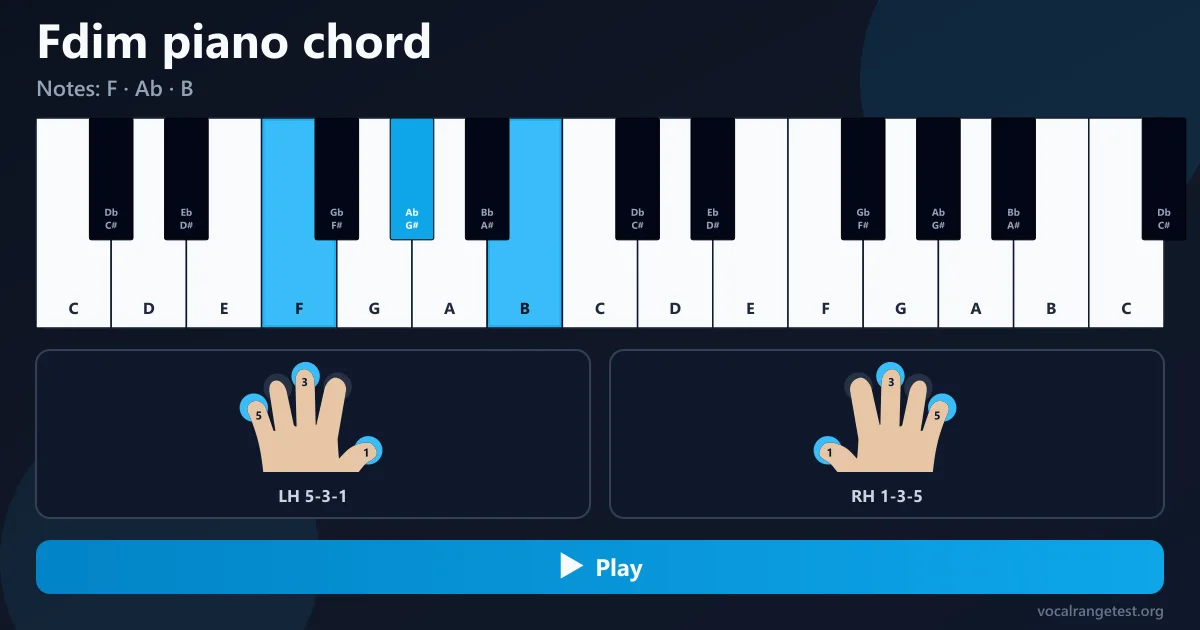
What is fdim chord piano, in plain English?
The short version: F diminished is a three-note chord built from F, Ab, and B. On paper, people call it a stack of minor thirds. At the keyboard, it feels like a compact shape with a strong pull. It rarely sounds like a final resting point. Instead, it creates suspense and then wants to move somewhere else. That is why you often hear it in passing moments, turnarounds, film cues, jazz colors, gospel movement, and pop arrangements that need a darker edge for one beat or one bar.
If you are new and wondered "fdim chord on piano" or "f diminished chord piano" in everyday terms, think of it like this: major chords feel settled, minor chords feel emotional, and diminished chords feel unstable on purpose. That instability is useful. It helps your next chord feel more satisfying. In practice, Fdim can push into Gm, resolve toward Em7b5-style colors, or act as a passing shape between nearby bass notes. You do not need advanced theory to start using it. You just need to hear how it behaves and test it in a progression you already play.
Hear before you memorize
Click to hear Fdim instantly, then switch between chord and arpeggio playback so your ear learns the sound, not just the shape.
Understand the construction
See the chord broken into notes and functions, so you can connect finger placement with theory in a way that actually sticks.
Use it in real songs
Try inversions, slash-bass variants, and nearby voicings to place Fdim smoothly inside intros, turnarounds, and transitions.
fdim chord on piano: why this page is different
Most chord pages stop at a static diagram. This one is built for players who want to hear, compare, and apply the chord quickly in real music.

One page for sound, structure, and movement
You can audition the chord online, read the note stack, and jump through inversions without leaving the page. That saves time when you are practicing and helps you connect ear training with finger memory.
- Online audio preview for instant A/B listening during practice
- Chord breakdown with clear note labels and playable voicing variants
- Inversions grouped for quick comparison across hand positions
- Slash-bass options to shape stronger bass motion in arrangements
- Fingering-friendly layouts that work for both beginners and returning players
f diminished chord piano: how to practice it in 10 minutes

1) Start with the core triad and ear match
Play F, Ab, and B slowly, then press the online playback button and match what you hear. Do not rush this step. Your goal is to make your own sound line up with the reference. If your voicing feels muddy, separate the notes and listen one by one, then re-stack them. This takes less than two minutes and makes everything after it easier.

2) Test inversions for smoother transitions
Next, move through the available inversions and listen to how each one leads into your target chord. The notes are the same, but the top note and hand position change the emotional feel and the ease of movement. If you are accompanying a singer, choose the inversion that stays out of the vocal range. If you are writing, choose the inversion that makes the melody line feel intentional rather than jumpy.

3) Add slash bass and context practice
Finally, try slash-bass versions to control the direction of your progression. This is where the chord becomes musical, not just theoretical. Set a simple loop such as one bar per chord and test Fdim as a passing tension. Keep what sounds clear and expressive, remove what sounds forced, and save one voicing you can recall tomorrow. Consistency beats complexity.