
G7 chord
Root position: The most common shape: the lowest note is the root named in the chord, with the other chord tones stacked above it.
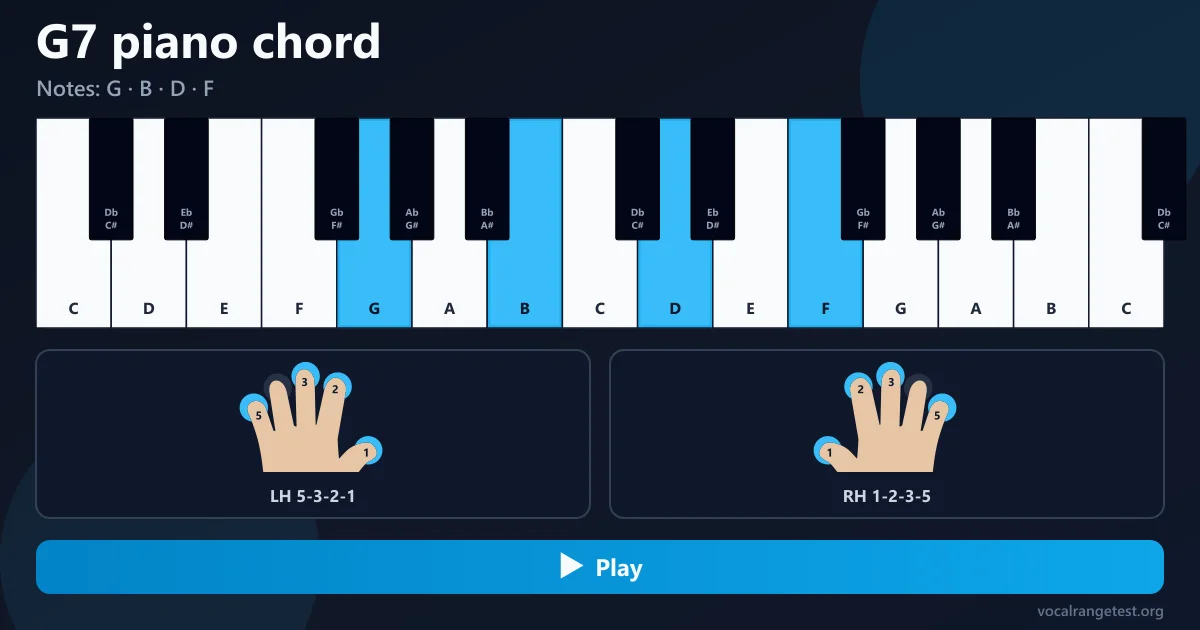
Notes: G · B · D · F
Voicing: 1 / 7
Fingering
Left hand: 5-3-2-1
Right hand: 1-2-3-5
Root
Chord type
Root position & inversions
Alternate bass
G7 on the piano — the dominant that refuses to sit still
A g7 chord piano shape is G–B–D–F: a major triad with a minor seventh stacked on top. That F is the whole personality. Against B it forms a tritone — the restless interval that makes Western ears expect motion — so the chord rarely feels finished the way a plain G triad does. Writers drop G7 when a phrase needs to lean, swagger, or pull. In the key of C major it is the classic V7, the doorway that wants to walk into C. In a G blues it can sit as the home colour itself, rough and grinning instead of unresolved. Jazz turnarounds, hymn cadences, country walks, and rock riffs all lean on that same four-note engine. This page stays on G7 alone: diagram, click-to-hear playback, fingering, inversions, and alternate bass — so you can hear the bite of the seventh before your hand guesses which white keys to grab.
When charts ask for G7 — and what the pull usually feels like
G7 shows up wherever harmony needs forward lean. The textbook home is the key of C: G7 as V7 under a melody that is about to land on C or Am. Church music, beginner lead sheets, and pop ballads print that move constantly because ears already know the story. Blues and rock treat G7 differently. There the chord can be the tonic colour in a G blues — I7 instead of V7 — so the “unresolved” seventh becomes attitude rather than a cliffhanging cadence. Jazz players meet G7 inside ii–V–I lines (Dm7–G7–Cmaj7) and in cycle-of-fifths walks where every bar is a dominant waiting for the next. Folk and country use it for walkdowns and “amen” setups. Emotionally G7 reads tense, bluesy, a little cocky — closer to unfinished business than to sadness. It is brighter than Gm7, sharper than a bare G triad, and warmer than a thin power-fifth stack because B and F argue in the middle of the chord.
Practicing g7 in piano terms means owning four white keys that still demand clear voicing. G, B, D, and F sit in one span for many hands, which tempts players to crush them into a muddy cluster. The useful skill is hearing which tone is doing the work: B carries the major third, F carries the dominant bite, D fills the fifth, and G anchors the name. Charts rarely leave you in root position. Bass lines walk G7/B, G7/D, and especially G7/F — the third inversion with the seventh underneath that makes gospel and jazz bass motion feel inevitable. Slash marks park non-chord tones under the same upper structure when a chart wants a pedal or a passing bass. Hearing the block chord next to an arpeggio turns those symbols into sounds your ear can approve, which is how G7 stops being a stamp on a lead sheet and becomes the tension you recognise under a vocal that is about to resolve — or deliberately refuses to.
One dominant — not every seventh on the board
The diagram stays locked on G–B–D–F so you can judge spacing and which finger owns the seventh. Neighbouring qualities and other roots live on the full chart; this page is for hearing this dominant cleanly before you wander.
Break the chord open before you force the grip
Chord mode stacks all four tones for the full restless ring. Arpeggio mode walks them so you can tell whether F is speaking as the seventh or vanishing under a heavy thumb on G. That split is the difference between a confident dominant and a vague G-ish smear.
Bass moves; the label can still read G7
Root position is the starting map. The same tools surface inversions and alternate-bass (slash) shapes, so the harmony still functions as G7 when the lowest note is B, D, F, or something the chart wrote underneath. Lead sheets throw that at you constantly.
A G7 workbench you can hear — not a mute diagram of four whites
Printed charts freeze one grip. Here the diagram ties to piano samples, left- and right-hand fingering, inversions such as G7/B–G7/F, and alternate-bass shapes — so practice time goes into hearing dominant colour, not decoding a still image.

Hear the pull, then take the chord apart
Tap once for a solid G7 when you want the full forward lean. Switch to arpeggio when you need to isolate the tritone between B and F, or to check whether the seventh is actually ringing. Playback follows the voicing you picked, so an inversion or a slash bass sounds like the notes on screen rather than a generic root-position loop. That listen-and-compare loop is how four lit keys become a dominant you trust in a cadence, a blues bar, or a turnaround.
- Click-to-hear chord or arpeggio on real piano samples
- Left- and right-hand fingering that updates with the voicing
- Root position plus G7/B, G7/D, and G7/F inversions
- Alternate-bass (slash) shapes when the chart puts a different note underneath
- Diagram first — less lecture, more sound and hand shape
How to play G7 chord piano on this page

1. Lock G–B–D–F on the diagram
Confirm all four tones before you mash the span. G7 is all white keys, which makes crowding easy: a soft finger on F turns the dominant into a shy G triad. Use the lit keys as a map of who owns the seventh.

2. Hear the block, then the arpeggio
Play the stacked sound once so your ear catches the restless colour. Then switch to arpeggio and walk G–B–D–F slowly. If the bite disappears, lighten the fifth or bring F forward until the chord stops sounding like plain G.

3. Match left- and right-hand fingering
Open the fingering view and fit it to your span. Many players split the chord — root or shell in the left, upper tones in the right — and that still counts as G7 if the pitches are right. Small hands should prefer clarity over a crushed four-note cluster.

4. Step through inversions and slash bass
Move from root position into G7/B, G7/D, and G7/F. Listen for how G7/F especially changes the gravity — same four tones, seventh in the basement, a favourite walk for gospel and jazz bass. Then try alternate-bass options when a chart writes a slash that is not a chord tone.

5. Put G7 in a key (and ignore the “key of G7” myth)
Search phrases like “key of g7 chords piano” usually mean G7 inside a real key, not a mythical key named G7. In C major, treat G7 as V7 and walk a short C–F–G7–C or Dm–G7–C so your ear feels the pull home. In a G blues, sit on G7 as I7 and notice how the same chord feels like swagger instead of a cliff. Context decides whether the seventh is tension or attitude.