
F6 chord
Root position: The most common shape: the lowest note is the root named in the chord, with the other chord tones stacked above it.
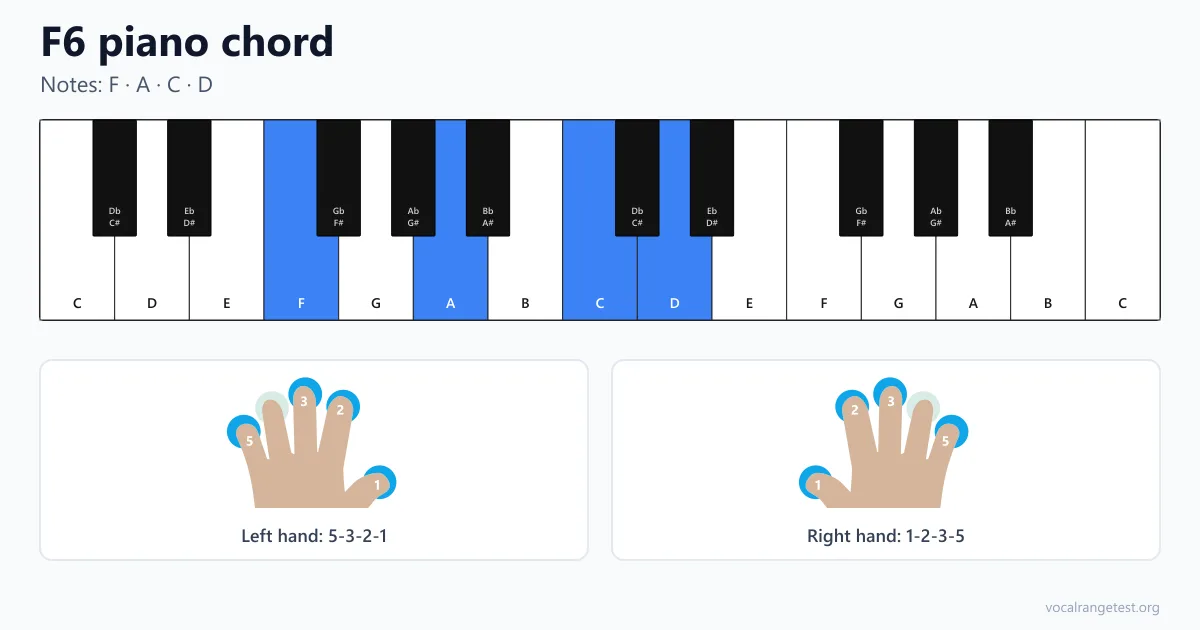
Notes: F · A · C · D
Voicing: 1 / 4
Fingering
Left hand: 5-3-2-1
Right hand: 1-2-3-5
Root
Chord type
Root position & inversions
F6 piano chord guide when you want F-major warmth with a little daylight still showing
An F6 piano chord is an F major triad with D parked on top of the color: F–A–C–D. All four tones sit on white keys, so beginners often meet this shape early—then wonder why charts bother writing the 6 at all. Plain F can feel blocky under a vocal. Fmaj7 brings in E and tips brighter, more jazz. F6 keeps the major frame and adds the major sixth (D), so the landing softens without that seventh sparkle. If you typed “F6 chord on piano” looking for something you can hear—not a silent fingering poster—start with the keyboard above.
What is an F6/9 piano chord—and how it differs from plain F6
People searching “F6 9” usually mean F6/9 (sometimes written F69): the F6 stack plus a ninth, G. So F6 alone is F–A–C–D. F6/9 is F–A–C–D–G (voicings vary; you may drop C or spread the G up an octave). On this page the interactive tool focuses on F6—the four-note sixth chord—because that is the foundation. Once your ear knows how D colors F major, adding G for a 6/9 sound is a small next step on your own instrument.
F is a favorite singer key: comfortable midrange for many voices, and a common home for piano-led ballads and soft pop. Arrangers reach for F6 when a bare triad feels too square for the lyric, but they do not want the more modern lift of Fmaj7. You will also see F6 as I in F major, or as a warmer IV when the song lives in C. A useful shortcut: F–A–C–D are the same pitch classes as Dm7; bass on F says F6, bass on D leans toward D minor seventh. Flip those bottoms in the inversion controls and the labels stop feeling arbitrary.
D is the softener
Without D you have ordinary F. With D, the major color stays, but the chord stops short of a hard full stop—handy under held vowels.
White keys, still easy to mash
F–A–C–D line up neatly, which tempts beginners to clamp everything equally. Let D speak; if C and D blur, lighten the middle or roll the chord.
Neighbors: Fmaj7 and Dm7
Fmaj7 wants E, a half step under the next F. F6 wants D, a whole step above C. Same letter set as Dm7, different bass story—learn both so charts do not confuse you.
How to play F6 chord on piano
Static dots will not teach the color. Here you audition the harmony, peel it into single tones, and walk the inversions your left hand meets in real charts.

Sound first, then fingers, then bass motion
Trigger F6 as a full chord or as a broken arpeggio so F, A, C, and D each get a turn. Left- and right-hand fingering guides sit beside the keys. Move through root position plus F6/A, F6/C, and F6/D without leaving the page. That mix—live piano sound, note-by-note breakdown, and voiced positions—is the point of this tool: ear and hands learn the same shape in the browser, free, with no signup.
- Play F6 as a chord stack or note-by-note arpeggio
- See which keys light and which fingers cover them
- Compare inversions F6, F6/A, F6/C, F6/D by the bass
- Browser-based—no app install, no account wall
From first stack to chart-ready voicings

Build F–A–C, then invite D
Right hand: thumb on F, then A and C (try 1–2–3). Confirm the bright major triad before you add D. Left hand can hold a low F alone if four notes feel crowded at first.

Seat D so the sixth actually reads
Add D above C (common four-note fingering 1–2–3–5 with 5 on D). Play F–A–C, then add D, and listen for the color change—that interval is why the chord is called a sixth. If D disappears under a heavy C, thin the fifth or shift the whole voicing up an octave.

Walk the slash bass lines you will see
F6/A smooths stepwise bass through A. F6/C puts the fifth underneath for a wider foundation. F6/D borrows the Dm7 bass flavor when a chart wants major harmony with a minor-ish bottom. Cycle them here until you can name the lowest note without peeking at the label.

Register around the singer, not against them
Low vocals? Move the right-hand cluster up so you are not doubling the melody. Sparse piano parts often sound cleaner with low F in the left hand and a compact F6 in the right than with two dense walls of white keys.