
Gsus chord
Root position: The most common shape: the lowest note is the root named in the chord, with the other chord tones stacked above it.
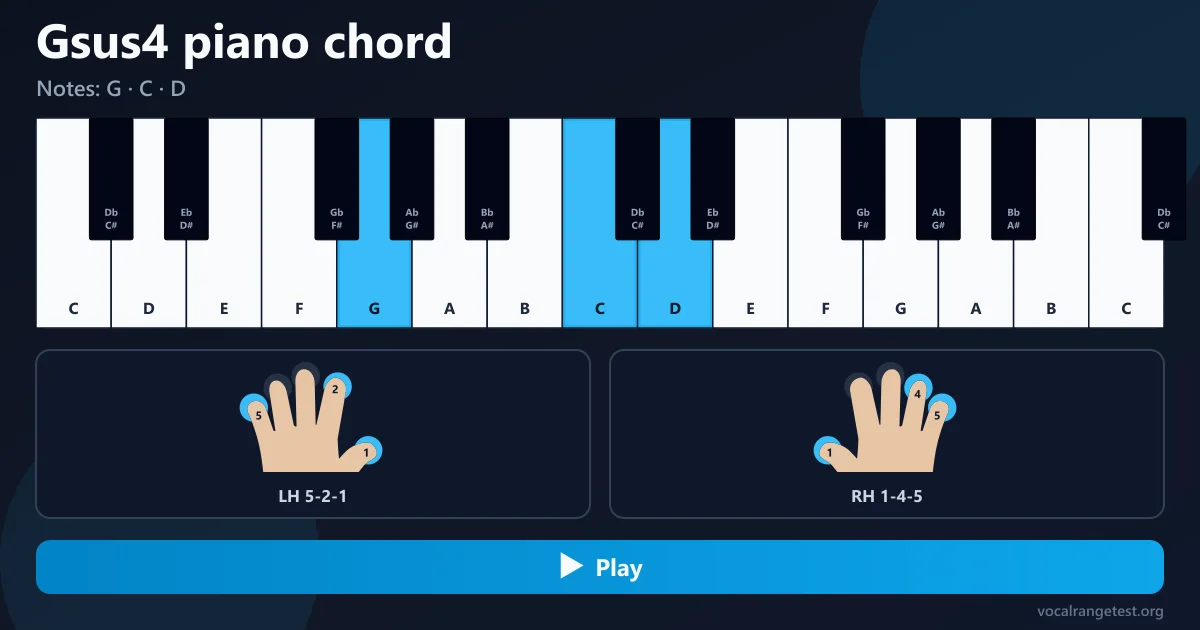
Notes: G · C · D
Voicing: 1 / 6
Fingering
Left hand: 5-2-1
Right hand: 1-4-5
Root
Chord type
Gsus4
Gsus2
G sus chord piano: the hang that keeps G from sounding finished
On a lead sheet or worship PDF you often see bare Gsus next to a plain G, then sit at the piano wondering which middle note belongs. A G sus chord on piano keeps the outer posts of G and D while the usual B steps aside. Slide C into that gap for the common g sus 4 piano chord; slide A in for the quieter g sus 2 piano chord. This page is built so you can hear g sus in piano under your fingers—block chord or arpeggio—before you lock in a fingering.
The missing B is the whole personality
Think of plain G as a three-story house: G downstairs, B in the middle, D upstairs. Suspensions kick the middle tenant out. With C in the middle apartment, the house still says “G neighborhood,” but it stops sounding cheerfully major. That tension is useful when a song sits on G too long and starts to feel like a closed door. With A in the middle, the house sounds wider and less urgent—good for pads, intros, and verses that want space more than push.
G also sits next to F♯ on the keyboard, the leading tone of the G major scale. Beginners sometimes grab F♯ by accident when hunting for Gsus shapes. Knowing the target tones—G and D fixed, middle note either C or A—keeps the hand honest. If a chart only prints Gsus, reach for G–C–D first; that is the default reading in most pop and worship books. If it prints Gsus2 or G2, aim for G–A–D.
Follow pitch names, then the finger map
Start from the highlighted note names on the piano diagram, then use the left/right fingering hints as a comfortable starting grip—not as the only legal hand shape.
Two middles, one page
Toggle the Gsus4 group and the Gsus2 group on the same keyboard view so the ear—not the spelling—picks which hang fits the song.
Check the sound before muscle memory
Play the stack as a chord, or walk an arpeggio so each tone lights in order. That is faster than staring at dots on a printout.
Gsus as traffic control in G–C–D progressions
In songs that bounce between G, C, and D, a suspended G often acts like a yield sign: same neighborhood as G, but it asks the harmony to keep moving. Hearing that on piano clarifies why the chart bothered with the sus at all.

Practical jobs Gsus gets hired for
Before a big G landing after a long C chord, writers sometimes park on Gsus so the arrival feels earned instead of abrupt. In campfire-style loops (G–C–D–G), swapping one G for Gsus4 softens a repeat that was starting to sound square. Country and folk intros love that open, ringing hang over a static bass. Electronic or lo-fi beds prefer Gsus2 because the A sits closer to a drone and less like a church-style resolve. None of this requires fancy language: if plain G feels too “finished,” borrow the hang; if the hang feels too sticky, let it fall to G or lean into Em for a minor turn.
- Online piano tone for full chords or broken arpeggios—confirm the color before you memorize.
- Break the chord into lit keys so you see which pitch is the suspended middle.
- Fingering maps for root position, plus inversions when the bass needs a different floor.
- Alternate voicings grouped so Gsus4 and Gsus2 stay distinct instead of blurred into one vague “sus.”
- Works in the browser at the bench—no install, no account gate for a quick listen.
How to play gsus chord piano with this tool

1. Lock the outer posts: G and D
Ignore the middle for one second. Find a comfortable G, then the D above it. Those two poles stay put in both Gsus4 and Gsus2. If those poles drift, the chord stops reading as G anything.

2. Choose the middle on purpose
Add C for the default chart spelling (Gsus / Gsus4). Or add A for Gsus2. Play each option into plain G afterward. Whichever release matches the lyric—sharper or softer—is the one to keep for that song.

3. Move the bass only when the line asks
Stay in root position while you learn. When the left hand wants a step under a long G harmony, open an inversion so C, D, or A can sit on the bottom without rebuilding the whole grip. Same three pitch classes, different floor story.