
G chord
Root position: The most common shape: the lowest note is the root named in the chord, with the other chord tones stacked above it.
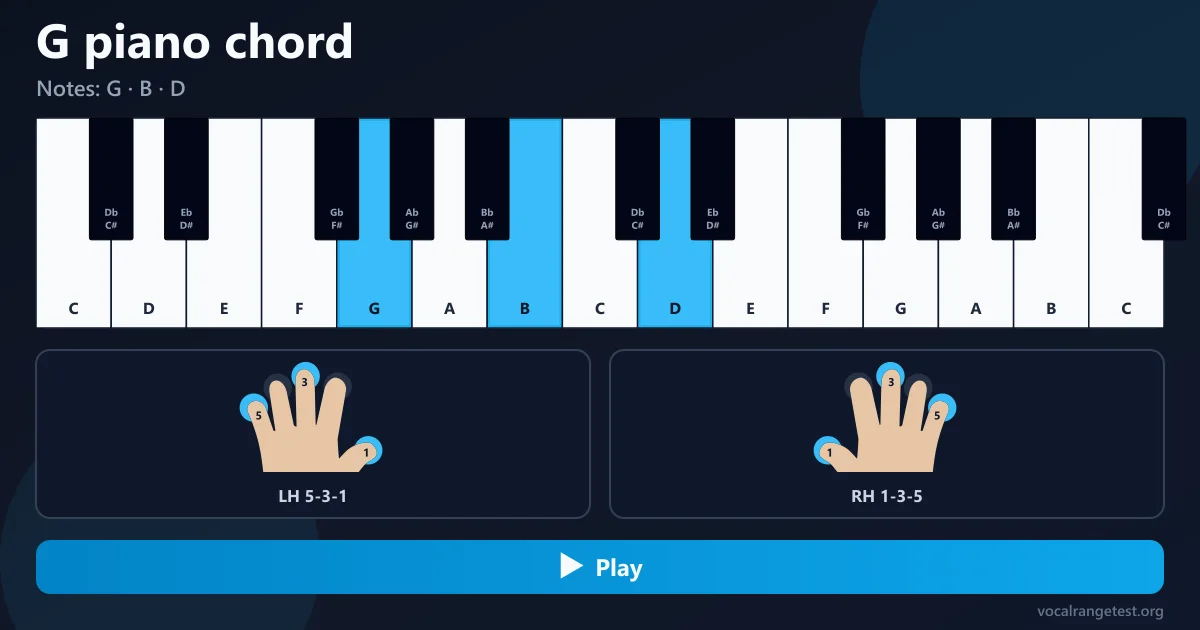
Notes: G · B · D
Voicing: 1 / 6
Fingering
Left hand: 5-3-1
Right hand: 1-3-5
Root
Chord type
Root position & inversions
Alternate bass
G major on piano: bright, steady, and flexible enough for pop, worship, folk, and rock
If you search for a g major chord piano shape, you usually want more than three note names on a static chart. You want to hear whether your voicing sounds clean, see where your fingers should land, and understand why this one chord appears in so many songs. G major is G-B-D, a major triad that feels open and forward-moving without sounding as final as C in many progressions. On guitar-led music, G often acts like home base; on piano, it becomes a practical hub chord because it connects smoothly to C, D, Em, and Am with minimal hand travel. This page is designed for that real use case: not just theory labels, but immediate sound and hand-level feedback so you can make musical choices faster.
When players reach for G major, and what emotion it usually carries
G major tends to read as clear, optimistic, and grounded. It can be warm in a ballad, energetic in a chorus, and supportive in verse accompaniment without stealing focus from vocals. In the key of G, it is the I chord and gives tonal stability; in the key of D, it becomes IV and adds lift before a return to the tonic; in C major, it functions as V and creates natural forward pull. That flexibility explains why learners meet it early and keep using it at every level. In practical arranging, G major is often where you decide whether a section should feel settled or still in motion. A plain root-position G can sound direct and confident, while a softer voicing or inversion can make the same harmony feel less blocky and more connected to the melody.
People also search related terms like g major in piano or key of g chords piano when they are really asking two different questions: first, how to play the chord itself cleanly; second, how to place it inside common progressions. Both matter. A good chord page should let you hear the full block chord and the arpeggiated version, because those reveal different problems. Block playback exposes balance and tone weight. Arpeggio playback exposes note order clarity and whether one finger is over-accenting. Once that foundation is solid, slash forms like g/b chord piano and g/a chord piano become practical tools for bass motion rather than confusing symbols. That is where a basic chord dictionary turns into a useful musicianship tool.
Hear first, then decide your voicing
Static diagrams tell you where to press; audio tells you whether it works in context. Use one click to hear a full chord, then switch to arpeggio to check internal balance and clarity.
One page for root, inversions, and slash bass
Instead of jumping between separate lessons, compare root position, inversions, and alternate bass options on one screen. That makes transitions easier to learn by ear, not by memorizing labels alone.
Built for practice decisions, not just chord naming
Left/right fingering diagrams, voicing swaps, and playback modes help you answer practical questions: which shape feels stable at tempo, and which bass note supports the lyric best.
A playable g major chord piano workspace, not a dead screenshot
This page combines online sound, chord breakdown, fingerings, inversions, and alternate bass voicings in one workflow. You can audition ideas immediately instead of guessing from a frozen keyboard image.

Online hearing + chord breakdown in one loop
Click chord mode to hear the full G-B-D stack, then arpeggio mode to hear each note step-by-step. This reveal is especially useful for students who can locate the notes but are still training ear control for balance, touch, and timing.
- Click-to-hear piano sound for chord and arpeggio modes
- Left-hand and right-hand fingering diagrams tied to voicing
- Root position and inversion options on the same page
- Alternate bass (slash) choices including G/B and G/A
- Fast compare workflow for sound, feel, and song context
How to play g chord piano on this page (step by step)

1. Start with the core triad: G-B-D
Lock in the three notes before worrying about fancy voicings. Keep your hand relaxed and let the spacing breathe. If the chord sounds muddy, do not add force first; fix note balance first.

2. Play full chord, then split it into arpeggio
Use chord mode to check the overall color. Then switch to arpeggio to hear whether B (the major third) is clearly present. If B gets buried, your voicing may feel neutral instead of truly major.

3. Match fingering to your hand size and tempo goal
The default fingering is a starting point, not a rule carved in stone. For slower ballads, prioritize tone control and sustain. For faster rhythm comping, pick the fingering that resets quickly and cleanly between shapes.

4. Move through inversions before adding slash bass
Test each inversion and listen to how the same harmony shifts in weight. Then add slash bass options only after inversion clarity is stable. This order prevents random trial-and-error and gives your bass line a purpose.

5. Apply to progressions in the key of G
Use short loops such as G-D-Em-C and G-C-D to hear function, not just shape. If you came from a key of g chords piano search, this is where the page becomes practical: you are no longer practicing isolated grip memory; you are training real harmonic movement.