
Gdim chord
Root position: The most common shape: the lowest note is the root named in the chord, with the other chord tones stacked above it.
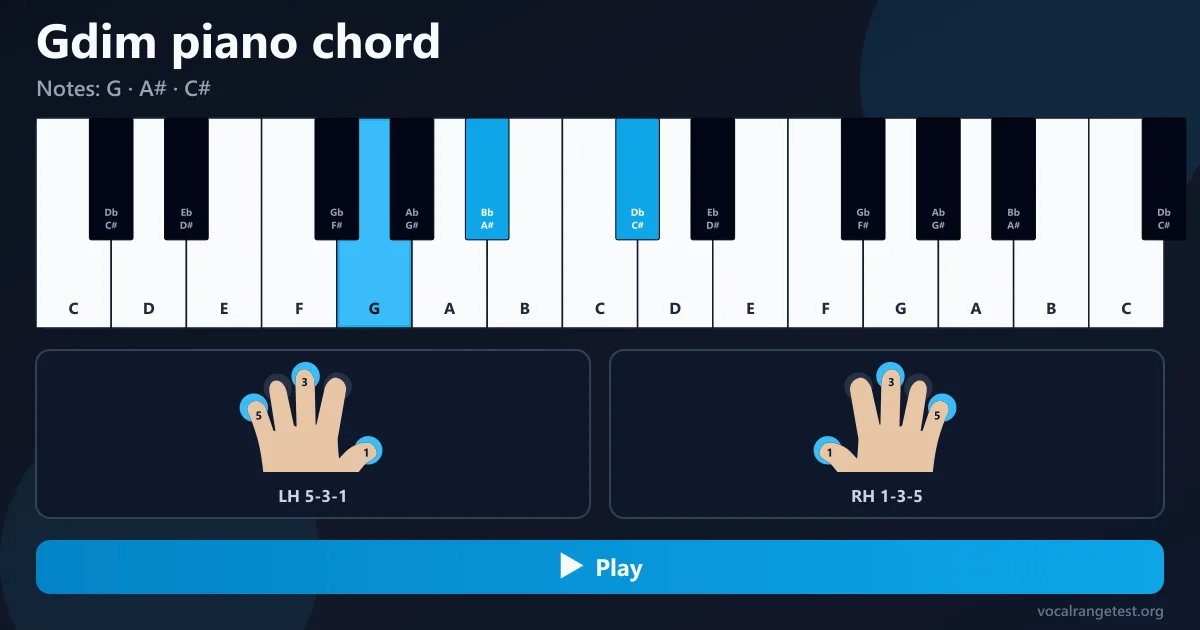
Notes: G · A# · C#
Voicing: 1 / 3
Fingering
Left hand: 5-3-1
Right hand: 1-3-5
Root
Chord type
Root position & inversions
gdim piano chord: a clear, practical guide you can hear and play
If you searched for gdim piano chord, you’re probably not trying to pass a theory quiz. You’re trying to solve a real music moment: the sheet shows a diminished chord and the progression suddenly feels tense, unfinished, or “almost right.” You might want the sound, you might need fingering ideas, and you definitely want the chord to connect cleanly to what comes before and after. Gdim is perfect for those moments because it’s made to create motion. The triad built on G (with Bb and Db) doesn’t sit like a major chord or soften like a minor chord. It tends to pull forward, like it’s expecting the next step. In other words, diminished chords often behave like a question. You can answer the question in your arrangement by choosing the right bass note, the right hand position, and the right moment. What makes it useful (and not just “weird”) is that it’s predictable once you hear it. When you play the chord as a whole, you’ll notice the sound feels compact and slightly tense. When you switch to arpeggio, the notes show the same feeling in a clearer order: the “need to resolve” lives right inside the three-note stack. That means you can use it without fear once you train your ear for that feeling. So when would you actually reach for gdim chord on piano? A few everyday situations: First, when the progression feels too flat for one small bar. Instead of rewriting the whole harmony, you insert a short burst of tension. Gdim can act like a musical elbow: it nudges the next chord to arrive with more clarity. Second, when you want a turnaround color. Turnarounds are those moments before the next section where you want drama but you don’t want to sound “overly technical.” Diminished chords are great for this because they add a distinct color immediately. Third, when the bass line needs direction. If the bass jumps awkwardly, the whole chord can sound wrong even if the top notes are correct. That’s exactly why this page includes slash-bass (alternative bass) options and inversion switching. You can keep your musical intent while fixing the connection. On this page, you don’t just look at a static diagram. You can listen online, break the chord into notes in plain language, switch inversions (including the hand-position “where is my bass?” view), and test slash-bass (alternative bass) options. You’ll also get fingering-friendly layouts so your hands have a path that feels playable, not just theoretical. The goal is simple: help your ear decide faster and help your hands land what you choose.
What is gdim chord piano? Learn G diminished the usable way
Here’s the core idea in straightforward terms. The gdim piano chord usually means a G diminished triad. On the keyboard, its basic notes are G, Bb, and Db. (Depending on spelling, Db might be described enharmonically, but the sound you hear is the same “diminished pull.”) If you think in intervals, it’s a stack of short, tense distances: it doesn’t feel like a “rest,” it feels like a “lean.” One practical detail: diminished chords are symmetric in a way that can tempt you to memorize only one shape. Don’t. Instead, treat it like a tool. Yes, you learn the basic shape, but then you use inversions so the bass and your hand position support the musical sentence you’re writing or performing.
If you’ve also seen “gdim chord on piano” or “g diminished chord piano,” don’t let the name confuse you. In everyday use, those phrases usually point to the same listening experience: a dark, unstable three-note chord that works best when it’s placed for connection. A common beginner mistake is to treat Gdim as if it’s a final destination. In real arranging, it’s more often a connector. It can make a transition sound intentional, especially when the next chord is stronger or more stable. You can also use it to “color” a harmony for a single beat without turning the whole section into chaos. Here’s the “big picture” rule of thumb: whenever you place a diminished triad, you should also be thinking about what it is leading to. If you don’t have that next step in mind, the chord may still sound strange—but it will sound strange in a way that feels accidental. With the right bass choice and inversion, it feels like the chord is doing its job.
Listen first, then memorize
Tap the sound and switch between chord and arpeggio playback so your ear learns the shape before your hands commit.
Decompose it into understandable notes
You can see the chord as a simple note stack, then use that knowledge to correct muddy voicings.
Use inversions and slash-bass on purpose
Choose the bass and hand position that match your progression so the chord lands naturally.
gdim piano chord page: different from a frozen chord diagram
Most pages show where to place fingers. This page helps you place the chord in music: audio first, notes next, then inversions and alternative bass.

One workflow for sound and setup
Hear the chord online, inspect the notes, compare inversions, and test slash-bass (alternative bass) options without leaving the page.
- Online audio for instant chord and arpeggio comparison
- Chord breakdown with clear note labels so you understand what you’re playing
- Inversions grouped for quick “what feels smoother?” testing
- Slash-bass options (alternative bass) for stronger bass-line motion
- Fingering-friendly layouts to help both beginners and returning players
- Practice-focused guidance that turns the diagram into an actual musical decision
g diminished chord piano: a practical 3-step practice plan

1) Lock the sound: G–Bb–Db (whole chord first)
Start by playing the full gdim piano chord as one block. Then switch to arpeggio so you hear the same three notes in order. Your goal is not to analyze everything at once; it’s to train your ear to recognize the “leaning” sound. If the chord sounds unclear, separate the notes briefly and restack.

2) Choose the inversion that matches your next chord
Now try inversions. The notes stay the same, but the bass and hand position change the feeling. This is the part that helps beginners most: the chord connects better when the bass note matches the line you want. Test a few options and listen for what feels less like a jump and more like a step.

3) Add slash-bass (alternative bass) to guide the progression
Finally, test slash-bass and alternative bass options. Think of Gdim as a “push” that can be directed. Put it where it naturally leads into the following harmony, and use the alternative bass to keep the bass line smooth. Save the voicing that stays clear at tempo. Consistency matters more than collecting many shapes.