
G9 chord
Root position: The most common shape: the lowest note is the root named in the chord, with the other chord tones stacked above it.
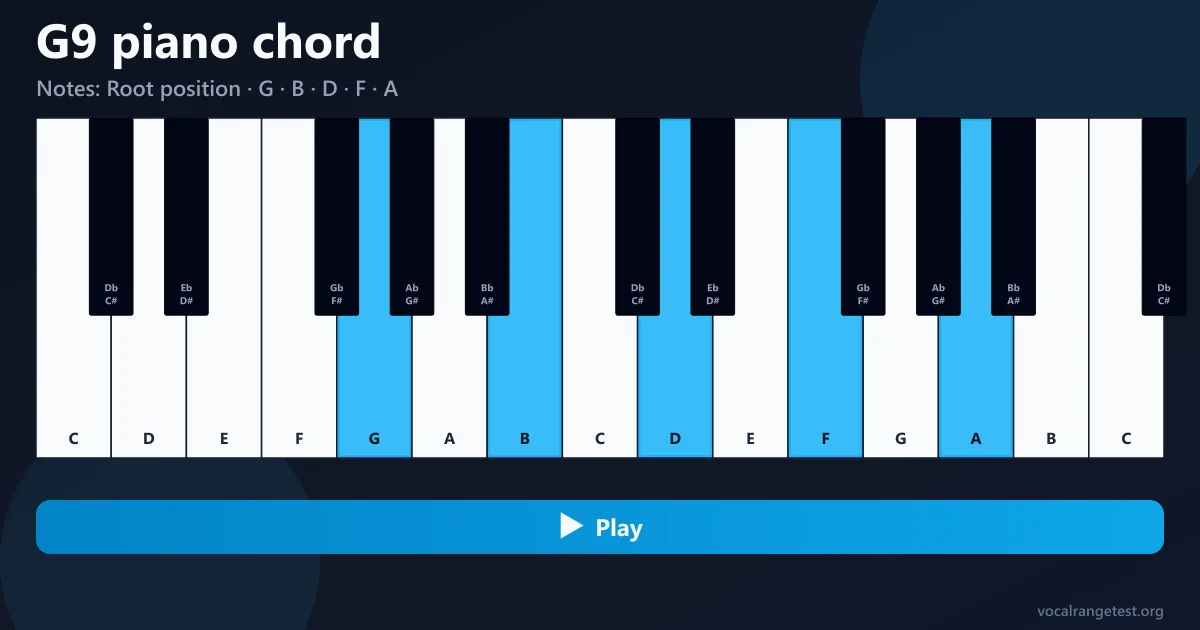
Notes: G · B · D · F · A
Voicing: 1 / 4
Root
Chord type
Root position & inversions
Two-hand voicing
G9 Piano Chord
A G9 chord on piano is a G7 grown one note taller: stack G–B–D–F, then park an A on top. That A is the ninth—the lift that turns a plain G7 into G9 on a chart. Every tone sits on a white key, so you can learn the shape without hunting accidentals. Hear the color in the player above before you commit to a five-note reach, then keep reading for how the tones fit together and how to voice them without fighting the keyboard.
How to Play G9 Chord on Piano
Pick a G that feels natural under your left thumb—often the G below middle C for song work, or a higher G if you are voicing for a small combo. Build the sound in pieces so your ear leads: G and B (root and major third), add D (the fifth), add F (the flat seventh—this is the bluesy hinge; F# would flip you into major-seventh territory), then drop A on top as the ninth. When those five speak together, you are playing a G9 piano chord. Close-position G–B–D–F–A in one hand is a wide bite for many players. Skip the D if you need room, or split duties: left hand holds G (maybe with D or F), right hand takes the color cluster—F–A–B, A–B–D, or similar. The chart still reads G9; you are just arranging it the way pianists actually do on a gig.
A useful drill: play G7 alone and notice the pull. Slide the A in and listen for the chord to bloom without losing that dominant edge—the F keeps it from sounding like a soft major ballad. Flip the tool to arpeggio and walk G–B–D–F–A; that sequence is the fastest way to catch a wrong finger on the seventh. After the root shape settles, try G9/F on this page (seventh in the bass). Same pitch set, F underneath—classic for walking G–F–E–D, gospel turns, and soft landings into C or Cmaj7 when G9 is acting as the V chord in C major. Spend a short minute A/B-ing root position against that slash voicing by ear. Once you can tell them apart without reading the label, the finger chart becomes a reminder instead of a riddle.
Preview the color first
Tap the diagram for a full G9 hit or a rolled arpeggio. Lock in the sound you want from the chart, then shape the hand. Silent pictures alone are how people learn F# by accident.
White keys, clear map
G, B, D, F, and A all light on white keys here. Match the glow to your instrument. If the chord feels cloudy, rebuild one tone at a time until the A sits cleanly on top.
Swap voicings when one hand complains
Move to G9/F or the two-hand open layout when close position fights you. Same chord label, kinder spacing—and usually the take you will use in a real groove.
Inside the G9 Chord on Piano
Tone recipe, look-alikes people mix up, and why hearing the stack beats guessing from a still frame.

Tone-by-tone recipe
Spell G9 as a G major triad plus a minor seventh plus a major ninth: G, B, D, F, A. From the root that is major 3rd, perfect 5th, minor 7th, major 9th. Theory books want all five; players often thin the fifth (D) because B, F, and A already announce “dominant ninth.” Keeping G somewhere in the bass—or letting the band cover it—still sells the symbol.
Working the Interactive G9 Player

1. Full hit, then roll it
Start in chord mode to catch the blended color. Switch to arpeggio and follow G–B–D–F–A. A single “wrong” step usually means a missing tone or an F that drifted sharp.

2. Mirror the highlighted keys
Place your fingers where the diagram lights up. Keep the first passes soft; five loud notes can hide a seventh mistake. Fix the map, then dig into the groove dynamics you need.

3. Tour inversions and the two-hand spread
Cycle root position, G9/F, and the open two-hand shape. Park on the version that fits the pocket you are practicing. Memorize the sound—not only the picture—so you can call it back mid-song without a phone.