
Amaj7 chord
Root position: The most common shape: the lowest note is the root named in the chord, with the other chord tones stacked above it.
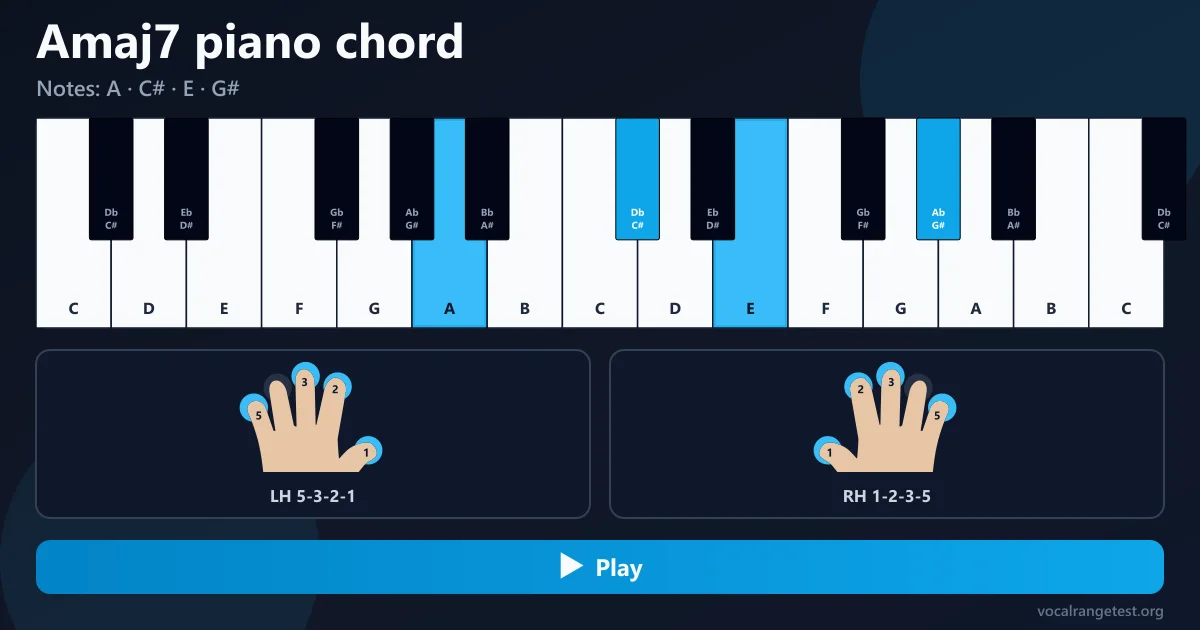
Notes: A · C# · E · G#
Voicing: 1 / 4
Fingering
Left hand: 5-3-2-1
Right hand: 1-2-3-5
Root
Chord type
Root position & inversions
Amaj7 on the keys — A, C♯, E, G♯, the chord that hangs like late sun on water instead of landing hard
Charts reach for Amaj7 when plain A major feels square and A7 feels too restless. Amaj7 chord piano is A, C♯, E, and G♯ — the major triad with a major seventh parked a half step under the octave. That G♯ is the whole personality: it keeps the chord from settling into a blunt “home” thud and leaves a thin bright seam between the seventh and the root. Bossa and jazz ballads lean on it; neo-soul and indie film cues use it when they want warmth without cheerleader energy. This page stays on that one seventh chord. Large diagram, playback from the bench, fingering that updates when the bass moves — not a scrapbook of every maj7 shape in the book.
Where Amaj7 earns its keep (and what the colour usually feels like)
Writers drop Amaj7 into songs when they want major colour that still breathes. Think closing bars of a ballad that refuse to clang shut, bossa nova grooves that float under a soft vocal, neo-soul pads that bloom instead of punch, acoustic pop that needs a Imaj7 resting place in A, and jazz standards where Amaj7 often sits as the tonic seventh or as IVmaj7 inside E major. Emotionally Amaj7 tends to read as luminous, slightly wistful, and open — more golden hour than parade. Compared with plain A, it softens the landing; compared with A7, it removes the grit of the flat seventh and trades tension for sheen. One letter change from A to Amaj7 can turn a blunt cadence into a chord that still has air left in the room.
Learning amaj7 in piano practice also forces an honest conversation about the two black keys. C♯ and G♯ have to speak clearly or the chord collapses into either A major (missing G♯) or a muddy A7 flavour (if G drifts natural). Real charts rarely freeze you in root position. Bass lines walk through Amaj7/C♯ and Amaj7/E, and third-inversion Amaj7/G♯ shows up when the major seventh itself sits underneath — a favourite soft approach into the next harmony. Hearing block chords and broken patterns here turns those marks into something your ear can approve before your fingers copy them — which is how amaj7 chord piano stops being a theory label and becomes a sound you recognise mid-song.
Built around Amaj7 — not a wall of every maj7 ever printed
The diagram stays zoomed so you can judge spacing across A–C♯–E–G♯ and how the major seventh blends with the triad. When you need a wider grid for key of amaj7 chords piano study — neighbouring sevenths and related qualities — the full chart is one jump away without losing the voicing you were hearing.
Prove the G♯ before you force the stretch
Chord mode stacks A–C♯–E–G♯ so the major seventh is unmistakable against the triad. Arpeggio mode walks the tones so each lit key matches a pitch — especially useful while that top G♯ still feels optional, or while a tired finger wants to drop it to G and tip the chord toward dominant colour.
Bass moves; the name still reads Amaj7
Root position is home. The same tools surface inversions so the harmony still functions as Amaj7 when the lowest note is no longer A — including Amaj7/G♯, where the major seventh itself becomes the bass.
An Amaj7 workbench you can hear — not a mute photo of two black keys and two whites
Printed charts freeze one grip. Here the diagram stays tied to piano samples, left- and right-hand fingering, and the inversions lead sheets actually print — so rehearsal time goes into listening and placement instead of decoding a still image.

Hear the glossy seventh, then split it open
Tap once for a solid Amaj7 when you want the full luminous ring. Switch to arpeggio when you need to isolate whether G♯ is truly speaking as the major seventh, or whether a soft finger has flattened it toward G and muddied the colour toward A7. Playback follows the voicing you selected, so an inversion sounds like the notes on screen rather than a generic root-position loop. That listen-and-compare loop is how a four-note picture becomes a chord you trust under a vocal.
- Fingering for both hands that updates with the voicing you choose.
- Amaj7/C#, Amaj7/E, and Amaj7/G# inversions with a plain-language read of the slash.
- Chord or arpeggio playback synced to the diagram and fingertip highlights.
- Clear hearing of C♯ and G♯ so the major colour does not collapse into A or A7 by accident.
- Quick jump to the full piano chart when you need neighbouring seventh qualities.
How to play Amaj7 chord piano

1. Build A major first, then park G♯ as the bright roof
Start near middle C with A if the stretch feels honest; smaller hands can drop an octave without changing the chord’s identity. Form the A major triad — A, C♯, E — then add G♯ above E (or place G♯ in the left hand if the right already feels crowded). In a compact right-hand shape many players use 1–2–3–5; the left often mirrors a wider 5–3–2–1. If the chord suddenly sounds unfinished or “bluesy,” check that G♯ did not fall to G natural.

2. Balance four even attacks so the seventh gleams without stabbing
Amaj7 lives or dies on blend. Aim for four even attacks with no neighbouring keys ghosting under soft fingertips — especially around the two black keys. The major seventh should polish the triad, not sit on top like a wrong melody note a half step below the octave. When the shape feels stable, trigger chord mode and compare your blend to the reference — especially whether G♯ sits inside the colour rather than poking above it.

3. Break it into an arpeggio until G♯ stops feeling optional
Arpeggio mode lights each key as the pitch climbs. Watching A, then C♯, then E, then G♯ fire in order is one of the fastest ways to lock the four-note identity into muscle memory — and to separate it from the A7 stack that uses G instead. If one finger arrives late, slow down until your broken chord matches the page. This is where amaj7 chord piano practice starts to feel musical: you hear the major seventh arrive as part of the harmony, not as an afterthought bolted on.

4. Move into Amaj7/C#, Amaj7/E, and Amaj7/G# when the bass needs to walk
Use the voicing controls for the inversions. Amaj7/C# puts C♯ underneath — common when a bass line rises through the third. Amaj7/E parks E in the bass for a lighter middle. Amaj7/G# is third inversion: the major seventh itself sits lowest, a favourite when charts want a soft stepwise approach or a luminous handoff into the next chord. Listen in both chord and arpeggio modes so the new lowest note is obvious before you copy the grip.

5. Treat Amaj7/G# as the “seventh in the bass” lesson
Many players first meet major-seventh colour only in root position. Third inversion flips the story: G♯ is the floor, and A sits a half step above it. That tight major-seventh interval in the bass is exactly why the chord can feel floaty instead of planted. Preview it above the fold until your ear owns the colour — then your hands stop guessing which black key belongs on the bottom.
6. Expand into neighbouring sevenths when you need context
Open the full-chart tab and stay near Amaj7: the plain A triad beside it, then other sevenths in the same neighbourhood — F♯m7, Bm7, E7, and friends that often share a progression with this tonic colour. That is how key of amaj7 chords piano vocabulary usually grows in practice rooms, without abandoning the sheen you just secured. Come back to this single-chord page whenever you want the large diagram, the inversion set, and the listen-and-break-apart tools again.