
Asus chord
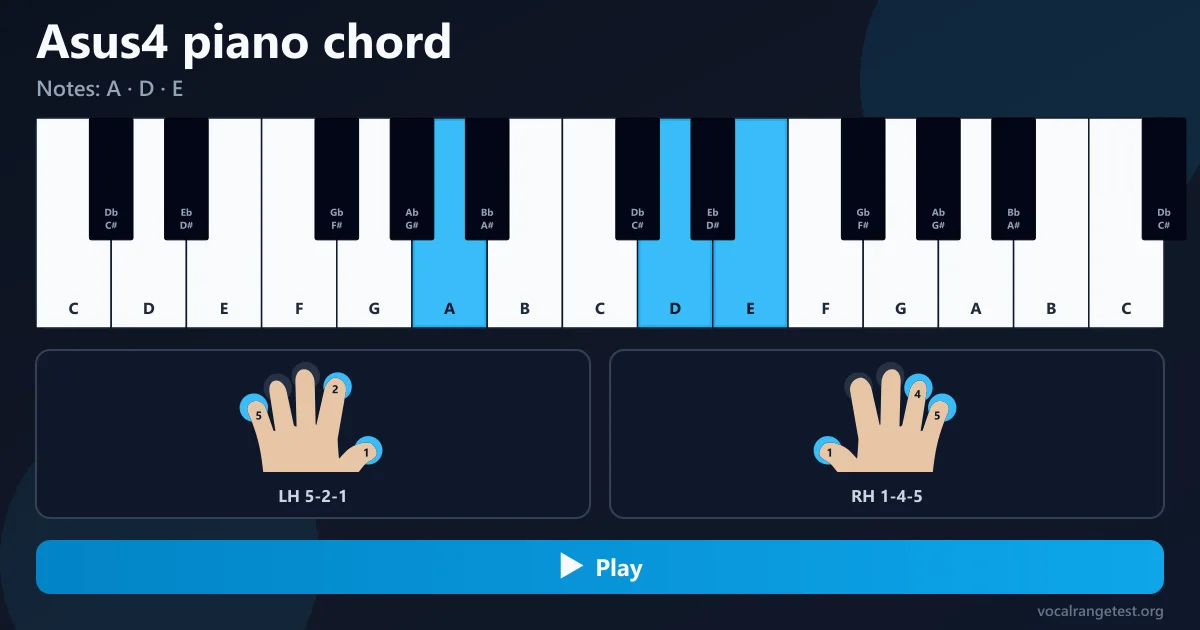
Root position: The most common shape: the lowest note is the root named in the chord, with the other chord tones stacked above it.
Notes: A · D · E
Voicing: 1 / 6
Fingering
Left hand: 5-2-1
Right hand: 1-4-5
Root
Chord type
Asus4
Asus2
A sus chord piano when A needs to hover, not land
If you play with guitarists, you already know A as a home base: open strings ring, the A–D–E loop shows up in folk, rock, and worship without anyone announcing a theory lesson. Then a chart writes Asus next to a plain A and your middle finger (or your brain) has to relocate. An a sus chord piano shape keeps A and E as the outer posts and swaps the usual C♯ for either D (Asus4) or B (Asus2). This page puts both spellings on one live keyboard so you can hear the hang before you commit a hand shape at rehearsal.
A major smiles; suspended A waits
A regular A triad is A, C♯, and E. C♯ is the bright major third—the note that makes the chord sound finished and major. Suspended A removes that smile on purpose. Slide D into the middle slot and you get the everyday a sus 4 piano chord: A–D–E. Slide B in instead and you get the softer a sus 2 piano chord: A–B–E. Floor stays A; ceiling idea stays E a fifth up. Only the filler changes. Without a clear major or minor third, the chord will not pick a mood for you. It parks in between.
People who search for an a sus chord on piano are rarely hunting a rare museum piece. They are usually already camping in the key of A—open-guitar comfort, capo math that lands on A shapes, or a singer who sits well there—and they need a color that refuses to close the phrase. In the key of a sus chords piano vocabulary, Asus4 often feels “inside” the neighborhood because D is already a close relative of A (think A–D–E progressions). Asus2 brings B, a step that can color a verse without demanding a big cadence. You do not need roman numerals first. You need to hear D tugging toward C♯ (into A major), or B sitting like a quieter neighbor, then choose which story matches the lyric.
Asus / Asus4 — what most charts mean
Bare “Asus” on a lead sheet almost always means A–D–E. D is the fourth; when you finally release to A, that middle note often wants to fall toward C♯.
Asus2 — same outer posts, calmer middle
A–B–E keeps A and E but feels less urgent. Useful for pads, soft intros, and verses that need width without a big resolve gesture.
Check sound, then hand, then bass
Play the full chord, split it as an arpeggio, follow fingering hints, and move the bass with inversions when the left hand needs a step under a long A section.
What is a sus chord piano, in plain speech
It is an A chord that has set its third aside so the harmony can hover. Below is when that hover earns a spot in a song—and what this interactive page adds that a printed diagram cannot.

When songs reach for Asus instead of plain A
Think of a chorus that has already stated A three or four times. Another plain A can feel like stamping the same stamp again. Park Asus4 for a bar—D in the middle—and the harmony stays related to A without sounding finished; drop to A and the landing finally means something. Folk and singer-songwriter parts love that trick because open-A guitar habits already train the ear to hear D as a neighboring color. Worship loops that orbit A–D–E use the same family of sounds; the suspended middle can feel like a held breath before the title line. Arena-rock intros sometimes hang on Asus before the riff commits. Quieter electronic or lo-fi beds often prefer Asus2 because B sits closer to a drone and less like a church cadence. Straight talk for non-theory players: if A feels done too early, borrow the hang; if the hang sticks around too long, land on A or tip into F♯m when you want a minor shade without leaving the key’s orbit.
- Online playback for the full chord or a note-by-note arpeggio.
- Asus4 and Asus2 kept in separate groups so you compare hangs instead of decoding one abbreviation.
- Fingering help for comfortable root-position shapes.
- Inversions and alternate bass for smoother left-hand motion.
- Free in the browser—no install, no account wall for a quick check.
How to play an a sus chord on piano on this page

1. Plant A and E before you pick the middle
Skip the suspended tone for one pass. Find A, then E above it. If those two posts are wrong, no middle note will make the chord feel like an A-family sound. Both Asus4 and Asus2 share that frame, so locking it early prevents half the confusion.

2. Add D for the chart default, then try B
Place D between A and E for Asus / Asus4. Play it as a block, then as an arpeggio so each glowing key has a voice. Switch to the Asus2 group (A–B–E) and resolve both shapes into plain A major. Notice which release feels like a clearer drop (often sus4 into A) and which feels softer (often sus2). That short listen beats another worksheet synonym.

3. Move the bass with inversions when the line walks
Root position teaches the spelling. When you accompany a long stretch in A, open an inversion so E, D, or B can sit underneath—alternate bass without inventing a new chord name. Same three tones, different floor under the singer. Use the on-page inversion controls instead of rebuilding the grip every time the left hand wants a step.