
A9 chord
Root position: The most common shape: the lowest note is the root named in the chord, with the other chord tones stacked above it.
Notes: A · C# · E · G · B
Voicing: 1 / 4
Root
Chord type
Root position & inversions
Two-hand voicing
A9 Piano Chord
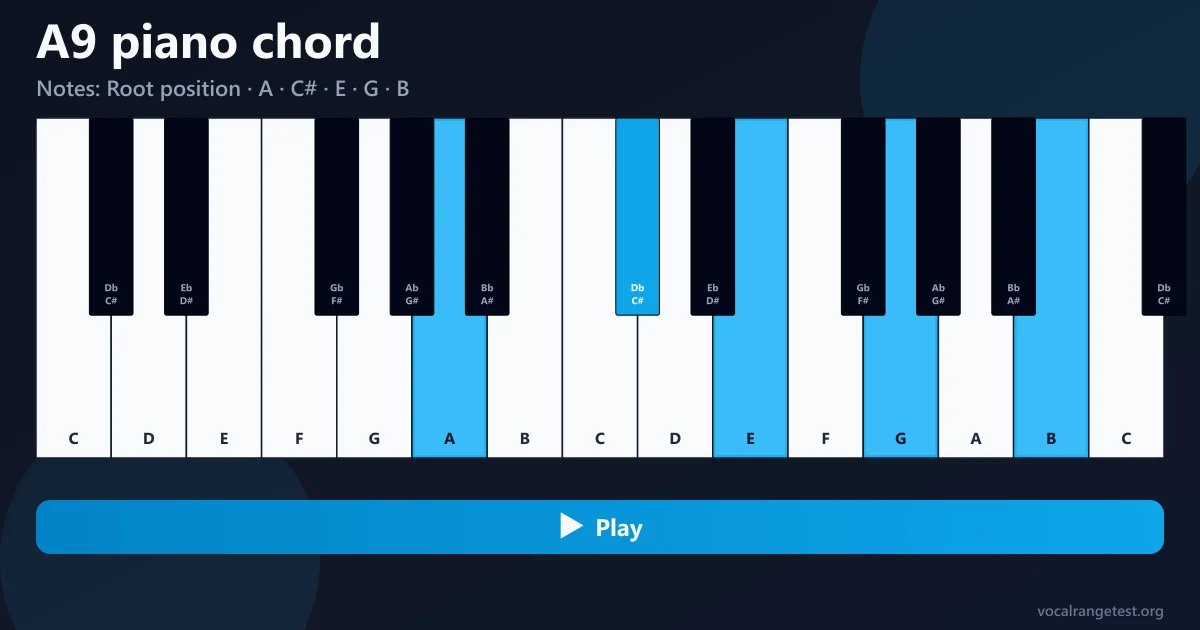
An A9 chord on piano is an A7 with a ninth grown on top: A–C#–E–G–B. C# is the major third—flatten it and the chord tips toward minor. G is the flat seventh that keeps the dominant pull. B is the ninth that sweetens the top. The black-key third is the easy miss, so hear the color above before you stretch across five keys, then use the rest of this page for why those pitches matter and how to move them into a reachable grip.
How to Play A9 Chord on Piano
Anchor on an A that fits the song—often the A below middle C for left-hand roots, or a mid-range A when you are covering the whole harmony alone. Assemble the A9 piano chord in listening order, not as a frozen photo: A plus C# first (root and third—this black key is the one beginners most often miss or flatten), then E for the fifth, then G for the flat seventh, then B for the ninth. When the five ring together, you have A9. One-hand close position A–C#–E–G–B is a serious span. Thin it by leaving out E, or hand it off: left hand on A (with E or G if you like), right hand on a tight color set such as G–B–C# or B–C#–E. The chart still says A9; you simply voiced it for real hands instead of a textbook stack.
Train the ear with a before-and-after. Play A7 (A–C#–E–G) and sit with that bluesy lean. Add B and notice the chord open upward without turning “pretty major”—the G still pulls. Switch the player to a note-by-note split and walk A–C#–E–G–B; that climb exposes a wrong C natural or an accidental F# faster than staring at a still diagram. Once root position feels familiar, open the A9/G inversion on this page. Same five pitch classes, G in the bass—handy for walking A–G–F#–E, for soft entries into D or Dmaj7 when A9 is the V chord in D major, and for funk or soul pockets where the bass wants motion under a held right-hand shell. Compare root and slash by ear until the difference is obvious without reading the label. After that, the chart is just confirmation.
Sound check before the stretch
Trigger a full A9 or the split playback. Decide you like the dominant-ninth color, then place the hand. Guessing from silence is how C# becomes C.
Watch the black-key third
The diagram lights A, C#, E, G, and B. Match that geography on your keyboard. If the chord feels dull or “minor-ish,” rebuild and confirm C# is actually sharp.
Inversions when the reach fights back
Jump to A9/G or the two-hand open spread. Identical chord name, kinder spacing—usually the shape that survives a real tempo.
What Makes This A9 Chord on Piano Tick
Pitch spelling, look-alike symbols, and the musical neighborhoods where A9 earns its keep.

Spelling from the ground up
Write A9 as A major triad + minor seventh + major ninth: A, C#, E, G, B. Interval path from the root: major 3rd, perfect 5th, minor 7th, major 9th. Full theory wants every tone present; gigging players often drop the fifth (E) because C#, G, and B already announce dominant ninth. Keep A sounding in the bass—or let bass guitar cover it—and the symbol still reads clean.
Getting Value from the A9 Player

1. Blend, then split
Use chord mode for the stacked color. Flip to the split/arpeggio view and track A–C#–E–G–B. One sour step usually means a missing pitch or a natural where a sharp belongs.

2. Copy the lit keys at soft volume
Put fingers where the chart glows. Stay quiet at first so C# versus C stays audible. Once the map is honest, raise the dynamic to match the groove you need.

3. Sample inversions and the two-hand layout
Rotate root position, A9/G, and the open two-hand voicing. Keep the version that fits the pocket you are practicing. Store the sound in memory—pictures fade mid-set; timbre does not.