
Am9 chord
Root position: The most common shape: the lowest note is the root named in the chord, with the other chord tones stacked above it.
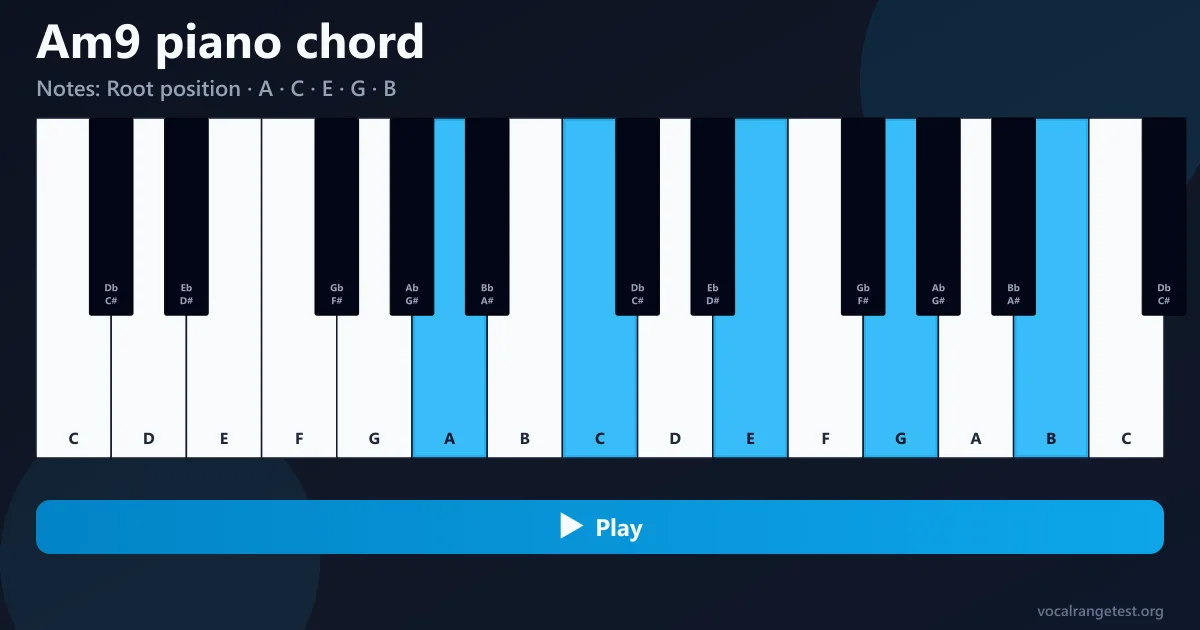
Notes: A · C · E · G · B
Voicing: 1 / 4
Root
Chord type
Root position & inversions
Two-hand voicing
Am9 on the bench — five white keys, one gentle sparkle, the colour charts write when Am alone feels too thin
If a lead sheet says Am9 and you freeze for a second, you are not alone. Most players know Am. Fewer know what the “9” is asking for. The Am9 piano chord is A, C, E, G, and B — the familiar A minor triad, plus the minor seventh G, plus the ninth B on top. On a standard keyboard every one of those notes is a white key, which makes this one of the friendliest extended minors to find by eye. This page is built around that single colour: a large diagram, piano sound you can trigger from the page, a note-by-note breakdown, fingering for each hand, and the positions and inversions real charts actually use — not a mute screenshot you have to guess at.
When Am9 shows up (and what that “9” is doing)
Writers reach for Am9 when plain Am feels bare and Am7 still wants a little more air on top. You hear that colour in neo-soul and R&B pads, late-night ballads, jazz-leaning pop bridges, lo-fi loops, and film cues that need minor warmth without turning gloomy. Emotionally it sits between soft and open: the A–C–E core keeps the minor mood, G rounds it into a seventh, and B — a whole step above A — adds a quiet lift that does not flip the chord into major. If Am is a cloudy afternoon, Am9 is the same sky with a thin bright edge.
Searchers looking for an Am9 chord on piano usually want three things at once: the note list, a clear hand shape, and a way to check the sound before they commit it in a song. That is why this tool exists. We got tired of diagrams that never make a sound and theory blurbs that never show a usable grip. Here you hear the full stack, peel it into an arpeggio so each tone lands in your ear, then flip through inversions when the bass needs to move. The goal is simple — leave the page able to play Am9 on purpose, not just recognise the symbol.
All white keys — easy to spot, easy to miss the B
A, C, E, G, and B sit on white keys, so the shape looks simple. The trap is leaving B out and landing on Am7 by accident, or stacking so tightly that the ninth gets buried. Hearing the full chord beside a note-by-note walk makes that top B obvious.
Am7 plus one — know the difference by ear
Am7 is A–C–E–G. Am9 adds B. Same minor family, different finish. Use chord mode for the blend, then arpeggio mode to confirm the ninth is actually speaking before you tuck the shape into a progression.
Same harmony, new bass when the chart walks
Root position is home. Inversions and other positions keep the Am9 colour while the lowest note changes — the kind of move arrangers write so the left hand can step without rewriting the chord symbol.
A live Am9 workbench — hear it, take it apart, move the bass
A printed Am9 diagram freezes one grip. Here the keyboard stays tied to piano samples, a breakdown you can follow note by note, left- and right-hand fingering, and the inversions and positions you will meet on real sheets — so practice time goes into listening and placement instead of decoding a still image.

Hear the blend, then split the stack
Tap once for a solid Am9 when you want the full soft-minor shimmer with that ninth on top. Switch to breakdown (arpeggio) when you need to isolate whether B is truly speaking, or whether your hand stopped at G and left you on Am7. Playback follows the voicing on screen, so an inversion sounds like the notes you see rather than a generic root-position loop. That listen-and-compare loop is how a five-note symbol becomes a chord you recognise mid-song.
- Fingering for both hands that updates with the voicing you choose.
- Root position plus inversions with a plain-language read of each bass change.
- Extra positions for when the chart keeps the colour but moves your hands.
- Chord or note-by-note playback synced to the diagram and fingertip highlights.
- Quick jump to the wider piano chart when you need neighbouring A-minor family chords.
How to play Am9 chord on piano

1. Start from Am you already know, then add G
Find A just below middle C (or an octave higher if that stretch feels more honest). Build the A minor triad first: A, C, and E — all white keys. Many right hands use thumb–middle–pinky (1–3–5) on that triad; the left often mirrors pinky–middle–thumb (5–3–1). Next add G above E. That is Am7: A–C–E–G. Pause here and listen. If this stack already sounds familiar from ballads and pop verses, you are halfway to Am9. The ninth is one more white key up, not a whole new hand philosophy.

2. Place B on top and balance the five-note shape
B sits a whole step above A — on the white key between A and C if you are counting upward from the root an octave higher, or simply the next white key above G in a close stack A–C–E–G–B. That top B is the colour people mean when they ask for Am9. Smaller hands may drop the A an octave, play A in the left hand, and keep C–E–G–B in the right; the chord’s identity stays the same. Aim for even attacks with no ghosted neighbours. Then trigger chord mode on this page and compare your blend to the reference — especially whether B peeks through without turning the whole grip harsh.

3. Break it into a note-by-note walk until B stops being a guess
Arpeggio (breakdown) mode lights each key as the pitch climbs: A, then C, then E, then G, then B. Watching that order fire is one of the fastest ways to lock the ninth into muscle memory under a moving hand. If one finger arrives late or you keep skipping B, slow down until your broken chord matches the page. This is where Am9 practice starts to feel musical rather than purely positional — you hear the harmony assemble, not just a frozen block of five keys.

4. Learn the common mix-ups so charts stop surprising you
Am9 is not Amadd9. Amadd9 usually means A–C–E plus B with no G — triad plus ninth, no seventh. Am9 expects the seventh in the family (G) plus the ninth (B). Am9 is also not A9: A9 is a dominant sound with C♯ (major third), not C. And Am9 is not Amaj9, which leans on C♯ and G♯. If a chart says Am9 and you play a bright major-leaning ninth chord, the band will hear it immediately. Use the listen tools here to plant the soft minor version in your ear before rehearsal.

5. Move into inversions when the bass needs to walk
Root-position Am9 parks A underneath. First inversion puts C in the bass; second puts E down low; further voicings shuffle which chord tone sits on the bottom while A–C–E–G–B colour stays in play. Arrangers use those moves so a left-hand line can rise or fall without changing the chord symbol on the page. Select each inversion above the fold, hear chord mode for the new weight, then arpeggio mode so the lowest note is obvious before you copy the grip. That is the practical answer when someone says “same Am9, but walk the bass.”
6. Drop it into a progression and check the neighbour chords
Am9 loves sitting where Am or Am7 already lived: try Am9–F–C–G, or Am9–Dm7–G7–C, or a long Am9 pad under a vocal before you move. Hold the shape, sing a simple line over it, and notice how B wants to resolve or linger. When you need the wider A-minor neighbourhood — Am, Am7, C, F, G — open the full chart tab, then come back to this page whenever you want the large Am9 diagram, the breakdown, and the inversion set again.