
Bbmaj7/A#maj7 chord
Root position: The most common shape: the lowest note is the root named in the chord, with the other chord tones stacked above it.
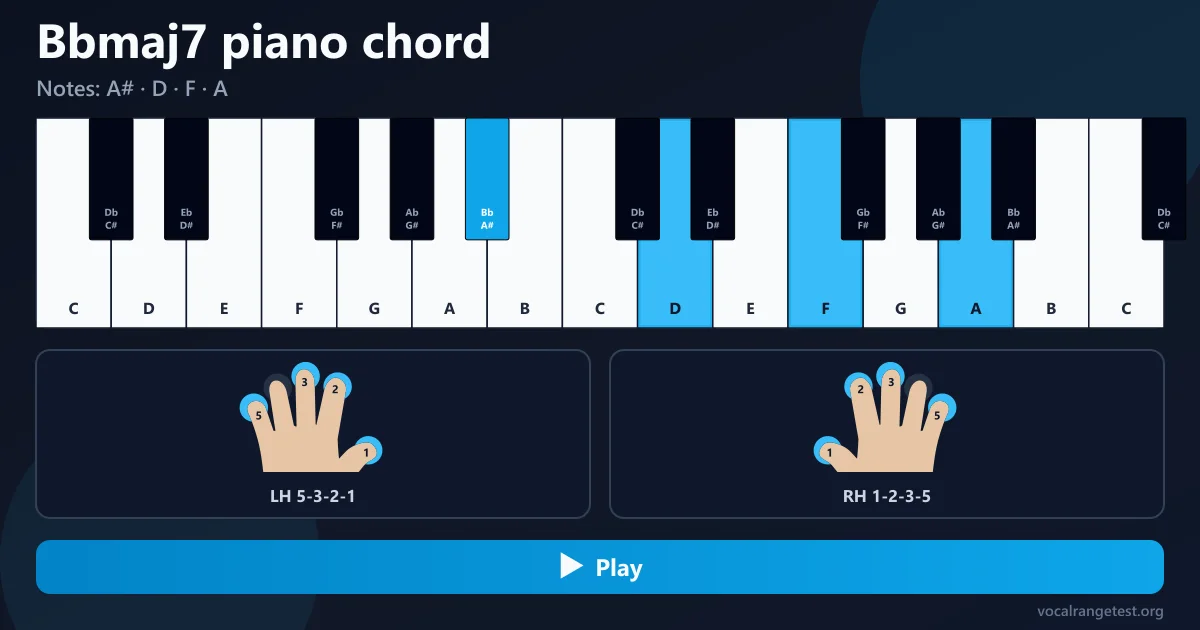
Notes: A# · D · F · A
Voicing: 1 / 4
Fingering
Left hand: 5-3-2-1
Right hand: 1-2-3-5
Root
Chord type
Root position & inversions
Bbmaj7 (A#maj7) piano chord — major warmth with a thin bright edge instead of a hard full stop
Spell a Bbmaj7 (A#maj7) piano chord in flats and you get Bb, D, F, and A. That last note—A♮ sitting a half step under Bb’s octave—is the whole personality. Plain Bb major ends the sentence. Bbmaj7 leaves a little light at the top, the kind of sound ballads and soft jazz use when they do not want the last chord to clang. Sharp-key theory drills may write the twin as A#maj7; everyday charts almost always print Bbmaj7. On this page you can hear that sheen on real piano samples, break the four tones apart, read finger numbers for either hand, and walk the bass through inversions and alternate-bass options without treating the diagram like a mute sticker.
Where Bbmaj7 earns its keep (and how it usually lands emotionally)
Songwriters call Bbmaj7 when major needs air. As Imaj7 in Bb major it is a tonic that still breathes—closing bars of slow pop, wedding ballads, and film cues use it so the ending glows instead of stomping. As IVmaj7 in F major it sits under melodies like a warm plateau: brighter than Fm, calmer than C7. Bossa grooves, neo-soul pads, and quiet R&B bridges hang on it when the band wants gloss without blues grit. Compared with Bb7, there is no raised-eyebrow push toward Eb; compared with Bbm7, there is no dusk shade from a minor third. In plain English the mood is late-afternoon sun on a clean room—open, slightly wistful, polished. If you are collecting key of Bbmaj7 chords piano vocabulary, start with those Imaj7 and IVmaj7 jobs; they cover most sheets that bother to write the full symbol.
Theory without the fog machine: stack root, major third (D), perfect fifth (F), and major seventh (A). The major third keeps the chord smiling; the major seventh is the thin bright seam a half step under the octave. Flatten that seventh to Ab and you tip into Bb7 tension. Drop the seventh entirely and you are back to blunt Bb. Raise nothing but change D to Db and you have left major colour for minor. Players who only know triads often flatten A by accident or skip it, then wonder why the chart sounded “prettier” on the recording. Hearing the full stack beside a slow arpeggio on this site makes that missing A obvious in one or two listens—especially useful when Bbmaj7 in piano arrangements shares the board with other Bb flavours in the same song.
The A♮ is not decoration
If A goes missing, you only played Bb major. If it drifts flat to Ab, the chord starts sounding dominant. Chord mode proves the sheen; arpeggio mode makes you hear A arrive.
Bbmaj7 vs A#maj7 is ink, not a different instrument
Same keys under the fingers. Band and singer charts prefer Bbmaj7. Keep A#maj7 for the rare sharp-key page that refuses flats.
Half-step friction that still sounds pretty
A against Bb can feel “wrong” to triad-only ears until you hear it in context. Online playback here lets you trust the colour before you force a stretch in a quiet room.
A Bbmaj7 workbench tied to sound—not a frozen four-note drawing
A silent grip cannot tell you whether the major seventh is speaking. This diagram keeps piano samples, fingering, inversions, and slash bass on one screen so you can check the luminous colour by ear.

Full chord, then peel the major seventh into view
Hit block playback when you want the complete glossy ring. Switch to arpeggio when A keeps getting underplayed or flattened. The audio follows the voicing you picked, so Bbmaj7/D or Bbmaj7/A sounds like the notes on screen. Fingerings update for left and right hand as you flip shapes. That loop—hear online, break the chord down, confirm the hand, move the bass—is what turns a chart thumbnail into a chord you can trust under a vocal in Bb or F.
- Block chord or arpeggio on piano samples
- Left/right fingerings that track the current voicing
- Root position plus inversions (D, F, or A in the bass)
- Alternate-bass previews for odd slash marks on a chart
- One luminous colour for Bbmaj7 or A#maj7 spelling
How to play Bbmaj7 chord piano

1. Build Bb–D–F first, then add the A that creates the sheen
Plant Bb on the black key between A and B near middle C. Add D and F on the white keys above—that is plain Bb major. Now place A♮ on the white key just below Bb’s octave (or the A below if your hand is smaller and you are voicing tightly). Right hand often uses 1–2–3–5; left hand often 5–3–2–1. If the chord suddenly sounds bluesy or restless, you grabbed Ab. If it sounds unfinished in a dull way, A never landed.

2. Let D smile and A glow—neither should yell
D keeps the chord major-bright; A is the thin edge that refuses a hard landing. Aim for four even hits. Common mud: soft fingertips smearing Bb’s neighbours, or A whispered so quietly the ear only hears a triad. Match the page’s chord sound before you chase speed. You want polished major with air, not a crushed cluster and not parade-ground Bb with a shy A tagged on afterward.

3. Arpeggiate until Bb–D–F–A is muscle memory
Broken-chord mode lights each key in order. Watching A arrive after F is the fastest fix for players who keep substituting Ab from Bb7 habits. Slow down until your fingers match the lights. This is where Bbmaj7 in piano practice stops being homework: the major seventh is part of the colour, not an optional flourish you remember after rehearsal.

4. Move the bass through D, F, and A without new panic
Inversion controls put D underneath for a lighter middle, F underneath for an open bandstand floor, or A underneath when a bass line walks through the major seventh. Listen in both block and arpeggio modes so the new lowest note is obvious. Those slash labels are still one Bbmaj7 / A#maj7 harmony—same pitch classes, different weight at the bottom.

5. Preview alternate bass when the sheet gets creative
Some arrangements keep the maj7 colour in the right hand while the bass wanders outside the usual inversion set. Use the alternate-bass options until your ear owns the new floor. Same upper colour, different note underneath—that is what trips people who only drilled root position from a book.
6. Put the chord to work so the sheen has somewhere to go
When you explore key of Bbmaj7 chords piano in real progressions, try Imaj7 holding under a slow melody in Bb, or IVmaj7 in F resolving gently toward Bb or C. Hold the chord, then walk a short line into the next harmony and listen for why the writer wanted that A♮ instead of a blunt triad or a dominant Ab. Come back to this diagram when the next chart writes Bbmaj7/D—or somehow respells the stack as A#maj7—and you need the sound, the breakdown, and the finger map in one place.