
Abmaj7/G#maj7 chord
Root position: The most common shape: the lowest note is the root named in the chord, with the other chord tones stacked above it.
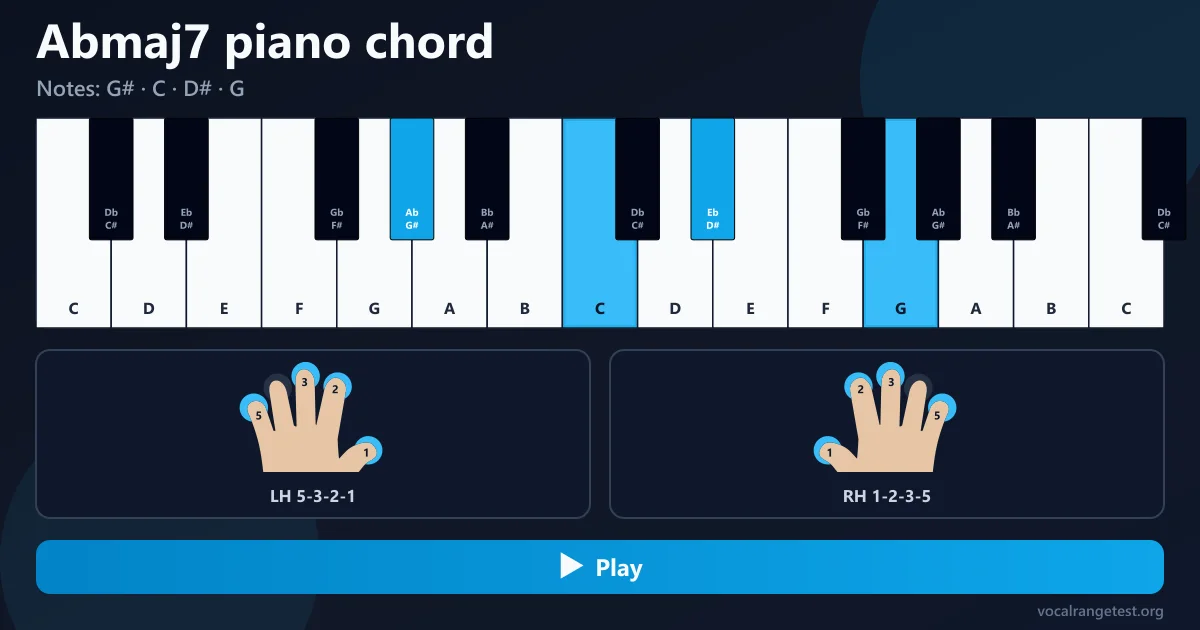
Notes: G# · C · D# · G
Voicing: 1 / 4
Fingering
Left hand: 5-3-2-1
Right hand: 1-2-3-5
Root
Chord type
Root position & inversions
G#maj7 chord piano — major colour with a thin bright seam instead of a hard landing
A G#maj7 chord piano shape is a major triad with a major seventh tucked under the octave. Spell it G#–B#–D#–F## on paper if a sharp-key theory drill insists, or—more often in real charts—read the twin as Abmaj7 chord piano writing (Ab–C–Eb–G). Same keys under the fingers either way. What matters is the top interval: that major seventh keeps the chord from thudding shut like plain G# / Ab, and it refuses the grit of a dominant seventh. Guitar tabs and sharp-side pop sheets love the G#maj7 label; flat-key jazz and concert charts lean Abmaj7. This page treats them as one luminous colour you can hear online, break into an arpeggio, finger cleanly, and walk through inversions and alternate bass without getting stuck in a spelling argument.
Where G#maj7 earns a place in real music
Writers call for G#maj7 when plain major feels square and a dominant seventh feels too restless. As Imaj7 in G# major—or Ab major under flat spelling—it is a tonic that still breathes. Closing bars of ballads use it when they do not want the last chord to clang. Bossa and soft jazz hang on it under a quiet vocal. Neo-soul and film pads reach for it when warmth should bloom instead of punch. Inside Eb / D# neighbourhoods it often appears as IVmaj7: a plateau with sheen rather than a functional V that pulls hard. Sharp-key guitar arrangements print G#maj7 whenever the rest of the chart already thinks in sharps. Emotionally it tends to read as late-sun major—open, slightly wistful, glossy. Not parade-ground cheerful; not bluesy. If you are collecting key of g#maj7 chords piano vocabulary, start with tonic-seventh and IV-major-seventh jobs; those two cover most sheets that bother to write the full symbol.
Interval by interval you are stacking root, major third, perfect fifth, and major seventh. The major third keeps the chord bright; the major seventh is the personality—sitting a half step under the octave and refusing to resolve. Flatten that seventh and you tip toward G#7 / Ab7 tension. Drop it entirely and you are back to a blunt triad. On this site the diagram is tied to piano samples: hear the full stack, then split it so each tone lights in order. That listen-and-break-apart habit matters here because the major seventh is easy to underplay or to flatten by accident. Fingering updates with the voicing; inversions and alternate bass stay on the same page so g#maj7 in piano practice is about hearing sheen and placing the hand—not collecting mute screenshots.
G#maj7 and Abmaj7 share the keys
Different letters, same pitches. Learn the luminous colour once, then read whichever spelling your chart prefers.
The major seventh is the whole point
If that top tone goes missing, you only have a plain major triad. If it drifts flat, the chord starts sounding dominant. Chord mode proves the sheen; arpeggio mode makes you hear it arrive.
What a static poster cannot do
Here you get click-to-hear chord or arpeggio, left/right fingering, inversions, and alternate-bass options together—so practice time goes into listening and placement, not decoding a silent picture.
A G#maj7 workbench with sound attached
A frozen grip cannot tell you whether the major seventh is speaking. This page keeps the diagram linked to piano samples, fingering, inversions, and slash bass so you can trust the colour before you force a stretch.

Hear the sheen, then isolate the seventh
Trigger a full G#maj7 when you want the complete luminous ring. Switch to arpeggio when you need to check whether the major seventh is clear, or whether a soft finger has flattened it toward dominant colour. Playback follows the voicing on screen, so inversions and alternate-bass shapes sound like the notes you see. Online listening, broken-chord listening, fingerings, inversions, and alternate bass on one page—that is the useful difference between a chart thumbnail and a practiseable chord page.
- Online piano samples for block chord or arpeggio
- Left- and right-hand fingering that updates with the voicing
- Inversions for walking bass and soft handoffs
- Alternate-bass (slash) shapes when the lowest note sits outside the stack
- Abmaj7 recognised as the same sound under flat spelling
How to play G#maj7 chord piano

1. Build the major triad, then park the major seventh
Start with the G# major (or Ab major) triad in a comfortable octave. Add the major seventh above—or place it in the left hand if the right already feels crowded. Confirm that top tone is a major seventh, not a flat seventh. A crowded right hand often uses 1–2–3–5; smaller hands split the chord without losing the identity.

2. Compare your blend to the page
Play the four notes yourself, then tap chord mode. Listen for whether the seventh polishes the triad or stabs above it like a wrong melody note. Soft fingertips that flatten the seventh are the usual miss—suddenly the colour tips toward G#7 / Ab7 grit instead of sheen.

3. Arpeggiate until the seventh stops feeling optional
Switch to arpeggio and watch each tone light in order. Broken playback is how many players finally treat the major seventh as part of the harmony, not a decoration bolted on. Slow down until your broken pattern matches the reference. Clean sheen beats a rushed, unclear stack.

4. Walk through inversions when the bass needs to move
Use the voicing controls. First and second inversion put the third or fifth underneath while the quality stays G#maj7 / Abmaj7. Third inversion parks the major seventh itself in the bass—a tight half-step under the root that many ballads use as a soft approach into the next chord. Hear each shape as a block chord and as an arpeggio so the new floor note is unmistakable.

5. Preview alternate bass for slash marks outside the set
Some charts keep this major-seventh colour in the right hand while the bass walks to a non-chord tone. Alternate-bass options let you preview that studio habit: same upper sheen, different gravity underneath. Useful before a rehearsal throws a slash at you that root-position drills never covered.
6. Put G#maj7 in a key so the colour has somewhere to rest
Sit on it as Imaj7 in G# / Ab major under a slow melody. Or treat it as IVmaj7 beside an Eb / D# centre and notice how the plateau feels brighter than a plain triad yet calmer than a dominant. That is how key of g#maj7 chords piano study sticks—progressions remember what isolated grips forget. Return here whenever you need the large diagram and the listen-and-break-apart tools again.