
Am7 chord
Root position: The most common shape: the lowest note is the root named in the chord, with the other chord tones stacked above it.
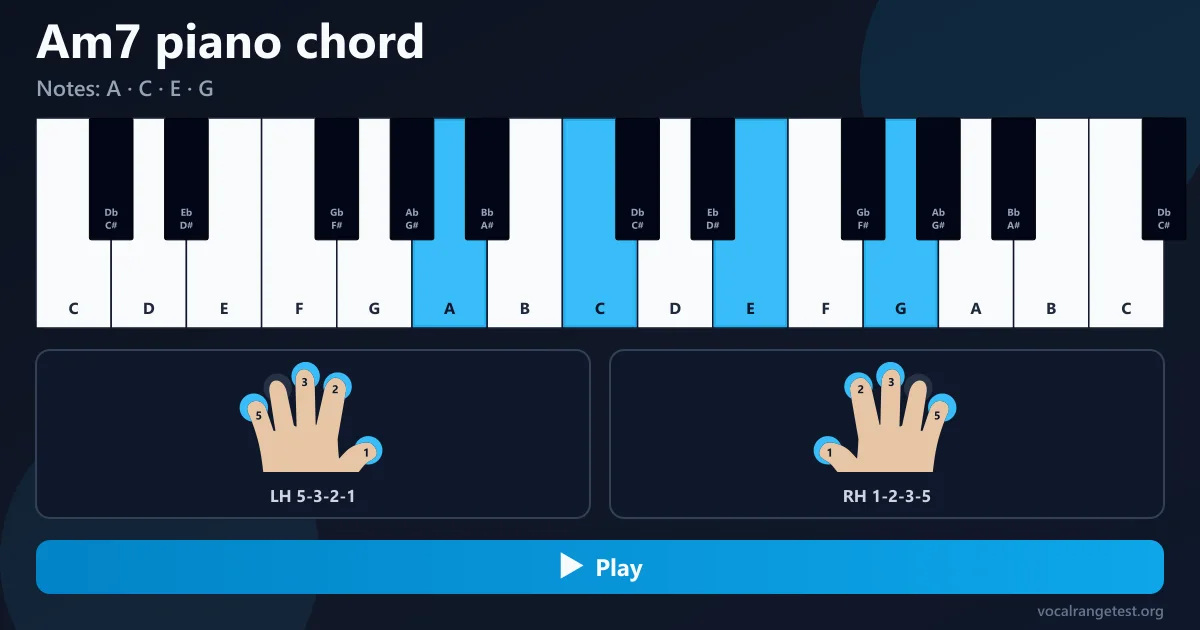
Notes: A · C · E · G
Voicing: 1 / 7
Fingering
Left hand: 5-3-2-1
Right hand: 1-2-3-5
Root
Chord type
Root position & inversions
Alternate bass
Am7 on the keys — four whites, one extra G, the shade that opens a door instead of slamming it
Charts reach for Am7 when plain Am feels too bare and Amaj7 feels too polished. Am7 chord piano is A, C, E, and G — four white keys — the minor triad with a soft seventh parked on top. That G does real work: it loosens the grip of the triad, lets air into the harmony, and points the ear toward motion even when your right hand is holding still. Jazz players treat it as furniture; pop and R&B writers treat it as the default “late night” colour under a vocal. This page stays on that one seventh chord. Large diagram, playback from the bench, fingering that updates when the bass moves — not a collage of unrelated jazz grips.
Where Am7 shows up in real writing (and what the colour usually feels like)
Writers drop Am7 into songs when they want minor feeling without the clenched jaw of a plain triad. Think neo-soul grooves that sit under a breathy verse, acoustic pop that needs a floating ii or vi, Motown-adjacent ballads that want warmth before the cadence, lo-fi loops that hover instead of resolve, and jazz standards where Am7 is often the ii7 walking toward D7 or the vi7 resting inside C major. Emotionally Am7 tends to read as cool, open, slightly smoky — more open window at midnight than empty hallway. Compared with Am, it softens the edges; compared with Am9 or richer jazz stacks, it stays lean enough for small hands and sparse arrangements. One letter change from Am to Am7 can turn a blunt minor into a chord that invites the next bar.
Learning am7 in piano practice also forces an honest stretch conversation. Four notes mean the hand has to choose: stack them tightly, drop a tone into the left hand, or leave a note out in the right while the diagram still shows the full identity. Real charts rarely freeze you in root position. Bass lines walk through Am7/C and Am7/E, third-inversion Am7/G shows up when the seventh itself sits underneath, and slash marks appear when the line keeps moving under a held right-hand colour. Hearing block chords and broken patterns here turns those marks into something your ear can approve before your fingers copy them — which is how am7 chord piano stops being a theory label and becomes a sound you recognise mid-song.
Built around Am7 — not a wall of every seventh ever printed
The diagram stays zoomed so you can judge spacing across four whites and how the seventh blends with the triad. When you need a wider grid for key of am7 chords piano study — neighbouring sevenths and related qualities — the full chart is one jump away without losing the voicing you were hearing.
Prove the G before you force the stretch
Chord mode stacks A–C–E–G so the minor seventh is unmistakable against the triad. Arpeggio mode walks the tones so each lit key matches a pitch — especially useful while that top G still feels like an optional add-on instead of part of the chord’s identity.
Bass moves; the name still reads Am7
Root position is home. The same tools surface inversions and alternate bass so the harmony still functions as Am7 when the lowest note is no longer A.
An Am7 workbench you can hear — not a mute photo of four white keys
Printed charts freeze one grip. Here the diagram stays tied to piano samples, left- and right-hand fingering, inversions, and the alternate-bass shapes lead sheets actually print — so rehearsal time goes into listening and placement instead of decoding a still image.

Hear the soft seventh, then split it open
Tap once for a solid Am7 when you want the full cool ring. Switch to arpeggio when you need to isolate whether G is truly speaking as the seventh, or whether a soft finger has thickened C or E and muddied the stack. Playback follows the voicing you selected, so an inversion or slash shape sounds like the notes on screen rather than a generic root-position loop. That listen-and-compare loop is how a four-note picture becomes a chord you trust under a vocal.
- Fingering for both hands that updates with the voicing you choose.
- Am7/C, Am7/E, and Am7/G inversions with a plain-language read of the slash.
- Alternate-bass options (Am7/F, Am7/D, Am7/B) for walking lines under a held Am7 colour.
- Chord or arpeggio playback synced to the diagram and fingertip highlights.
- Quick jump to the full piano chart when you need neighbouring seventh qualities.
How to play Am7 chord piano

1. Build Am first, then park G as the soft roof
Start near middle C with A if the stretch feels honest; smaller hands can drop an octave without changing the chord’s identity. Form the Am triad — A, C, E on whites — then add G above E (or place G in the left hand if the right already feels crowded). In a compact right-hand shape many players use 1–2–3–5; the left often mirrors a wider 5–3–2–1. If the chord suddenly sounds major or “closed,” check that C stayed natural and that G did not drift up to G♯.

2. Balance four even attacks so the seventh does not poke or vanish
Am7 lives or dies on blend. Aim for four even attacks with no neighbouring keys ghosting under soft fingertips. The seventh should soften the triad, not sit on top like a wrong melody note. When the shape feels stable, trigger chord mode and compare your blend to the reference — especially whether G sits inside the colour rather than floating above it.

3. Break it into an arpeggio until G stops feeling optional
Arpeggio mode lights each key as the pitch climbs. Watching A, then C, then E, then G fire in order is one of the fastest ways to lock the four-note identity into muscle memory. If one finger arrives late, slow down until your broken chord matches the page. This is where am7 chord piano practice starts to feel musical: you hear the seventh arrive as part of the harmony, not as an afterthought bolted on.

4. Move into Am7/C, Am7/E, and Am7/G when the bass needs to walk
Use the voicing controls for the inversions. Am7/C puts C underneath — common when a bass line rises through the third. Am7/E parks E in the bass for a lighter middle. Am7/G is third inversion: the seventh itself sits lowest, a favourite when charts want a stepwise descent or a soft approach into the next chord. Listen in both chord and arpeggio modes so the new lowest note is obvious before you copy the grip.

5. Try alternate bass when the chart keeps stepping
Slash chords with a tone outside the tetrad — Am7/F, Am7/D, and Am7/B on this page — appear when the bass keeps walking while the right hand holds Am7 colour. Diagram and audio include that extra bass note, so you hear five pitches, not four. Practice them after the plain inversions so your ear can tell “same chord, new bass” from “new chord quality.” That distinction matters when someone calls “Am7 over D” across a rehearsal room.
6. Expand into neighbouring sevenths when you need context
Open the full-chart tab and stay near Am7: the plain Am triad beside it, then other sevenths in the same neighbourhood. That is how key of am7 chords piano vocabulary usually grows in practice rooms — Am7 next to Dm7, G7, Cmaj7 — without abandoning the colour you just secured. Come back to this single-chord page whenever you want the large diagram, the inversion set, and the listen-and-break-apart tools again.