
C#maj7/Dbmaj7 chord
Root position: The most common shape: the lowest note is the root named in the chord, with the other chord tones stacked above it.
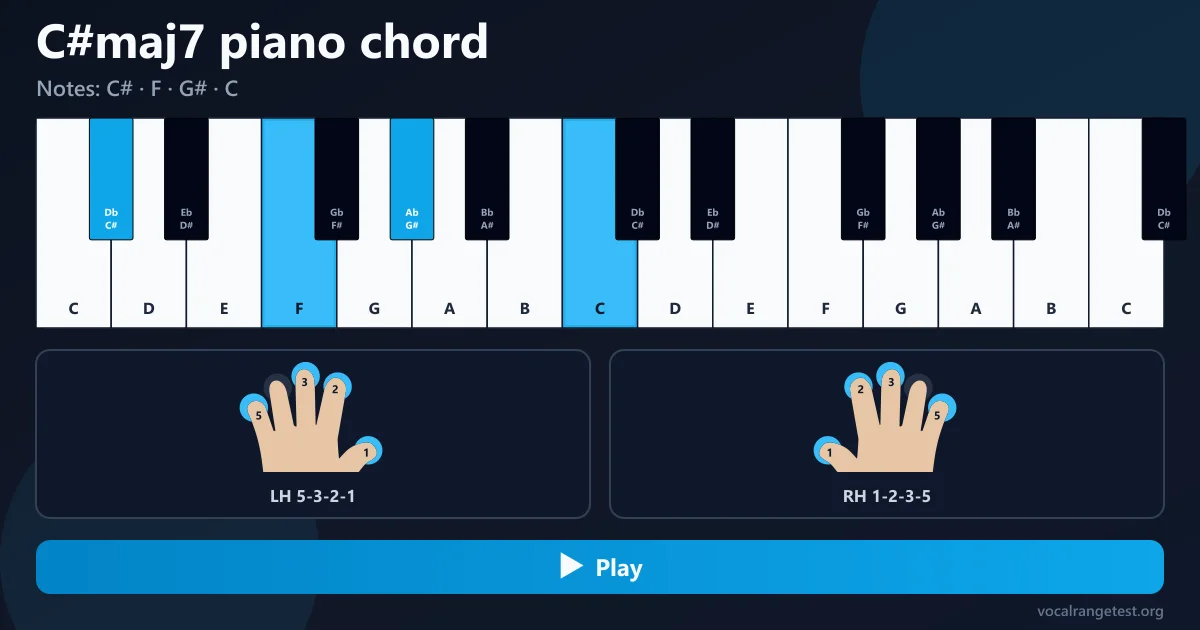
Notes: C# · F · G# · C
Voicing: 1 / 4
Fingering
Left hand: 5-3-2-1
Right hand: 1-2-3-5
Root
Chord type
Root position & inversions
C#maj7/Dbmaj7 chord piano — the lush major colour that jazz charts print as Dbmaj7 and sharp-key sheets keep as C#maj7
Under the hands, a C#maj7/Dbmaj7 chord piano grip is four pitches: a sharp (or flat) root, a major third, a perfect fifth, and a major seventh sitting a half step under the root’s octave. On this site’s diagram that stack reads C#, F, G#, and C — F standing in for the E# sharp theory prefers, C acting as the B# that completes a strict C#maj7 spelling. Jazz lead sheets and flat-key songbooks usually write the twin as a Dbmaj7 piano chord: Db, F, Ab, C. Same keys, different ink. The major seventh is the whole personality: it sweetens the triad without the restless shove of a dominant seventh. This page stays on that one floating colour so you can hear it online, break the chord into an arpeggio, check fingerings, and move through inversions and alternate bass before you trust the shape in a ballad.
Why arrangers reach for maj7 here — and how the mood lands
C#maj7 (or its flat twin) shows up when a writer wants major harmony that still feels open and expensive. In Db major it is home base — Imaj7 — the chord film cues and neo-soul hooks sit on while the melody floats above. In Ab major the same pitches often appear as IVmaj7, a lift chord that brightens a verse without slamming into a hard cadence. Sharp-side pop and worship charts that already live in C# or F# will print C#maj7 piano chord symbols so nobody has to flip the page into flats mid-rehearsal. Emotionally the sound reads luminous and slightly dreamy: major brightness in the triad, plus a seventh that hovers instead of pulling. Hold a plain C# or Db triad next to it and the triad feels blunt; add the major seventh and the chord gains air. Hold C#7 beside it and you hear the opposite job — dominant grit with B♮ versus maj7 silk with C♮.
Recipe in plain language: major triad plus a major seventh above the root. That top interval is a half step below the octave, so your ear catches a gentle rub between C and C# (or C and Db). Miss the seventh and you are back to a plain major triad. Play B instead of C and you have flipped into dominant seventh territory — the most common mix-up on sharp-key lead sheets. For Dbmaj7 in piano reading, trust the flat spelling when the rest of the bar is already full of flats; switch to C#maj7 only when neighbouring chords demand sharps. Inversions matter early. Compact left hands and walking basses ask for C#maj7/F, C#maj7/G#, and C#maj7/C — still one maj7 harmony, different lowest note. Hearing the stacked chord and the broken arpeggio here turns those slash marks into sounds you can approve before the fingers copy them.
The major seventh is a half-step story
C against C# (or C against Db) is the rub that makes maj7 feel lush instead of plain. If that top note disappears, the chart’s expensive colour collapses into a triad.
Dbmaj7 and C#maj7 are paperwork twins
Jazz and flat-key rooms prefer Dbmaj7; guitar-friendly sharp charts often keep C#maj7. Your hands press the same four keys either way — match the spelling to the rest of the measure.
Practice with sound, not a mute chart
This site lets you hear real piano samples as a full chord or an arpeggio, shows left- and right-hand fingerings, and unlocks inversions plus alternate bass so you judge colour and stretch by ear.
Audition Dbmaj7 and C#maj7 with breakdown, fingerings, and inversions
A printed four-note diagram cannot prove the major seventh is speaking. Here the keys are wired to piano samples, fingering hints, inversions, and alternate bass — so rehearsal time goes into listening and placement, not guessing from silence.

Lock the lush stack, then isolate the floating seventh
Block playback gives you the full maj7 in one hit — triad glow plus that close seventh. Switch to arpeggio when you need to confirm C is clean against the C# root; soft fingers love to thin that half-step or blur it into the octave. Playback follows the inversion or slash on screen, so you hear the voicing you chose rather than a stock root-position loop. In ballads and cinematic pads, that listen-first habit is what keeps the chord sounding expensive instead of accidentally plain or accidentally dominant.
- Hear stacked chord or rising arpeggio on real piano samples
- Left- and right-hand fingerings update with each voicing
- Root position plus C#maj7/F, C#maj7/G#, and C#maj7/C
- Alternate bass when a chart writes a slash outside the basic set
- Same maj7 sound whether the sheet says C#maj7 or Dbmaj7
How to play Dbmaj7 chord piano

1. Build the major triad, then place the major seventh on purpose
Think Db–F–Ab–C if your sheet is in flats, or C#–F–G#–C if it is in sharps — identical keys. Plant the root on a black key near middle C, add the major third on the white key (F), the fifth on the next black key, then the major seventh on C, a half step under the root’s octave. Right hand often sits on 1–2–3–5; left hand commonly 5–3–2–1. If the chord suddenly feels like a plain major triad, the seventh never landed. If it feels bluesy or restless, you probably grabbed B instead of C and slipped into dominant colour.

2. Balance the close seventh so it shimmers instead of fighting
Maj7 lives on that narrow gap between the root and the seventh. Keep the triad clear, then let C colour the top without hammering the half-step into a cluster. Even attacks matter: F should keep the major identity alive, C should float. Once the grip is steady, play the block chord on this page and match the blend — luminous maj7, not a smashed fist and not a timid triad with a forgotten top note.

3. Arpeggiate until the four tones are automatic in either spelling
Arpeggio mode lights each key as the pitch rises. Use it to wire Db–F–Ab–C (or C#–F–G#–C) into muscle memory and to separate this grip from dominant seventh shapes that want B/Cb. Slow down on the seventh if it hesitates. This is where Dbmaj7 in piano practice starts to sound like the chart: the major seventh becomes part of the colour, not a late afterthought.

4. Move into C#maj7/F, C#maj7/G#, and C#maj7/C
Use the inversion controls. Third in the bass (F) is common for smoother voice-leading mid-phrase. Fifth in the bass (G#) opens the floor while the maj7 colour stays intact. Seventh in the bass (C) puts the floating tone underneath for a thicker, more stacked landing you hear in jazz ballads and neo-soul left hands. Listen in both block and arpeggio modes so the new bass note is obvious before you copy the fingering. Those slash labels are still one C#maj7/Dbmaj7 harmony.

5. Preview alternate bass when the arrangement wanders
Some charts keep maj7 colour in the right hand while the bass walks to a note outside the strict inversion set. Preview those alternate-bass options here until the new floor makes sense by ear. Same chord tones above, different gravity below — that is where players who only drilled root position lose the plot mid-song.
6. Drop the chord into a key so the lush colour has a job
When you study key of Dbmaj7 chords piano in real progressions, start where writers actually park it: as Imaj7 in Db major, as IVmaj7 in Ab major, or as the sharp-key twin C#maj7 inside C# or F# neighbourhoods. Hold the chord, then move to a neighbouring symbol on a real sheet and notice how little “push” maj7 needs compared with a dominant. Come back to this page for the large diagram, the hear-and-break-down tools, the fingerings, and the inversion set whenever the next lead sheet flips spelling between Dbmaj7 and C#maj7 or throws a new slash at you.