
Bmaj7 chord
Root position: The most common shape: the lowest note is the root named in the chord, with the other chord tones stacked above it.
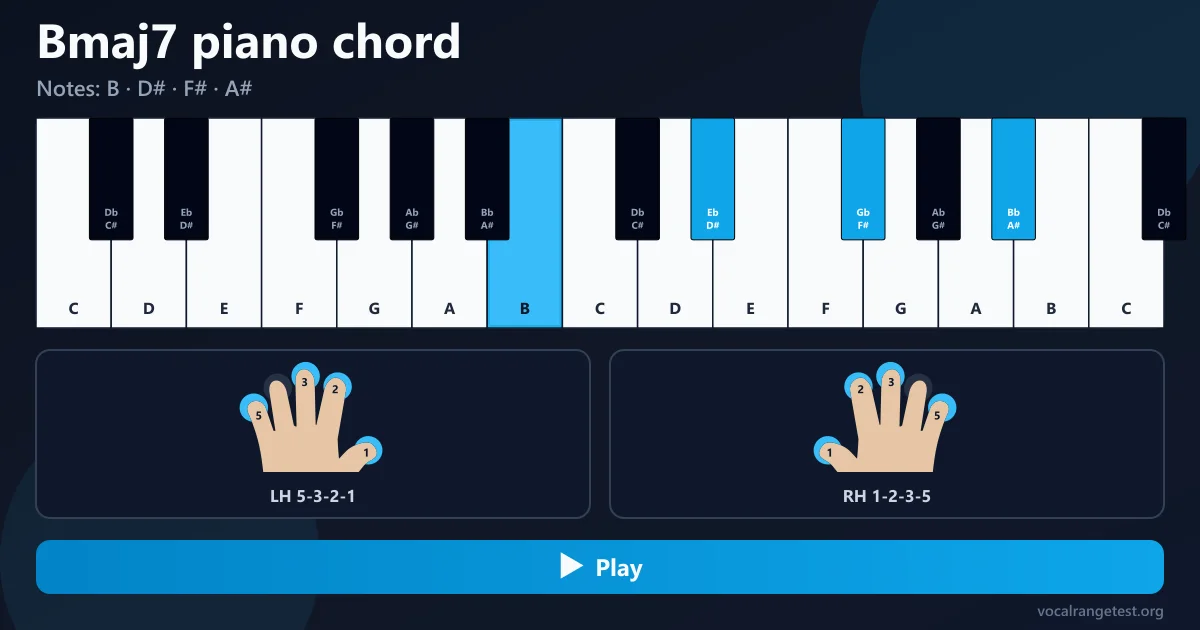
Notes: B · D# · F# · A#
Voicing: 1 / 4
Fingering
Left hand: 5-3-2-1
Right hand: 1-2-3-5
Root
Chord type
Root position & inversions
Bmaj7 piano chord — B major with a thin bright seam under the octave
A Bmaj7 piano chord is B, D#, F#, and A#. Take a B major triad and add A# — the major seventh, parked a half step below the next B. That close interval is the whole mood: still major, still warm, but it refuses to land like a brick. Songwriters use Bmaj7 when plain B feels too blunt and B7 feels too restless. You will meet it in jazz ballads, neo-soul pads, quiet pop outros, and film cues that want glow instead of grit. This page stays on that one chord so you can hear it, split it into notes, check fingerings, and move through inversions and alternate bass without hunting across a giant chart.
Why Bmaj7 gets written — and how it usually feels in plain English
Plain B major sounds proud and finished. Bmaj7 keeps the major glow and adds a little air under the ceiling. Emotionally it often reads as polished, slightly dreamy, and calm — more golden-hour than brass-band. In the key of B, it can sit as a soft I chord at the end of a phrase. In F# major, the same shape often works as IVmaj7 and feels like a warm pause before the music continues. Jazz standards lean on it when they want tonic color that still breathes. Neo-soul and R&B use it in held pads because the major seventh stops the harmony from sounding square. Pop ballads reach for it when a final B triad would clap shut too hard.
Searches for Bmaj7 in piano or key of Bmaj7 chords piano usually come down to practical questions: which four notes, how to keep D# and A# honest on the black keys, and why the chord stops sounding right the moment A# slips to A. That slip is the classic trap — A natural turns the chord into B7, and suddenly it wants to resolve somewhere else. Root position shows the stack clearly. Real music moves the bass through Bmaj7/D#, Bmaj7/F#, and Bmaj7/A#, and sometimes writes a slash bass outside that set. Listening to the full chord next to an arpeggio is how those marks become sounds you recognize mid-song, not just symbols on paper.
A# is the personality note
Miss A# and you are back to plain B major. Flatten it to A and you tip into dominant color. If Bmaj7 suddenly feels tense or too plain, that seventh is the first thing to check.
Two black keys do most of the work
D# and A# are easy to blur when you are moving fast. They define the major third and the major seventh. Clear black-key contact is half the battle for a clean Bmaj7 sound.
Inversions keep the name, change the bass
Bmaj7/D# puts the third underneath. Bmaj7/F# opens the middle. Bmaj7/A# parks the major seventh in the bass — a soft approach into whatever comes next.
Hear a Bmaj7 piano chord the way it actually rings — then copy the hands
A screenshot cannot tell you if A# is speaking. Here you click for real piano tone, break the chord into an arpeggio, follow left- and right-hand fingerings as the bass moves, and preview inversions or alternate bass before you force an awkward stretch at the keyboard.

Stacked sound, note-by-note split, and bass options together
Chord mode gives you the full Bmaj7 color in one hit — useful when you only need to confirm the major-seventh sheen. Arpeggio mode walks B–D#–F#–A# so each lit key matches a pitch, especially while those two black keys still feel optional or late. When you pick an inversion or slash, playback follows that voicing, so Bmaj7/A# does not pretend to be root position. Fingerings update with the shape, which matters as soon as a chart asks for a smoother bass line or a smaller right-hand grip under a vocal.
- Real piano playback — full chord or arpeggio
- Left/right fingerings that track the voicing
- Root position plus Bmaj7/D#, Bmaj7/F#, and Bmaj7/A#
- Alternate bass previews for unexpected slash marks
- Free in the browser — no account
How to play Bmaj7 chord piano

1. Build B major, then add A# under the next B
Place B, D#, and F# for a B major triad near middle C. Add A# on the black key just below the octave B. A common right-hand pattern is 1–2–3–5; left hand often uses 5–3–2–1 for the rising shape. If it only sounds like B major, A# is missing or too soft. If it suddenly pulls toward E, you probably played A natural.

2. Keep D# and A# speaking clearly
Those two black keys carry the major third and the major seventh. Aim for four even attacks so the triad does not bury the top note. Compare your grip to the sound on this page until you hear warm major color with a soft upper edge — not a muddy cluster and not a dominant seventh itching to move.

3. Arpeggiate until the stack is unmistakable
Use arpeggio mode and walk B–D#–F#–A# slowly. This is the fastest way to stop mixing Bmaj7 with B, B7, or Bm7. If A# always arrives late, stay slow until your hand treats it as part of the chord, not decoration.

4. Move through Bmaj7/D#, Bmaj7/F#, and Bmaj7/A#
First inversion (Bmaj7/D#) often feels smoother for walking bass. Bmaj7/F# lightens the bottom. Third inversion (Bmaj7/A#) puts the major seventh underneath — a favorite soft approach into the next harmony. Hear each one stacked and broken so the new lowest note is obvious before you copy it.

5. Check alternate bass when the slash is not a standard inversion
Some charts keep Bmaj7 in the upper structure while the bass walks somewhere unexpected. Preview those alternate-bass shapes here until the new gravity feels natural. Same major-seventh color on top, different floor underneath.
6. Use it where songs actually park this color
Try Bmaj7 as a soft landing in B, as IVmaj7 color in F#, under a long held vocal, or at the close of a ballad that should glow instead of thud. Hold Bmaj7, move to the next chord, and notice how different it feels from plain B. Context teaches the mood faster than isolated grips; come back whenever a new slash voicing shows up and you need the large diagram plus hear-and-split tools again.