
Adim chord
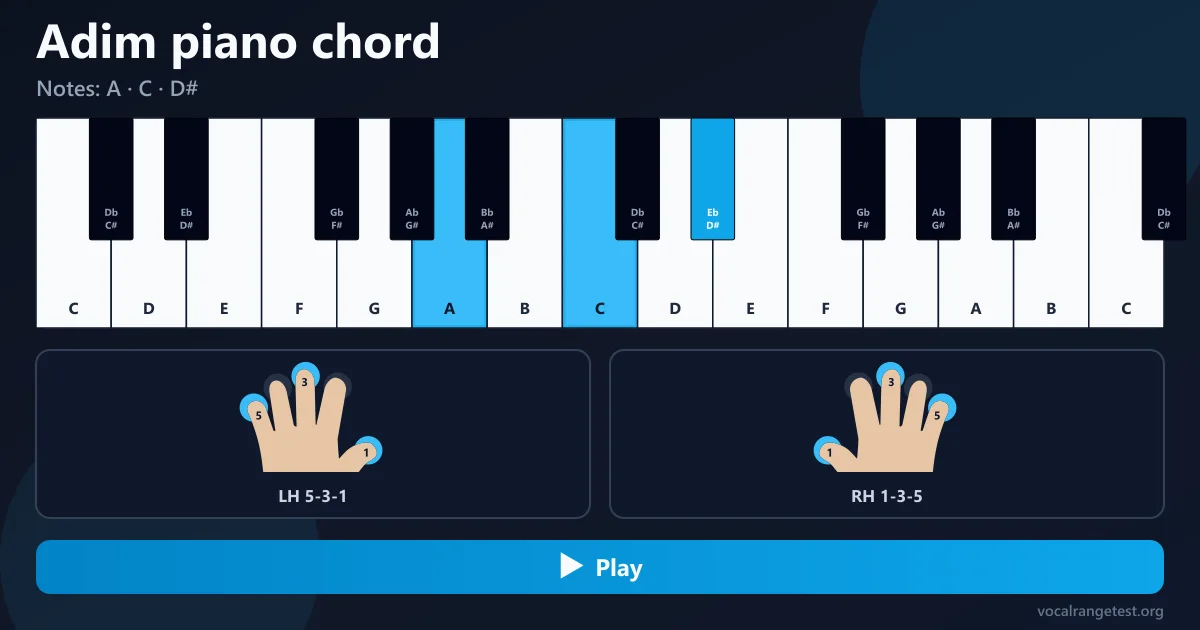
Root position: The most common shape: the lowest note is the root named in the chord, with the other chord tones stacked above it.
Notes: A · C · D#
Voicing: 1 / 3
Fingering
Left hand: 5-3-1
Right hand: 1-3-5
Root
Chord type
Root position & inversions
adim piano chord: practical, musical, and easy to apply
If you searched for adim piano chord, you are probably trying to fix something real in your playing. Maybe your progression feels flat and needs a push. Maybe your chart includes a diminished symbol and you are not sure how to make it sound intentional instead of accidental. Or maybe you know the notes, but the transition still feels awkward. That is exactly where Adim helps. A diminished triad is not usually a “sit here and relax” chord. It is more like a directional chord: short, tense, and useful when you need motion. In plain terms, it tells the ear that something is about to happen next. On piano, the core A diminished triad is A, C, and Eb. You can hear it as compact, edgy, and forward-leaning. In songs, it often appears for a beat or a short bar to connect two stable harmonies, add drama before a phrase change, or tighten a turnaround. This page is built for that practical use case, not just for memorizing a shape. You can listen online, decompose the chord into notes, compare inversions (including different hand-position and bass perspectives), and test slash-bass alternatives. That combination is the real difference: instead of guessing which voicing might work, you can hear and choose the one that actually fits your progression.
What is adim chord piano? A plain-English explanation
In everyday use, adim chord on piano usually means the A diminished triad: A, C, and Eb. Theory books may describe it as stacked minor thirds, but you do not need theory language to use it well. The sound is what matters: it feels unstable on purpose. Not wrong, not random—just unfinished in a way that points somewhere. That “unfinished” quality is why Adim works so well as a connector. If you drop it between two more stable chords, the next chord often sounds clearer and more satisfying. You are not adding complexity for the sake of complexity. You are shaping direction.
If you also searched a diminished chord piano, you are likely solving one of two problems: either your transition is too plain, or your current voicing feels jumpy. Adim can solve both, but only when placement and bass choice are handled carefully. Many players learn a single grip and force it everywhere. That is where diminished chords start sounding clumsy. A better method is to test inversions and slash-bass options against your actual next chord. Same chord identity, different floor under it. Once the bass line moves naturally, Adim stops sounding “strange” and starts sounding musical.
Train your ear before your fingers
Switch between full-chord and arpeggio playback so you recognize Adim by sound, not just by shape memory.
Understand the chord, not just the diagram
A clear note breakdown helps you hear why each tone creates tension and why certain transitions feel smoother.
Use inversions and bass options with purpose
Inversions and slash-bass alternatives let you keep the same chord color while improving your harmonic flow.
adim piano chord page: more than a static chord chart
Most pages tell you where to press. This page helps you decide how to use Adim in real music with online listening, chord decomposition, inversions, and alternative bass testing.

One workflow from sound to song-ready choice
Hear Adim online, inspect note structure, compare inversion feel, and test slash-bass movement without switching tools.
- Online audio preview in chord and arpeggio modes
- Chord decomposition with plain note labels and readable structure
- Inversion switching for quick transition testing
- Slash-bass alternatives to improve bass-line direction
- Finger-friendly layouts for beginners and returning players
- Practical use focus: choose what fits your progression, not just what looks correct
a diminished chord piano: a practical 10-minute routine

1) Lock the core sound first (A–C–Eb)
Play the Adim triad as a block chord and listen carefully. Then switch to arpeggio and hear each note separately. Your goal is to recognize the chord’s tension color quickly. If the sound feels muddy, separate and restack. Two focused minutes here save ten minutes of random retry later.

2) Compare inversions against your target chord
Keep the same chord identity, then rotate through inversions. The notes remain Adim, but the top voice and bass placement change how the transition feels. If your line sounds jumpy, an inversion can make it feel like a step instead. If you accompany vocals, pick the inversion that avoids crowding the melody range.

3) Add slash-bass alternatives for smoother movement
Now test alternative bass options. This is where many “almost good” progressions become convincing. The upper chord color stays diminished, but the lower note can guide the phrase into the next harmony with less friction. Keep one or two options that stay clean at real tempo and under both hands.