
Bbsus/A#sus chord
Root position: The most common shape: the lowest note is the root named in the chord, with the other chord tones stacked above it.
Notes: A# · D# · F
Voicing: 1 / 6
Fingering
Left hand: 5-2-1
Right hand: 1-4-5
Root
Chord type
Bbsus4
Bbsus2
Bb/A# sus chord piano when the chart sits in flats
A Bb/A# sus chord piano shape keeps Bb (or A#) and F as bookends and leaves the major third out on purpose. The middle seat goes to either Eb (fourth) or C (second). Lead sheets print Bbsus, A♯sus, B♭sus4, A#sus2, or a messy mix of all four. Searches land as bb sus chord piano, b flat sus piano chord, and sharp-side twins of the same grip. This page puts both everyday middle notes on one playable keyboard so you can hear which hang the song actually wants.
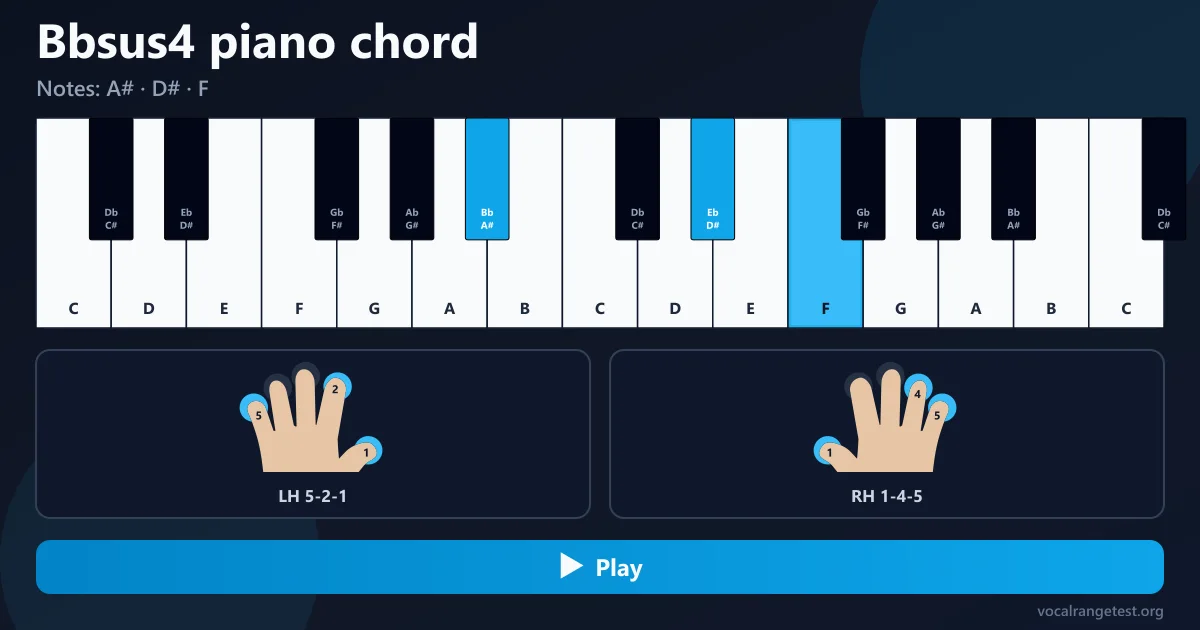
What is bb sus chord piano in everyday language?
A plain Bb major triad is Bb, D, and F. D is the bright middle note—the one that says “major” out loud. Pull D out. Park Eb there and you get Bbsus4: Bb–Eb–F. Park C there and you get Bbsus2: Bb–C–F. Neither stack owns a major or minor third, so the chord will not pick a side between cheerful and gloomy. It waits. That waiting is useful when a verse needs soft pressure, when a country chorus wants one bar of lift before the title line, or when a worship pad should not resolve on every downbeat.
Bb shows up constantly because it is friendly for singers and for bands that already live around F and Eb. In F major, Bb is the IV chord—the classic “lean forward” harmony before you tumble back to F—and a Bbsus on that IV stretches the lean. In Bb major itself, Bbsus paints the home chord so the groove can breathe. Guitarists often capo or barre their way into Bb; keyboard players get handed the sustained sus while everyone else moves. Sharp-key jazz charts may rename the root A#; the piano still presses the same two posts plus one middle choice. Learn the sound, then match the ink.
B flat sus 4 piano chord — the chart’s usual meaning
Bb–Eb–F (same keys as A#–D#–F) is what most writers mean by a bare Bbsus. Eb sits a step above the missing D, so when D returns the ear hears a clean settle into Bb major—the familiar held-then-release move in pop, country, and congregational writing.
B flat sus 2 piano chord — same frame, gentler fill
Bb–C–F keeps Bb and F and swaps the fourth for the second. It often feels roomier and less “please resolve now” than sus4—useful under long melody vowels, soft rock intros, and loops that need color without a hard cadence tug.
IV in F, home in Bb — two jobs, one grip
Many hit progressions treat Bb as a doorway chord in F, or as home base in Bb. Adding a sus does not invent a new key; it loosens the triad you already knew. Once you can grab Bb and F quickly, choosing Eb or C is a small, audible decision—not a theory exam.
Play the Bb/A# sus, then take the voicing apart
A printed box cannot prove whether Eb or C is doing the work. Here you trigger real piano samples as a full block or a rising arpeggio, check suggested fingerings for each hand, then walk inversions and alternate bass so the suspension can ride a different lowest note.

When a b flat sus piano chord actually helps the song
Use it on intros that should feel unfinished for a few bars. Use it under a sustained vocal so Bb major does not clap the door shut every measure. Use it on the IV area in F when you want the chorus to arrive half a breath later. Producers also drop it into two-chord beds so the loop flexes. Skip the Roman-numeral lecture if you want—if plain Bb feels too final for the lyric, borrow the suspension; put D back when the phrase lands.
- In-browser piano audio for the full chord or a note-by-note arpeggio—decide by ear.
- Bbsus4 / A#sus4 and Bbsus2 / A#sus2 grouped separately so you can compare the middle voice.
- Left- and right-hand fingering hints on root-position shapes you can check at the bench.
- Inversions and alternate-bass options when the chart wants F, Eb, or another tone underneath.
- No install and no signup wall—open the page, click, listen before the count-off.
How to settle a bb sus chord piano shape in three listens

Get Bb and F solid before the middle note
Find a Bb (or A#) that sits under your hand, then the F a fifth above. Both sus flavors share that pair. If those posts drift, Eb or C will not rescue the sound.

Choose Eb or C, then hear the return to major
Add Eb for the everyday b flat sus 4 piano chord. Play the block, then the arpeggio, until lit keys match what you hear. Flip to the b flat sus 2 piano chord group (C in the middle) and resolve both into plain Bb or A# major. Clock which fall feels snappier (often sus4) and which feels softer (often sus2).

Move the bass when the arrangement needs it
Open inversions or alternate-bass voicings when F, Eb, or another chord tone should sit underneath while the upper color stays suspended. That is how you keep a pad moving through a real chart without restarting in root position every bar.