
Bbm9/A#m9 chord
Root position: The most common shape: the lowest note is the root named in the chord, with the other chord tones stacked above it.
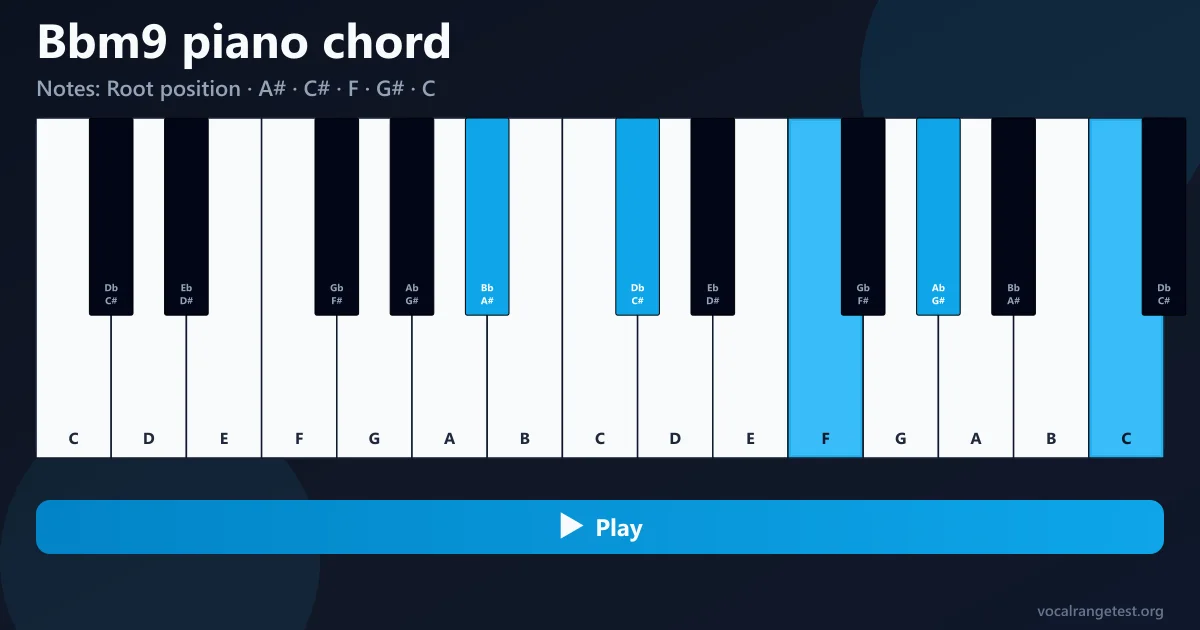
Notes: A# · C# · F · G# · C
Voicing: 1 / 4
Root
Chord type
Root position & inversions
Two-hand voicing
Bbm9(a#m9) piano chord — the warm minor stack with a clear ninth on top
If you typed Bbm9(a#m9) piano chord into a search box, you probably do not want a theory lecture. You want the shape, the notes, and a way to check that what you are playing actually sounds like the chord on the chart. That is exactly what this page is for. Bbm9 is a five-note minor ninth: Bb, Db, F, Ab, and C. A#m9 is the same sound with a sharper spelling. On a real keyboard those two labels land on the same keys—you just see Bb more often in charts because A# minor is awkward to write. Use the player above to hear the full grip, then split it into single notes so your ear catches the ninth instead of guessing from a static picture.
What people usually get stuck on with Bbm9
Most players already know Bbm and Bbm7. The jump to Bbm9 is only one extra pitch—the C a ninth above Bb—but that note changes the whole mood. Without it, the chord feels closed and heavy. With it, the minor colour stays, yet the top opens up like a soft light through a dark room. The trap is packing all five notes into one hand when you do not need to. A usable Bbm9(a#m9) chord on piano can be a compact right-hand cluster over a left-hand Bb, or a two-hand spread that leaves space between the bass and the upper colour tones. If a close stack feels cramped, that is a signal to open the voicing, not a sign you are “bad at ninths.”
We built this page because static chord books stop at a drawing. You cannot ask a printed diagram whether the C is in the right octave, or whether your Ab is fighting the melody. Here you can preview the full chord, arpeggiate it, switch positions, and try inversions with a different bass note. That loop—see it, hear it, adjust it—is how Bbm9 stops being a scary symbol and becomes a sound you recognise in R&B pads, neo-soul loops, and slow ballad turns.
Bb spelling beats A# in most charts
Both Bbm9 and A#m9 name the same piano keys. Song charts, lead sheets, and band parts almost always write Bb minor because A# minor forces ugly accidentals like E# and B#. If your sheet says A#m9, play the Bbm9 shapes on this page—you are not “translating wrong,” you are using the spelling players actually read.
The ninth is C — and it does the talking
Root, minor third, fifth, and flat seventh give you the Bbm7 body. The C is the ninth. It is often the note your ear notices first when the chord feels “modern” instead of plain minor. When you use breakdown mode, listen for that C against Bb and Db. If those three sit cleanly, the rest of the voicing usually falls into place.
Positions and inversions are not optional extras
Root position is useful for learning, but songs rarely stay there. An inversion with Ab (or G# in sharp spelling) in the bass keeps the minor-ninth colour while the left hand walks a smoother bass line. Switching positions also helps small hands: keep the essential colour tones and drop a doubled fifth if the stretch fights you.
A Bbm9(a#m9) chord on piano you can hear before you commit your hands
Diagrams alone leave you wondering if the voicing is right. This page pairs a clear keyboard map with live piano audio, note breakdown, alternate positions, and inversions so you can match what you see to what you hear—then carry that sound into a progression.

Audio first, then the fingering map
Hit play on the full Bbm9 grip so your ear learns the target colour. Then step through each note. That order matters: once you know how the chord should bloom, the fingering diagram stops being a puzzle and becomes a confirmation. You can compare a tight one-hand shape with a wider two-hand layout without leaving the page or signing up for anything.
- Preview the full Bbm9(a#m9) piano chord as a block or as an arpeggio
- Break the chord into single notes to isolate the ninth and the flat seventh
- Switch positions when root position feels too wide for one hand
- Try inversions to move the bass without losing the minor-ninth colour
- Use the fingering view as a check after your ear already knows the sound
How to play Bbm9(a#m9) chord on piano

Plant the Bb minor triad you already trust
Start with Bb–Db–F. That is plain Bbm, and it is the floor of everything that follows. Play it slowly in a comfortable octave. If the triad feels muddy, move it up or down a bit before you add extensions. A clean minor triad makes the later ninth much easier to hear, because you already know what “home” sounds like under the extra colour.

Add Ab for Bbm7, then bring in C
Slide Ab into the stack so you have Bb–Db–F–Ab. That is Bbm7—the body of the ninth chord. Only then place C above or beside that cluster. You now have the full Bbm9 set: Bb, Db, F, Ab, C. If five notes fight one hand, keep Bb and Ab in the left hand and let the right hand take Db–F–C, or another split that keeps the ninth audible. The goal is a clear minor colour with a singing ninth, not a heroic stretch.

Match your hands to the audio on this page
Play the interactive Bbm9(a#m9) piano chord above and listen once without touching the keys. Then play along. If your version sounds thicker or thinner than the preview, check whether you doubled a note by accident or left out the C. Breakdown mode is the fastest fix: mute the full block and hear each pitch in order so you can spot the missing or extra note in seconds.

Open the voicing when the stretch complains
A close-position ninth can feel huge, especially if you insist on keeping every chord tone in one hand. Drop the fifth (F) if you need air, or spread the chord across both hands. Positions on this page show workable layouts for that exact problem. You are still playing Bbm9 as long as the ear hears minor third, flat seventh, and ninth around the Bb root.

Borrow an inversion for smoother bass motion
Try the inversion that puts the flat seventh in the bass (often written like Bbm9/Ab). The upper structure still says “minor ninth,” but the bass line can move by step into Eb, F, or Ab chords without jumping back to Bb every bar. Toggle inversions in the tool, hear the bass shift, then copy the shape at the keyboard. That is how chart symbols turn into voice leading instead of isolated stamps.
Drop Bbm9 into a short progression you can loop
A simple practice loop: Bbm9 → Ebm7 → Abmaj7 → Dbmaj7, or Bbm9 holding as a pad under a melody that leans on C and Db. Play each change twice, then return to Bbm9 and listen for whether the ninth still rings clearly after the other chords. If it disappears, you are probably burying C under denser right-hand notes—simplify, replay the page audio, and reset your ear.