
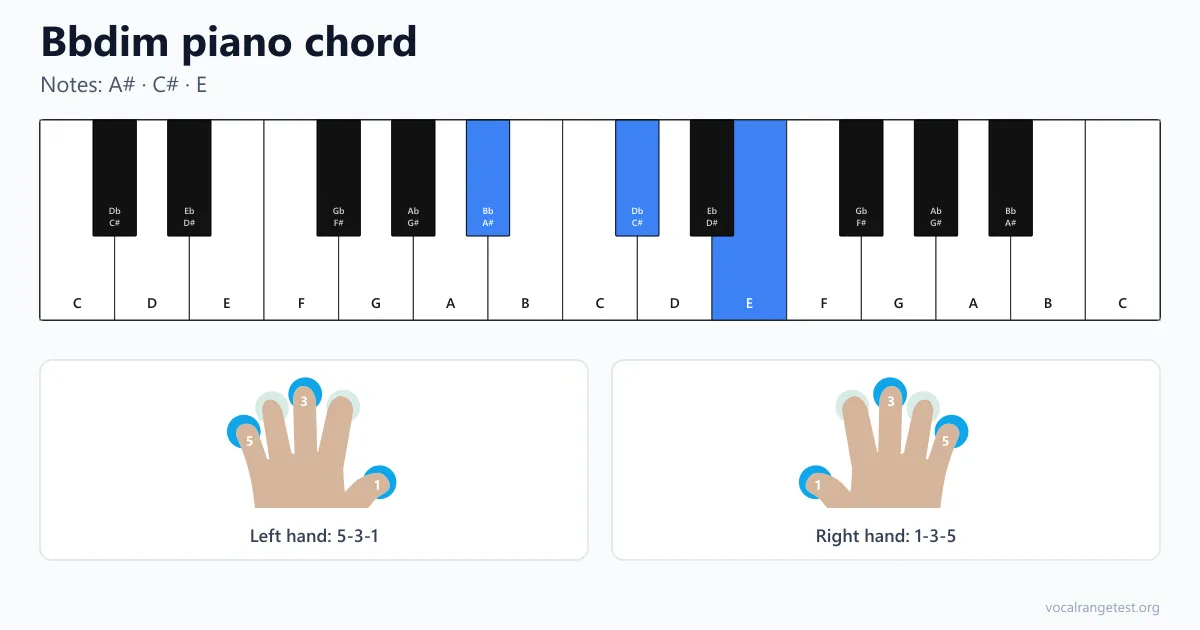
Bbdim/A#dim chord
Root position: The most common shape: the lowest note is the root named in the chord, with the other chord tones stacked above it.
Notes: A# · C# · E
Voicing: 1 / 3
Fingering
Left hand: 5-3-1
Right hand: 1-3-5
Root
Chord type
Root position & inversions
Bbdim piano chord
The Bbdim piano chord is three notes a minor third apart. On most interactive diagrams—including this page—you will see them labeled A#, C#, and E, which are the same keys as Bb, Db, and Fb. That means two black keys plus the white key E. Compared with Bb minor (Bb–Db–F), the top of the triad drops from F down to E (Fb). Half a step is enough to swap a chord that can sit as a mood pad for one that sounds unfinished and ready to tip into whatever comes next.
Flat-key charts say Bbdim; sharp-key charts often say A#dim
If your songbook lives in flats—Eb major ballads, Ab progressions, Bb bluesy turnarounds—you will meet Bbdim as a quick scrape between two friendlier chords. It is not usually the place the song “lives.” It is the half-beat that makes the landing chord feel earned. The enharmonic twin, A#dim, shows up when the ink is full of sharps: in B major, A#dim is the leading-tone triad (vii°), with A# itching to rise into B while C# and E keep the grip tense until you resolve. Same three piano keys either way. Search traffic also arrives as a# dim chord piano, a sharp dim chord piano, or b flat dim piano chord; they are asking for this grip, not three different instruments.
Reach for Bbdim when you want a short, dry twist—not a long spooky pad. Think of a gospel turnaround that brushes Bbdim before Cm or Bb, a verse that needs one bar of “almost,” or a film cue that frowns for a beat and then smiles again. It does not feel like happy major, and it is not the same soft sadness as Bb minor. It feels like a hinge with grit. Chart prints Bb° or Bbdim? Aim for Bb–Db–E (or the A#–C#–E spelling on the diagram). Prefer shapes? Black key for Bb/A#, next black for Db/C#, then E—listen for the hollow rub between the outer tones before you resolve.
What your fingers actually press
Root position is the A#–C#–E cluster (Bbdim spelling). First inversion puts C# lowest. Second inversion puts E lowest. Same triad; the bass note decides how hard the ear leans toward Bb, Cm, B major, or whatever you resolve to.
Bbdim vs Bbm vs Bbdim7
Bb minor keeps a perfect fifth (F). Bbdim replaces that fifth with E/Fb. Bbdim7 adds another minor third above E (usually G or Fx spellings), which fattens the classic full-diminished sound. Pop charts that only write dim usually want this three-note version first.
Why the diagram uses A# and C#
Music software and many chord databases spell this pitch set with sharps even when songbooks prefer flats. That is not a different chord—it is a labeling choice. If your lead sheet says Bbdim, trust the flat names; if it says A#dim, trust the sharps. Match the key signature on the page.
Audition Bbdim, then pull the notes apart
A still diagram cannot tell you if you accidentally kept the F from Bb minor. Here you can hear the chord, hear it as an arpeggio, and step through inversions with finger numbers before you commit on a real piano.

Online chord and arpeggio sound
Trigger A#–C#–E together or one after another. That split listening is the fastest way to catch a leftover F from Bb minor hiding in your grip.
How to play Bbdim piano chord

1. Build the black–black–white shape
Find Bb (A#), then Db (C#), then E. Keep the spacing even—minor thirds. Play it quieter than you think; this triad turns brittle if you hammer it.

2. Match the player before you memorize ink
Use the tool above for the full chord, then the arpeggio. Copy that color on your instrument. If it still sounds like soft minor, you probably still have F on top instead of E.

3. Resolve on purpose
Try Bbdim into Bb major, Bb minor, or Cm. If you are in a sharp-key headspace, resolve A#dim into B major. Training the exit teaches the chord’s job better than staring at dots.