
Bb9/A#9 chord
Root position: The most common shape: the lowest note is the root named in the chord, with the other chord tones stacked above it.
Notes: A# · D · F · G# · C
Voicing: 1 / 4
Root
Chord type
Root position & inversions
Two-hand voicing
Bb9 (A#9) piano chord: a Bb7 that grew a bright ninth on top
A Bb9 (A#9) piano chord is five notes: Bb, D, F, Ab, and C. Start with a plain Bb7 (Bb–D–F–Ab), then stack C a ninth above the root. That C is the whole personality upgrade — the chord still pulls like a dominant, but the top feels open and polished instead of blunt. Charts almost always print Bb9. The sharp twin — A#9, or what people type as a sharp 9 piano chord — hits the same keys; you mainly see that spelling when a page is already drowning in sharps. This page is built so you can hear the stack online, peel it into an arpeggio, check fingerings, and flip inversions before you drag the shape into a song.
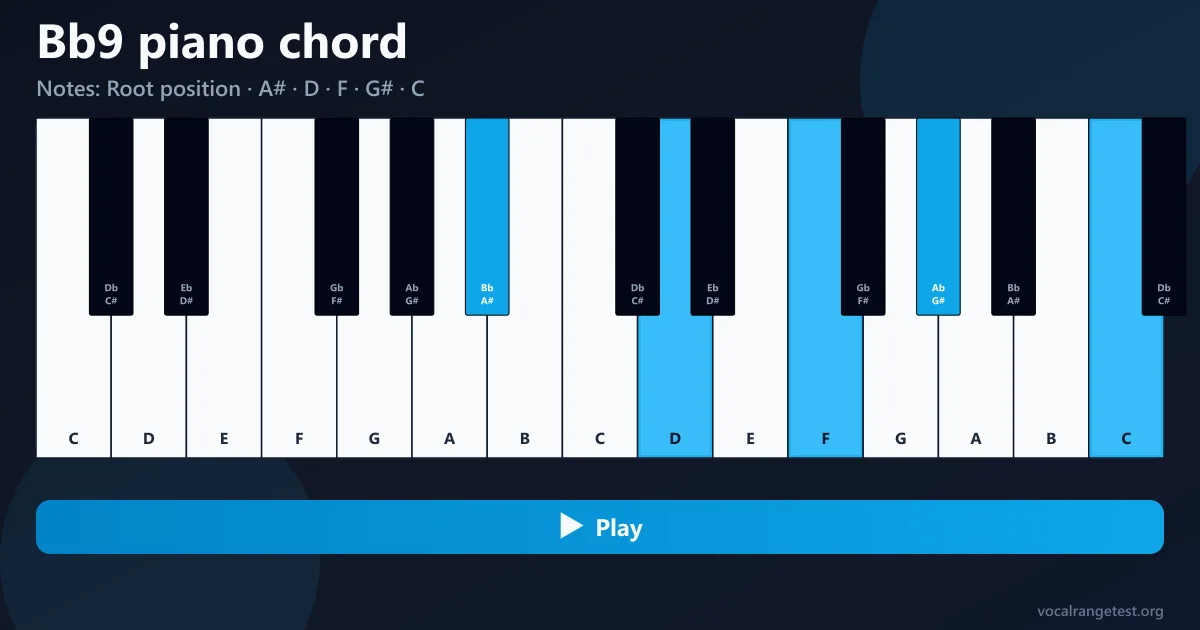
What people actually want when they search Bb9 chord on piano
Most searches for a Bb9 chord on piano are not hunting a theory lecture. Someone saw Bb9 on a lead sheet, a gospel chart, or a neo-soul progression and needs three practical answers: which keys, how it should sound, and how it differs from the cousins that sit next to it on the page. Bb9 is still a dominant colour — that Ab keeps the lean toward Eb — but the added C softens the attack and gives the right hand something sweet to land on. Think R&B pads, quiet jazz endings, funk turnarounds, and church music where a bare Bb7 feels too plain. If you only memorize a silent screenshot, you cannot tell whether the ninth is singing or whether your hand quietly dropped the Ab and turned the grip into something else.
People also type b flat 9 piano chord or a sharp 9 piano chord when the chart (or an app) leans on sharps: A#, Cx, E#, G#, B#. Same five pitches as Bb–D–F–Ab–C; different ink. Another common mix-up is b flat major 9 piano chord: that phrase often means Bbmaj9, which uses a natural A (major seventh) and floats instead of tugging. Bb9 keeps the bluesy Ab. Our reason for building this tool was simple — mute chord charts waste practice time. Here you preview the real sample as a block or broken arpeggio, watch left- and right-hand fingerings update with the voicing, and step through inversions plus alternate bass until the colour sticks. Then take the grip back to the song instead of guessing from a PNG.
Five pitches, one job
Bb and D keep it major and bright. F fills the middle. Ab supplies the dominant tug. C on top is the ninth that makes the chord feel finished and modern instead of stubby.
Bb9 on paper; A#9 when the page is full of sharps
Band and church charts prefer Bb9 with flats: Bb, D, F, Ab, C. Sharp-key pages and “a sharp 9” searches point to A#9 — same five keys under the fingers, only the printed accidentals change.
Not the same as Bbmaj9 or Bbadd9
Bbmaj9 swaps in a major seventh (A♮) and feels floatier. Bbadd9 keeps a major triad plus C without the flat seventh — prettier, less pull. If the chart says Bb9, keep the Ab.
Why this Bb9 page is built for ears, not mute screenshots
A still photo cannot prove the ninth is speaking or the seventh is still there. This interactive chart plays real piano samples, breaks the chord apart, shows fingerings, and lets you audition inversions and alternate bass before the shape leaves the page.

Hear the full stack, then break it down
Block mode drops all five tones together so you catch the colour as one object — warm third, restless Ab, shiny C on top. Arpeggio mode walks Bb–D–F–Ab–C so you can confirm nothing got swallowed in the middle of the hand. Playback follows the inversion or slash you picked, which matters on a five-note grip where a quiet thumb can erase the note that makes it a ninth.
- Online listen: full Bb9 / A#9 chord or note-by-note arpeggio on real samples
- Chord breakdown so each tone — especially Ab and C — stays honest
- Fingerings for both hands that track the selected voicing
- Inversions and alternate bass, including seventh-in-bass and two-hand spreads
- Same sound whether your sheet says Bb9 or a sharp 9 (A#9)
How to play Bb9 chord on piano

1. Build Bb7 first, then add the ninth (C)
Find Bb near middle C — black key between A and B. Add D and F for the major triad, then Ab (black key a whole step below Bb’s octave) for the dominant seventh. Finally place C above that stack. Right hand often needs a wider span than a triad; many players split the chord across two hands once it feels cramped. If the result suddenly sounds like plain Bb major, Ab vanished. If it sounds floaty and “pretty jazz” instead of bluesy, you may have grabbed A♮ (Bbmaj9 territory) instead of Ab.

2. Balance the colour: D smiles, Ab tugs, C sparkles
Do not mash five keys at equal volume and hope. Keep D clear so the chord stays major. Let Ab speak enough that the ear still expects motion toward Eb. Let C sit on top without drowning the middle. Mud usually means a soft fingertip brushing a neighbour, or the ninth getting whispered so quietly you only hear a fat Bb7. Play the block on this page and match that raised-eyebrow-plus-shine sound — not a crushed cluster and not a shy ninth glued on after the fact.

3. Use arpeggio mode until the five tones stick
Switch to arpeggio and watch Bb–D–F–Ab–C light in order. This is the fastest fix for mixing Bb9 with Bb7 (missing C), Bbmaj9 (A♮ instead of Ab), or Bbadd9 (no flat seventh). If Ab always arrives late or C never quite lands, slow down until your hand matches the diagram. That listen-and-check loop is why we built breakdown playback into the page instead of shipping another silent PNG.

4. Try the seventh-in-bass inversion and the two-hand spread
Five notes in one fist can feel athletic. Use the inversion control to put the seventh underneath — still Bb9 / A#9 harmony, only the floor note moved. Then try the two-hand open voicing: left hand takes root and fifth (or a leaner pair), right hand covers the upper colour. Listen in both block and arpeggio so the new layout is obvious before you copy it into a rehearsal.

5. Preview alternate bass when the chart writes a weird slash
Some sheets keep Bb9 in the right hand while the bass wanders outside the basic inversion set. Preview those alternate-bass options here until your ear owns the new floor. Same chord tones on top, different gravity underneath — that is exactly what trips players who only memorized root position from a paper chart.
6. Drop Bb9 into a real progression so the ninth has a job
In Eb major, Bb9 is a classic V9 — it wants to fall to Eb, only with a smoother top than a bare Bb7. In Bb major the same symbol can colour a secondary dominant or dress a turnaround depending on the bass. Gospel and R&B writers love it when a plain dominant feels unfinished but a full thirteenth stack would be too busy. Play a short cadence, swap Bb7 for Bb9 on the dominant, and listen for why the arranger wanted that C. Come back to this page whenever the next chart respells the chord as A#9 — the a sharp 9 spelling — or throws a slash you have not practiced yet.