
Bb6/A#6 chord
Root position: The most common shape: the lowest note is the root named in the chord, with the other chord tones stacked above it.
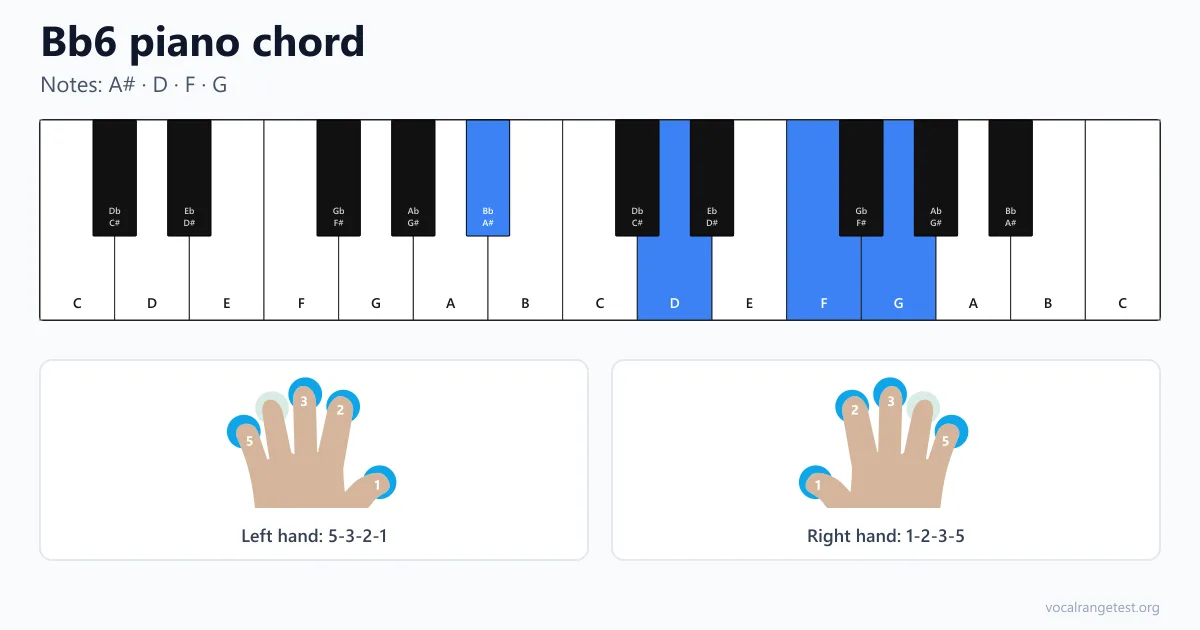
Notes: A# · D · F · G
Voicing: 1 / 4
Fingering
Left hand: 5-3-2-1
Right hand: 1-2-3-5
Root
Chord type
Root position & inversions
Bb6 piano chord — the flat-key major that smiles instead of parking the bus
A Bb6 piano chord is a Bb major triad with G sitting a major sixth above the root: Bb–D–F–G. Band charts, brass books, and flat-key pop almost always print Bb6. Sharp-side paperwork may label the same keys A#6 (a sharp 6 piano chord spelling). Under the hand you are still on Bb, D, F, and G. Plain Bb can feel like a full stop. Bbmaj7 lifts the top toward a thinner, jazzier sheen. Bb6 keeps the major smile and slips G into the cracks so the chord feels open without asking for a full seventh vocabulary. This page is built so you can hear that colour online, break it into an arpeggio, check fingering for both hands, and walk inversions plus alternate bass on one diagram — the difference between a mute chart thumbnail and a grip you can trust mid-song.
Why writers reach for Bb6 (and how it usually lands on the ear)
Bb is already a workhorse key for horns, school bands, and singers who live comfortably around F and Eb. Writers add the sixth when plain Bb feels too stamped and Bbmaj7 feels a little too polished for the lyric. In Bb major, Bb6 often softens the tonic — same home address, less of a hard knock on the door. In F major it shows up as a warmer IV: the G is already inside the key, so the chord blooms without borrowing drama. Country shuffles, Motown-leaning turnarounds, quiet gospel pads, and acoustic worship in flat keys all use that move. Closing bars sometimes rest on Bb6 so the last colour grins instead of thudding. If a lead sheet prints a#6 piano chord instead, treat it as the twin spelling; the b flat 6 chord piano shape does not change just because the letters did. Mood-wise Bb6 tends to read as sunny, grounded, and a bit breezy — major, but not parade-major. Think open window more than brass fanfare.
Build it by ear: root, major third, perfect fifth, major sixth. D keeps the chord clearly major; G is the personality. Mute G and you are back to blunt Bb. Raise that top tone to A and you tip into Bbmaj7. Flatten D and the whole stack tips minor. A practical shortcut many players notice after a few rehearsals: Bb–D–F–G uses the same four pitch classes as Gm7 (G–Bb–D–F). With Bb in the bass, listeners hear major-with-sixth. With G underneath, the same cluster often reads as G minor seventh. Hearing the full Bb6 chord on piano, then the arpeggio, makes that cousin relationship obvious faster than memorising two “unrelated” grips. Fingering updates with the voicing; inversions and slash bass stay on this page so practice time goes into listening and placement.
Bb6 is the everyday spelling; A#6 is the twin
Flat-key and band charts print Bb6. Sharp-side pages may write A#6. Learn the warm colour once, then read whichever ink your sheet uses.
G is the note that opens the door
Without G you only have Bb major. If D goes soft, the chord stops sounding major. Chord mode proves the blend; arpeggio mode proves each tone arrived — especially that sixth.
Black root, mostly white upstairs
Bb is the black key; D, F, and G are white. The shape looks friendlier than an all-flat stack, but soft thumbs still miss Bb and turn the chord into something that is not Bb6.
A Bb6 workbench you can actually hear
A printed fingering chart cannot tell you whether the sixth is clear. Here the keyboard stays tied to piano samples, hand numbers, inversions, and slash-bass options so you trust the colour before you stretch for it in tempo.

Stack the warm ring, then peel the sixth out
Trigger chord mode when you want the complete Bb6 colour in one hit. Switch to arpeggio when you need to confirm G is speaking, or that D has not slumped toward a minor third. Playback follows the voicing on screen, so inversions and alternate-bass shapes sound like the notes you see. Online listening, broken-chord listening, fingering, inversions, and alternate bass together — that is the useful gap between a still image and a chord page you can practise with.
- Piano samples for block chord or arpeggio playback
- Left- and right-hand fingering that updates with the voicing
- Inversions for walking bass and soft handoffs
- Alternate-bass (slash) shapes when the lowest note sits outside the stack
- A#6 recognised as the same sound under sharp spelling
How to play Bb6 chord on piano

1. Lock Bb–D–F, then invite G in
Find Bb, D, and F in a comfortable octave. Add G above the triad — or park G in the left hand if the right already feels crowded. Confirm G is a major sixth above Bb, not a random neighbour. Many right hands use 1–2–3–5 for the four-note stack; smaller hands can split across both hands without losing the identity.

2. A/B your blend against the page
Play your Bb6, then tap chord mode. Listen for an open major colour, not a thin triad with a stuck-on top note. If it sounds oddly minor, re-check D. If it sounds like plain Bb, G is probably too quiet or missing. Comparing your hands to the sample is faster than staring at a static picture and hoping.

3. Break it until G feels harmonic, not decorative
Switch to arpeggio and watch each key light in order. Broken playback is how a lot of players finally treat the sixth as part of the chord instead of a garnish. Slow down until your line matches the reference. A clean Bb–D–F–G pattern beats a rushed blur every time.

4. Flip inversions when the bass needs to move
Use the voicing controls. First inversion puts D underneath; second puts F underneath; third can park G in the bass — which is exactly where the sound starts overlapping the Gm7 cousin. Hear each shape as a block and as an arpeggio so the new floor note is unmistakable before you take it into a song.

5. Preview slash bass when the chart walks outside the set
Some arrangements keep Bb6 colour in the right hand while the bass steps to a non-chord tone. Alternate-bass options let you preview that studio habit on the same page: same upper warmth, different gravity underneath. Handy before rehearsal throws a slash your root-position drills never covered.
6. Give Bb6 a job inside a key
Sit on it as a softer tonic in Bb major under a slow melody. Or treat it as IV in F major and notice how the sixth already belongs to the scale — no borrowed tension, just a rounder plateau than plain Bb. That is how the Bb6 chord on piano stops being an isolated grip and becomes something you reach for on purpose. Return here whenever you need the large diagram and the listen-and-break-apart tools again.