
Ab9/G#9 chord
Root position: The most common shape: the lowest note is the root named in the chord, with the other chord tones stacked above it.
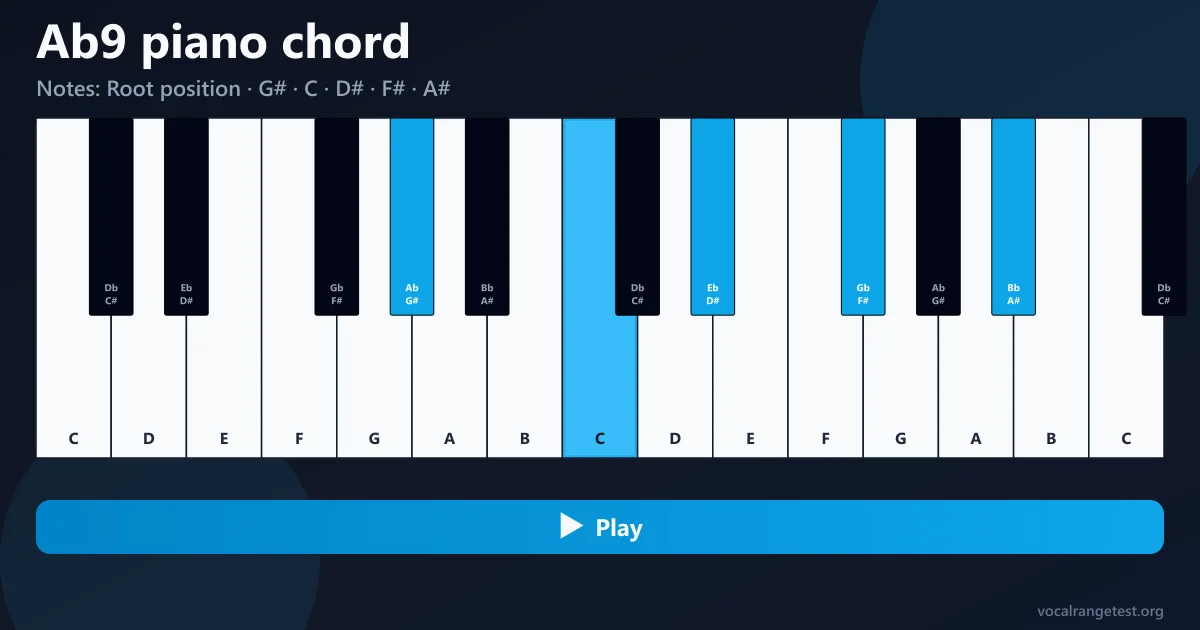
Notes: G# · C · D# · F# · A#
Voicing: 1 / 4
Root
Chord type
Root position & inversions
Two-hand voicing
Ab9 (G#9) piano chord — Ab7 with an open Bb on top
An Ab9(g#9) piano chord is five pitches: Ab, C, Eb, Gb, and Bb. Think of it as an Ab7 stack (Ab–C–Eb–Gb) with a major ninth (Bb) sitting a whole step above the root. That Bb is what people mean when they search for an Ab9 chord on piano — the colour that makes a plain dominant feel wider, softer, and a little more “sung” than a bare seventh. On a real keyboard those five keys are the same whether your chart prints Ab9 or G#9. Flat-key lead sheets, R&B pads, and brass books almost always write the a flat 9 piano chord spelling. Sharp-side charts that already live in G# or C# may label the identical sound a g sharp 9 piano chord. This page is built so you can hear that full colour online, peel it into single notes, check fingerings, and flip through inversions before your hand commits to a five-note stretch.
What people actually want when they look up Ab9 on piano
Most searches for Ab9 land in the same three questions: which keys do I press, how is this different from a major-ninth symbol, and how do I fit five notes under two hands without a cramped claw? Ab9 is a dominant ninth. The seventh is Gb (minor), not G♮ (major). If someone typed “a flat major 9 piano chord,” they may have meant Abmaj9 — Ab, C, Eb, G, Bb — which floats instead of pushing. Mixing those two up is the fastest way to ruin a Db cadence: Ab9 wants to lean forward; Abmaj9 wants to hover. In songs, Ab9 shows up as V9 into Db or Dbm, as a soulful I9 colour in Ab-centred R&B, and as a turnaround colour in gospel and neo-soul where Ab7 alone feels a bit plain. The Bb is not decoration — it is the note that opens the air above the seventh.
Practical piano reality: five notes in close position is a stretch for many hands. Players routinely drop the fifth (Eb), split the chord across two hands, or grab an inversion so Bb or C sits lower and the stack feels less like a claw. That is why hearing the chord, then hearing it broken, matters more than memorising a single JPEG. Use the diagram on this page to lock the sound, then move bass notes through the inversion set until the slash on your sheet matches something your ear already trusts. Whether the ink says Ab9 or G#9, you are training one harmony — five pitch classes, one restless-but-open colour.
Bb is the ninth — leave Gb alone
Ab9 keeps the minor seventh (Gb). Swap Gb for G♮ and you have left dominant territory for Abmaj9. The ninth does not replace the seventh; it sits on top of it.
Ab9 and G#9 share keys, not ink
Same five pitches. Prefer Ab9 in flat rooms and most vocal charts; prefer G#9 when the bar is already written in sharps. The piano does not care which spelling you read.
Five notes invite smarter voicings
Root-position clusters are optional. Dropping Eb, spreading across two hands, or parking a different tone in the bass keeps the ninth colour without forcing every finger into one octave.
Work an Ab9 chord on piano with sound, note-by-note breakdown, and movable bass
A mute five-key picture cannot tell you whether Bb is actually speaking or whether you accidentally played G♮. Here the diagram plays piano samples, peels the stack into an arpeggio, shows fingerings, and lets you audition inversions — so stretch and colour get judged by ear first.

Hear the full ninth, then isolate every tone
One click gives you the complete Ab9 — triad, flat seventh, and that Bb on top. Switch to arpeggio when you need each pitch clean, especially Gb versus a sneaky G♮, and Bb versus a thinned-out top. Playback follows the inversion or slash on screen, so you hear the voicing you selected rather than a generic root-position loop. That listen-and-compare habit is why we built these pages: charts teach symbols; ears teach whether the ninth colour is actually in the room before you take it into a Db cadence, an R&B pad, or a two-hand spread.
- Click to hear block chord or arpeggio on real piano samples
- Break the stack so Ab, C, Eb, Gb, and Bb each get a turn
- Left- and right-hand fingerings update with the voicing
- Root position plus inversions and alternate-bass options
- Same dominant-ninth sound whether your sheet says Ab9 or G#9
How to play Ab9 chord on piano

1. Build Ab7 first, then add Bb
Find Ab near middle C — the black key just left of A. Add C (white), Eb (black), and Gb (black) so you have a solid Ab7. Then place Bb a whole step above Ab (or an octave higher if the close grip feels jammed). Compact right-hand shells often omit Eb and keep Ab–C–Gb–Bb; left hand can own the root and fifth while the right hand takes the upper colour. If the chord suddenly sounds like plain Ab7, the ninth never arrived. If it sounds oddly floaty and “pretty,” check that you used Gb and not G♮.

2. Balance the seventh and the ninth so neither one disappears
Ab9 lives on two relationships: C against Gb (the dominant bite) and Bb against Ab (the open ninth). Aim for an even attack where Bb sweetens the top without covering Gb, and where C still keeps the major third honest among the black keys. Soft fingertips love to smear Bb into C, or thin Gb because the hand rushed the black-key cluster. Play the block chord on this page and compare — you want wide dominant colour, not a slammed cluster and not a timid triad with a polite ninth afterthought.

3. Arpeggiate until Ab–C–Eb–Gb–Bb is automatic
Arpeggio mode lights each key as the pitch rises. Watching the five tones in sequence is the fastest way to separate this grip from Abmaj9 (G♮ instead of Gb) and from Ab7 (no Bb). If one finger lags on the leap to Bb, or if Gb keeps getting skipped under a lazy third finger, slow down until you match the page. This is where an a flat 9 piano chord stops being a theory label and starts being a shape your hand trusts under tempo.

4. Flip inversions so the five-note colour fits real left-hand lines
Use the inversion controls. Putting C, Eb, Gb, or Bb underneath changes the gravity without changing the pitch classes. A bass on C lightens the middle; a bass on Gb thickens the dominant pull; a bass that highlights Bb can feel surprisingly vocal in R&B pads. Listen in both block and arpeggio mode so the new lowest note is obvious before you copy the hand. Those slash labels are still one Ab9 / G#9 harmony — same five pitch classes, different floor.

5. Preview two-hand and alternate-bass layouts when close position hurts
Lead sheets rarely demand every Ab9 as a single-hand claw. Preview two-hand splits and alternate-bass options until your ear owns the new floor. Same chord tones above, different note underneath — that mismatch is exactly what confuses players who only drilled one root-position JPEG from a printed chart. If your hand span is limited, dropping Eb while keeping Ab–C–Gb–Bb still reads as ninth colour in most band contexts.
6. Put Ab9 in a progression so the ninth has somewhere to point
When you study how the chord behaves in real music, start where charts use it most: as V9 resolving to Db or Dbm, as a softer I9 colour in Ab-centred soul and neo-soul, or as a turnaround colour where Ab7 alone feels too blunt. Hold the chord, then walk a short line into Db, Dbm, or the next pad and listen to why writers add Bb instead of stopping at the seventh. Context beats isolated drilling; come back here for the large diagram, the inversion set, and the hear-and-break-down tools when the next sheet throws a new slash — or a sudden respelling from Ab9 to G#9 — at you.