
Abm/G#m chord
Root position: The most common shape: the lowest note is the root named in the chord, with the other chord tones stacked above it.
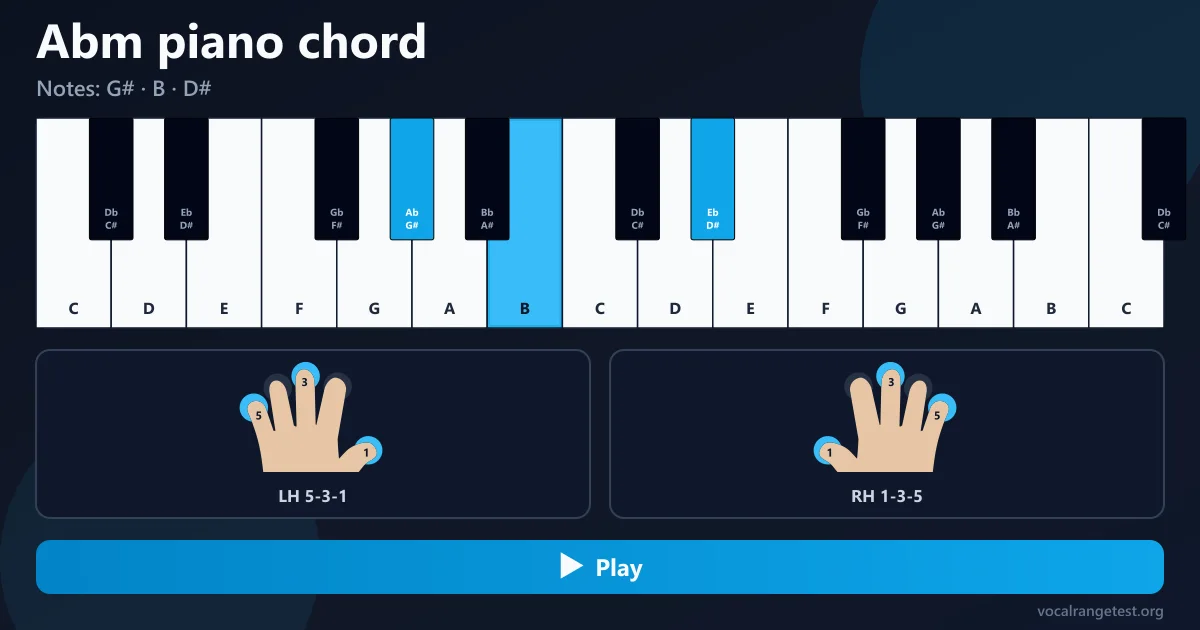
Notes: G# · B · D#
Voicing: 1 / 6
Fingering
Left hand: 5-3-1
Right hand: 1-3-5
Root
Chord type
Root position & inversions
Alternate bass
G#m/Abm chord piano — a compact minor triad that flat-key songbooks print as Abm and sharp-side charts keep as G#m
A G#m/Abm chord piano grip is three pitches: G♯, B, and D♯. On the keyboard that is two black keys with B natural between them — a tight shape that rewards slow placement over a rushed grab. Brass books, vocal scores in flats, and many R&B charts write Abm chord piano; guitar tabs and sharp-key pop often keep G#m chord piano for the same keys. Whether you arrived searching G#m in piano parts or the Abm twin on a lead sheet, the listening job is identical: own the minor third (B natural, not B♯), hear the triad as a colour rather than three anonymous dots, and learn the bass moves real arrangements print underneath. This page stays on that one minor stack so you can audition it online, break it into an arpeggio, check left- and right-hand fingerings, and walk inversions and alternate bass before a flat-key turnaround swaps the spelling on you.
Harmonic jobs Abm and G#m actually pull in charts
In F♯ major, G#m is the reliable ii chord — minor shade that steps toward C♯7 and makes a cadence feel like it arrived on purpose. In B major it often works as vi, tucking relative-minor warmth under a melody that still lives in a bright key. In E major it can appear as iii for a lateral colour change without leaving the sharp neighbourhood. In A♭ minor (or G♯ minor on paper) it is simply i: home, even when the printer chooses Abm because the page is already swimming in flats. Neo-soul comping, gospel walks, cinematic pads, and late-night pop in flat keys reuse the same three-note engine with different bass letters underneath. When players type key of G#m chords piano, they are usually mapping those neighbourhoods — ii in F♯, vi in B, i in A♭ minor — not asking for a theory-class key signature literally named G#m.
The mood tends toward weighted calm rather than flash: minor, but often buried inside a larger major field, so it reads as depth instead of tragedy. Against G♯ major the lowered third folds the harmony inward. Against G#m7 the triad feels more direct — no seventh softening the edge. Against F#m in a similar register, G#m can feel duskier and more grounded because the root sits lower on the flat side of the keyboard when you think in Abm spelling. Theory stays short: root, minor third, perfect fifth. B natural is the identity line — sharp it and you are not playing what the chart requested. Here you can prove that B by ear with block chord and arpeggio playback, then switch to Abm/B or Abm/D# (G#m/B and G#m/D# in sharp ink) and preview alternate bass such as Abm/Gb, Abm/E, or Abm/Bb when the sheet writes a slash you have never heard at the bench.
B natural is not negotiable
G♯ and D♯ set the frame; B makes the chord minor. Let the middle note drift toward C and the Abm chord piano colour you wanted thins into something brighter or wrong for the symbol on the page.
Abm and G#m are the same bench, different ink
Flat-key rooms prefer Abm; sharp-side guitar and pop charts often keep G#m. Read the measure you are in, not the argument on the internet — your hands stay on the same three keys either way.
Sound the slash before you sight-read it
Piano samples, arpeggio breakdown, fingering that follows each voicing, inversions plus alternate bass on one diagram — you rehearse what the arrangement asks for instead of decoding a frozen picture in silence.
Hear G#m and Abm with breakdown, fingerings, and moving bass
Three notes on a poster still will not tell you if B is speaking as a minor third. This diagram connects keys to piano samples, fingering hints, inversions, and alternate bass so placement happens with your ears engaged.

Stack it once, then march the tones in arpeggio
Block playback lands G♯, B, and D♯ together so the minor colour is obvious in one touch. Arpeggio mode separates the three when a weak B or a late D♯ is hiding inside a rushed grip — the usual suspects when a chart says Abm but the bench produces something mushy. Whatever inversion or slash you select is what you hear, not a generic root-position loop while the screen shows Abm/D#.
- Real piano samples for stacked chord or rising arpeggio
- Left- and right-hand fingerings track each voicing
- Root position plus Abm/B and Abm/D#
- Alternate bass including Abm/Gb, Abm/E, and Abm/Bb
- One minor sound whether the sheet says G#m or Abm
How to play G#m chord piano

1. Set G♯, then add B and D♯ with intent
Spell it G♯–B–D♯ in sharp charts or A♭–C♭–E♭ in strict flat theory — on a standard piano the practical grip is G♯ on a black key, B on the white key a minor third above, D♯ on the next black key. Right hand often uses 1–3–5; left hand often 5–3–1. Build G♯–B first if the span is new, then add D♯ so the fifth is a choice, not an accident. If the chord brightens suddenly, B has probably drifted sharp. If it feels empty, D♯ never arrived.

2. Arpeggiate until the minor third is yours
Use arpeggio playback and let the three tones speak in order. Slow down wherever B blurs — that note is the entire minor identity. This is the step that turns G#m in piano practice from a diagram exercise into a colour you recognise when only the symbol flashes on a lead sheet.

3. Shift the bass to Abm/B and Abm/D#
Open the inversion controls. First inversion puts B underneath — common when a bass line walks through B or when voice-leading wants a lighter floor in F♯-major progressions. Second inversion puts D♯ on the bottom for an open low register while the minor colour stays intact. Hear each shape in block and arpeggio before you copy fingering; slash chords fail in songs when the hand only knows root position.

4. Rehearse alternate bass the chart might throw in
Preview Abm/Gb, Abm/E, or Abm/Bb when your arrangement uses them. Same triad above, different gravity below — typical in descending gospel bass and neo-soul left-hand patterns. Fingerings update with the voicing you pick, so bench time matches the printed slash instead of a stock grip.

5. Loop short progressions so context sticks
When you explore key of G#m chords piano in real music, try compact moves: G#m to C♯ in F♯ major, G#m to E in B major, G#m to F#m in A♭ minor. Hold each change long enough to hear why writers choose this triad over G♯ major or G#m7. Return here for the large diagram, hear-and-break-down tools, and voicing set whenever the next page respells G#m as Abm or adds a bass note you have not sounded yet.