
Absus/G#sus chord
Root position: The most common shape: the lowest note is the root named in the chord, with the other chord tones stacked above it.
Notes: G# · C# · D#
Voicing: 1 / 6
Fingering
Left hand: 5-2-1
Right hand: 1-4-5
Root
Chord type
Absus4
Absus2
Ab/G# Sus Chord Piano When Charts Argue About Spelling
An a flat sus piano chord and a g# sus chord piano grip hit the same keys. The fight is on paper, not on the bench. Brass books and vocal scores love flats; guitar tabs and sharp-key pop often keep the G♯ spelling. Your ears do not care which ink won.
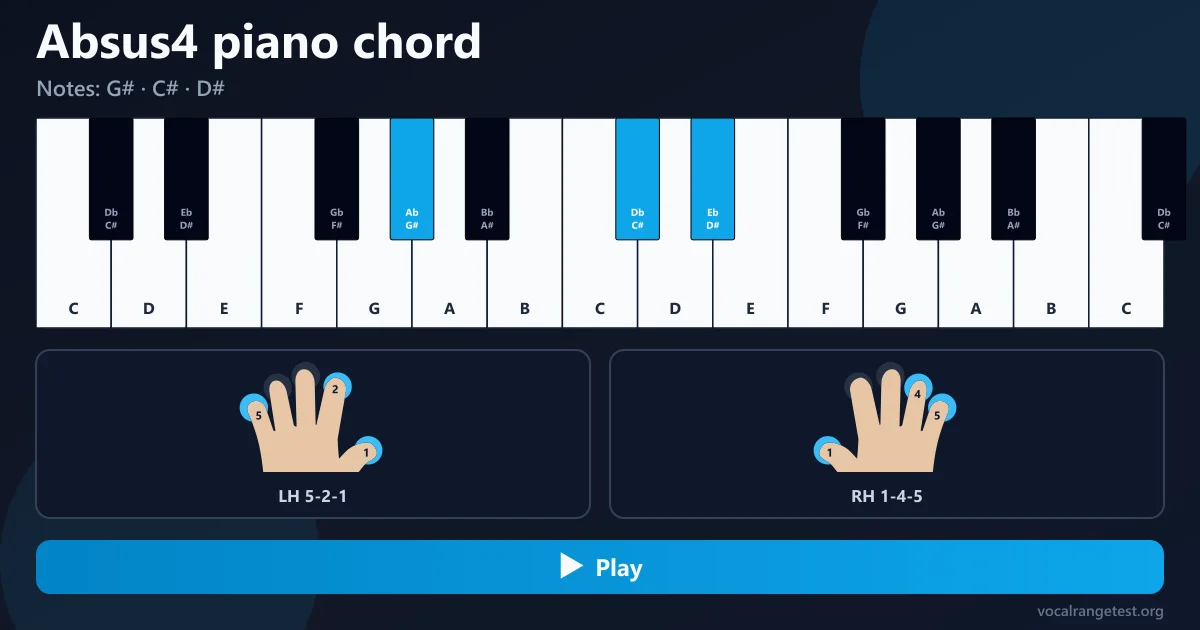
Same black-key neighborhood, two name tags
Absus4 (the everyday Ab sus 4 piano chord) is A♭–D♭–E♭. Absus2 (the Ab sus 2 piano chord) is A♭–B♭–E♭. Spell those pitches with sharps and you are looking at G#sus4 (G♯–C♯–D♯) and G#sus2 (G♯–A♯–D♯). On the keyboard the clusters feel almost entirely “black-key first”—compact, a little shaded, easy to grab once you stop treating every accidental like an emergency.
Why searchers land here under either name: a worship chart in D♭, an R&B pad in A♭, a film cue that wants tension without picking major or minor, or a guitarist’s G#sus tab that a pianist has to translate. The job is identical either way—own the unfinished middle tone, hear whether D♭ or B♭ (C♯ or A♯) is carrying the hang, then resolve when the lyric is ready. This page keeps both Absus groups audible so you are not stuck comparing mute PDFs that disagree about accidentals.
Absus / Absus4 — the default hang in flat charts
Bare Absus on a lead sheet almost always means A♭–D♭–E♭. Teachers and players treat Absus and Absus4 as the same daily color. If your page says Absus, open the Absus4 group first.
Absus2 — gentler middle, same outer frame
A♭–B♭–E♭ keeps the A♭/E♭ posts but swaps the fourth for a second. It often feels roomier and less “final cadence” than sus4. Writers who want that softness usually print the 2.
G# spelling is not a different chord
If a tab or sharp-key arrangement writes G#sus, you are still in this sound family. Match the pitches, ignore the typography war, and listen for the same unfinished pull toward A♭ major / G♯ major or the parallel minor.
Why Ab Sus Feels Like a Held Breath in Flat Keys
Without a major or minor third, Absus refuses to smile or frown on its own. Listeners often call it suspended, unfinished, or “waiting.” The feeling comes from what happens next—usually a drop into A♭ major, a turn toward F minor, or a slide into a neighboring flat-key chord—not from the grip alone.

Use cases you actually hear in songs
Producers park Absus under a pre-chorus that is not ready to land. Gospel and R&B left hands borrow it as a soft delay before A♭. Ballad intros hang here so the major third feels earned when it finally arrives. Film harmony uses it when the cue needs weight without tragedy. None of that requires reading modes first—just notice that the chord stalls the story on purpose.
- Absus4 and Absus2 in separate groups so you compare colors instead of guessing one abbreviation.
- Click to hear full chords or rising arpeggios on real piano samples.
- Fingerings for both hands that follow each voicing as you move.
- Inversions plus alternate-bass options when a walking left hand needs a new floor under a long A♭ section.
- Browser-only workflow—no install or login to audition one flat-key hang.
A Practical Path Through Ab Sus on This Diagram

1) Grab the outer frame before the middle note
Locate A♭ and E♭ (or G♯ and D♯ if you think in sharps). Those posts define the family. If they are fuzzy, no middle tone will read as Absus. Both Absus4 and Absus2 share this skeleton—secure it before you argue about D♭ versus B♭.

2) Swap only the middle board, then resolve out loud
Build the Ab sus 4 piano chord with D♭ between A♭ and E♭. Play the block, then arpeggiate so each highlighted key matches a pitch you hear. Move to the Absus2 group (A♭–B♭–E♭) and resolve both shapes into plain A♭ major. Decide which fall feels cleaner for your phrase and which feels softer—your ears beat a synonym list.

3) Change bass only after the color is trustworthy
When root position is clear, step through inversions or alternate bass on the same screen. Keep switching between chord and arpeggio modes so the new lowest note is obvious before you memorize the fingering. That hear-and-move loop is the advantage over a frozen chart that cannot prove the hang.