
Abm9/G#m9 chord
Root position: The most common shape: the lowest note is the root named in the chord, with the other chord tones stacked above it.
Notes: G# · B · D# · F# · A#
Voicing: 1 / 4
Root
Chord type
Root position & inversions
Two-hand voicing
Abm9 (G#m9) piano chord — same black-key colour, two spellings on the page
If a chart suddenly says Abm9 or G#m9 and your hands freeze, that is a fair reaction. Five notes look crowded on paper, and the sharp-versus-flat spelling makes it worse when you are already mid-rehearsal. The Abm9 (G#m9) piano chord is one sound: a minor triad, a minor seventh, and a ninth sitting a whole step above the root. In flat spelling that stack is Ab, Cb, Eb, Gb, and Bb. In sharp spelling it is G#, B, D#, F#, and A#. Same piano keys. Different ink on the lead sheet. This page exists so you can hear that stack, peel it apart, and find a grip that fits your hands instead of staring at a silent diagram.
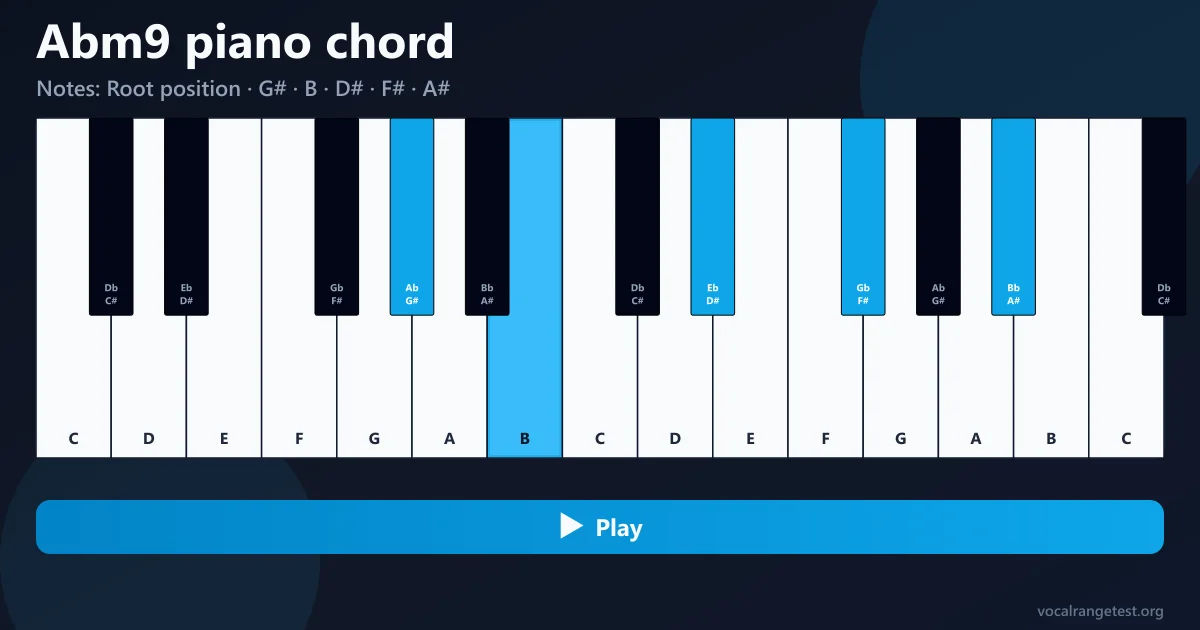
What usually blocks people on this symbol
Most of the time this is not theory homework. Someone saw Abm9 on a neo-soul pad, a ballad chart, or a jazz-leaning pop bridge and wants three practical answers: which notes, how to reach them without pain, and whether the sound in their head matches the symbol. G#m9 shows up for the same reason in keys that prefer sharps. Writers reach for this colour when plain Ab minor feels thin and Abm7 still wants a little air on top. The minor third keeps the mood soft; the seventh rounds it; the ninth lifts the top without flipping the chord into major.
We built the tool for that exact stuck moment. Static chord posters never play back, so you cannot tell if your top note is truly speaking. Pure theory blurbs rarely show a usable two-hand split. Here you can trigger the full stack as an Abm9 (G#m9) chord on piano, switch to a note-by-note breakdown, check fingering, then move through positions and inversions when the bass line needs to walk. Leave with a shape you trust, not just a symbol you recognise.
One chord, two spellings
Abm9 and G#m9 share the same pitch classes. Flat keys print Ab–Cb–Eb–Gb–Bb; sharp keys print G#–B–D#–F#–A#. If the band’s key signature leans flat, read Abm9. If it leans sharp, read G#m9. Your fingers land in the same places either way.
Hear the ninth before you stretch for it
Abm7 stops at Gb (or F#). Abm9 adds Bb (or A#). Chord mode gives the soft blend; breakdown mode isolates whether that ninth is actually audible or whether your hand quietly stopped on the seventh.
Positions when root position feels huge
Five close notes can span more than a comfortable right hand. Split the bass into the left hand, or flip to an inversion so the stretch shrinks while the minor-ninth colour stays intact.
An Abm9 (G#m9) chord on piano you can hear, take apart, and move
A printed diagram freezes one grip. This page keeps the keyboard tied to piano samples, a breakdown you can follow tone by tone, left- and right-hand fingering, plus the positions and inversions charts actually use—so practice time goes into listening and placement, not decoding a still image.

Listen first, then lock the shape
Tap once for the full soft-minor shimmer with the ninth on top. Switch to breakdown when you need to confirm Bb (or A#) is speaking, not buried under a heavy left hand. Playback follows the voicing on screen, so an inversion sounds like the notes you see rather than a generic root-position loop. That listen-and-compare loop is how a five-note symbol becomes a chord you recognise mid-song.
- Click-to-hear piano samples for this voicing
- Note-by-note breakdown (arpeggio) tied to the lit keys
- Fingering cues that update with the current voicing
- Root position, inversions, and practical two-hand splits
- Free to use in the browser—no signup wall
How to play Abm9 (G#m9) chord on piano

Start from the minor you already know
Find Ab (or G#) around middle C—or an octave lower if that feels calmer. Build the minor triad first: Ab–Cb–Eb in flats, or G#–B–D# in sharps. Those are the same three black-and-white landmarks either way. Many right hands use thumb–middle–pinky on a close triad; the left often mirrors pinky–middle–thumb. Get that triad steady before you add colour. Rushing straight to five notes is how people mash neighbours and blame the chord.

Add the seventh, then the ninth
Slide in Gb above Eb (F# above D#). That is Abm7 / G#m7—four notes, already a familiar soft-minor pad. Pause and listen. Then add the ninth: Bb a whole step above Ab, or A# a whole step above G#. That top tone is the sparkle people mean when they write m9. On a close stack you will often see Ab–Cb–Eb–Gb–Bb (or the sharp twin) climbing upward. If your hand cannot cover all five cleanly, drop the root into the left hand and keep the upper cluster in the right. The identity holds as long as the minor third, seventh, and ninth stay in play.

Use breakdown mode to catch missing notes
Arpeggio playback lights each key as the pitch climbs. Watching that order fire is one of the fastest ways to notice a skipped ninth or a doubled fifth that accidentally replaced Cb. Slow down until your broken chord matches the page. This is also where practice starts to feel musical: you hear the harmony assemble instead of only staring at a frozen block of five keys.

Sort it from the lookalikes
Abm9 is not Abadd9. Add9 usually keeps the triad and adds Bb without the seventh Gb. The m9 symbol expects that seventh in the family plus the ninth. It is also not Ab9: Ab9 is a dominant sound with C (major third), not Cb. And it is not Abmaj9, which leans on C and G. Charts sometimes get casual with labels, so when the band sounds “too bright,” check whether you accidentally raised the third. Hearing the ninth version next to Abm7 on this page usually settles the question in a few seconds.

Move the bass with inversions and positions
Root position parks Ab (G#) underneath. First inversion puts the minor third in the bass; later shapes shuffle which chord tone sits on the bottom while the Ab–Cb–Eb–Gb–Bb colour stays available. Arrangers use those moves so a left-hand line can rise or fall without rewriting the chord symbol. Select each inversion above the fold, hear chord mode for the new weight, then breakdown mode so the lowest note is obvious before you copy the grip. That is the practical answer when someone says “same colour, but walk the bass.”
Drop it into a short progression
Try holding the shape under a simple melody, then move to Dbmaj7, Ebm7, or Gb—common neighbourhoods in flat keys—or the sharp-key twins if your sheet is written in G# minor territory. Notice how Bb wants to linger or resolve. When you need the wider Ab-minor family—Abm, Abm7, Db, Eb—open the full chart tab, then come back here whenever you want the large diagram, the breakdown, and the inversion set again.