
Abm7/G#m7 chord
Root position: The most common shape: the lowest note is the root named in the chord, with the other chord tones stacked above it.
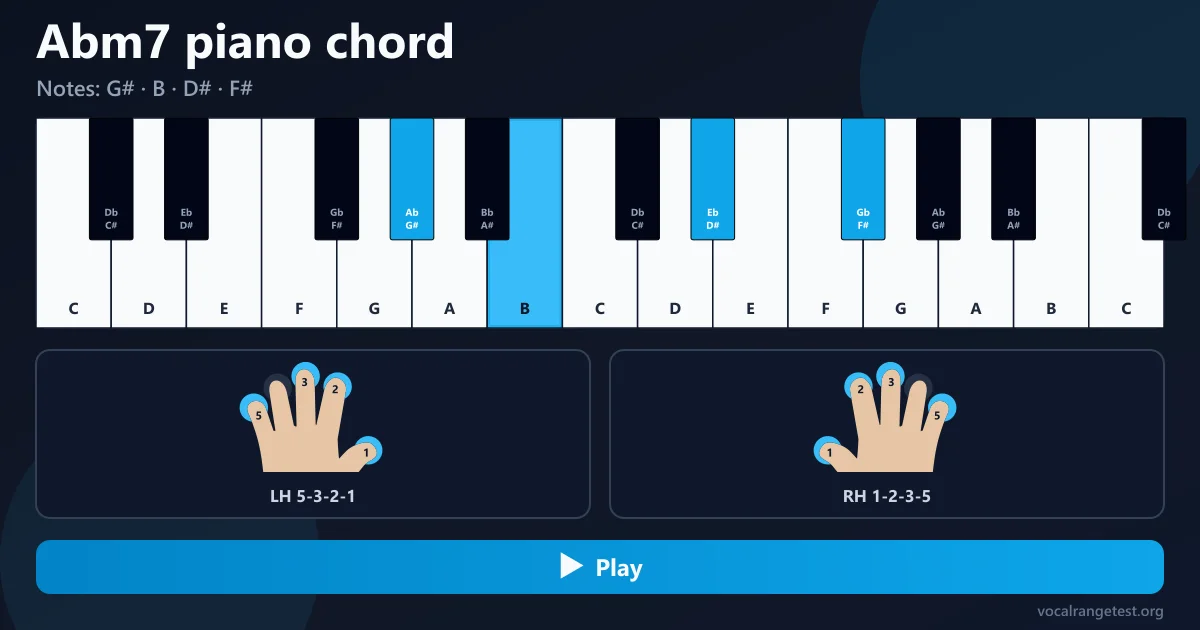
Notes: G# · B · D# · F#
Voicing: 1 / 4
Fingering
Left hand: 5-3-2-1
Right hand: 1-2-3-5
Root
Chord type
Root position & inversions
Abm7 (G#m7) piano chord — a mostly dark-key grip that guitar tabs love to spell in sharps
On paper an Abm7 (G#m7) piano chord is Ab, Cb, Eb, and Gb—or the same pitches written G#, B, D#, and F# when a sharp-key chart digs in. Under the fingers that cluster lives mostly on black keys, which is why the shape can feel thick before it feels musical. Concert and jazz sheets in flats print Abm7. Guitar tabs and sharp-side pop often print G#m7. Either label points at one cool, slightly hollow minor-seventh colour. This page lets you hear it online, peel the stack into an arpeggio, read left- and right-hand fingerings, and move the bass through inversions and alternate-bass options instead of trusting a mute screenshot from a forum thread.
When Abm7 shows up in real music—and what the colour usually does
Writers grab Abm7 when a bare Abm triad feels clamped shut. In Ab minor it often works as i7: home, but with a little air at the top from Gb. In Cb major (or its practical twin B major on many pop sheets) it appears as vi7 under vocals that need bittersweet support. In Eb major you will also meet it as iv7—a darker neighbour that still belongs in the neighbourhood. Quiet storm R&B, neo-soul pads, film underscores, and sharp-key guitar arrangements all lean on that sound. Emotionally it reads cooler and more metallic than white-key minors like Am7—more night-drive dashboard light than campfire. Not tragic opera, not cheerful major. If you are browsing key of Abm7 chords piano ideas, start with i7 and vi7 jobs; those two cover most sheets before anyone stacks 9ths on top.
Strip the jargon: root Ab, minor third Cb (often written B on piano diagrams because players recognise that white key faster), perfect fifth Eb, minor seventh Gb. The minor third sets the shade; the minor seventh is what keeps the chord from feeling finished. Drop Gb and you are back to a darker triad. Raise Cb to C and you leave minor colour entirely. Mix this grip up with Ab7 and you will hear the difference fast—Ab7 wants a bright C and a restless Gb lean toward Db, while Abm7 stays shaded with Cb/B. Hearing the full chord beside a slow breakdown on this site is the shortest path to catching whether Gb is speaking or buried in the black-key crowd. That is the real homework for Abm7 in piano practice—not memorising four letters you cannot hear.
Cb on paper often looks like B on the keys
Same pitch. Theory books love Cb inside Ab minor spelling; piano diagrams often mark B so your eye finds the white key quickly. Trust the sound either way.
G#m7 is not a different chord—it is different ink
Guitar charts in sharps print G#m7. Flat-key bands print Abm7. Learn one colour; read whichever spelling the sheet prefers.
Black keys crowd the hand—listening catches what eyes miss
Soft fingertips smear neighbours and swallow Gb. Online chord and arpeggio playback here shows whether every tone is clear before you force speed.
Tools that make Abm7 practiseable on a real keyboard
A printed grip freezes one shape. Here the diagram stays linked to piano samples, fingering updates, inversions, and slash bass so you can check the cool minor-seventh colour by ear.

Stack the chord, then isolate the soft seventh
Play the full Abm7 when you want the complete bittersweet ring. Switch to arpeggio when Gb (or F# in sharp spelling) disappears into the cluster. Playback tracks the voicing on screen, so an inversion or alternate-bass shape matches the notes you see. Finger numbers refresh for either hand as you change shapes. Hear it, break it down, confirm the hand, move the bass—that loop is what separates this page from a chart thumbnail you cannot audition.
- Block chord or arpeggio on piano samples
- Left- and right-hand fingerings that follow the voicing
- Root position plus inversions (B/Cb, Eb, or Gb/F# in the bass)
- Alternate-bass previews for unusual slash marks
- One sound for Abm7 or G#m7 spelling
How to play Abm7 chord piano

1. Find Ab, then add B (Cb), Eb, and Gb without crushing the blacks
Locate Ab—the black key between G and A near middle C. Add B (the white key) for the minor third, Eb on the black key above D, then Gb on the black key below G. Right hand often sits 1–2–3–5; left hand often 5–3–2–1. If the chord suddenly brightens, you may have hit C♮ instead of B/Cb. If it sounds like a closed minor triad, Gb never arrived. Match the page’s chord playback before you chase tempo.

2. Keep B/Cb shaded and Gb audible
B/Cb sets the minor colour; Gb is the soft open door. Aim for four even attacks. Mud usually means a fingertip is kissing a neighbour black key, or Gb is so quiet the ear only hears Abm. Compare your hand to the diagram until you hear cool air on top—not a clenched triad and not a random cluster.

3. Break the chord until Ab–B–Eb–Gb sticks in order
Arpeggio mode lights each key as the pitch climbs. Watching that order is the fastest way to stop mixing Abm7 with Abmaj7 (C and G) or Ab7 (C and Gb). If Gb always lands late, slow down until you match the lights. That is where Abm7 in piano work starts to feel like music: the seventh is part of the colour, not a bonus key you remember later.

4. Flip the bass so walking lines do not scare you
Inversion controls put B/Cb underneath for a lighter middle, Eb underneath for an open floor, or Gb/F# underneath when a bass line walks through the seventh. Listen in both block and arpeggio modes so the new lowest note is obvious. Slash labels are still one Abm7 / G#m7 harmony—same pitch classes, different weight at the bottom.

5. Preview alternate bass when the chart gets weird
Some sheets keep the minor-seventh colour on top while the bass wanders outside the usual inversion set. Use the alternate-bass options until your ear owns the new floor. Same upper tones, different note underneath—that is what trips players who only drilled root position from a book.
6. Park Abm7 inside a key so the colour has a job
When you work through key of Abm7 chords piano in actual progressions, try i7 holding under a vocal in Ab minor, vi7 in B/Cb major, or iv7 inside Eb. Hold the chord, then walk a short line into Db, Eb, or Gb depending on the song. Listen for why the writer wanted that soft Gb instead of a hard triad or a bright major seventh. Come back here when the next chart writes Abm7/Eb—or somehow respells the whole stack as G#m7—and you need sound, breakdown, and finger map in one place.