
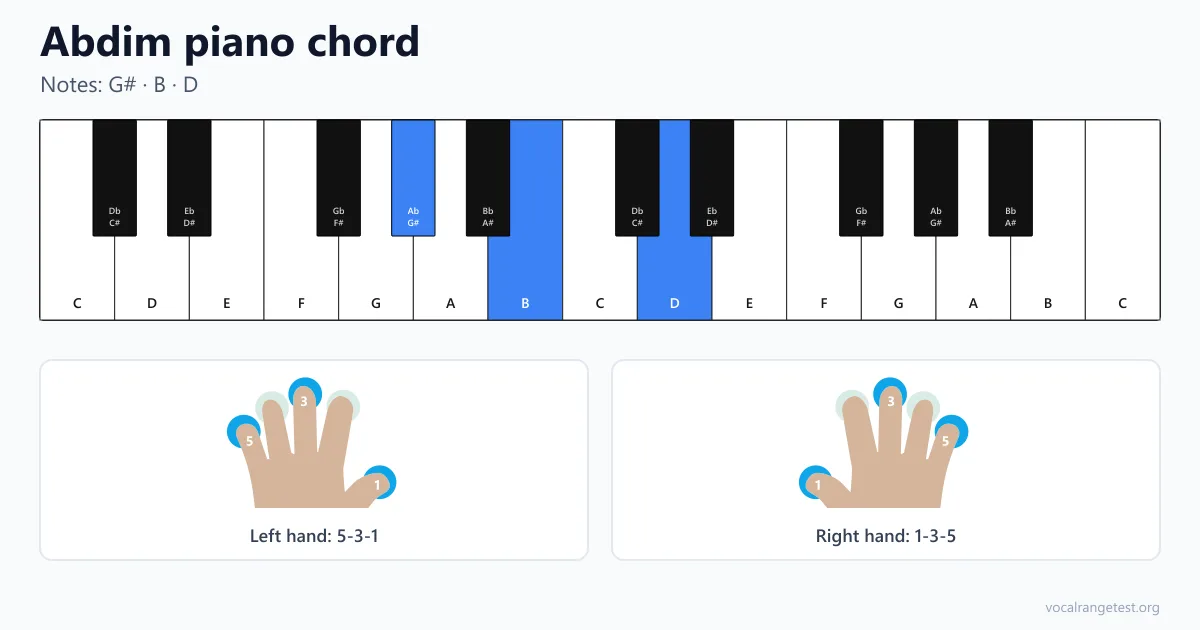
Abdim/G#dim chord
Root position: The most common shape: the lowest note is the root named in the chord, with the other chord tones stacked above it.
Notes: G# · B · D
Voicing: 1 / 3
Fingering
Left hand: 5-3-1
Right hand: 1-3-5
Root
Chord type
Root position & inversions
G#dim piano chords
Searchers often type g#dim piano chords, and charts answer with either G#dim or Abdim. On the instrument those names share one grip: G#, B, and D—two white keys stacked above a black-key root, each step a minor third. Compared with G# minor (G#–B–D#), the fifth drops from D# to D. That half-step is the whole personality shift: the minor can linger as a mood color, while the diminished version feels unfinished and leans hard toward the next chord.
Why G#dim keeps showing up next to A major
If you live in A major songs—pop ballads, worship keys, guitar charts capo’d to sound in A—you have almost certainly played this triad without stopping to name it. In A major, G#dim is the leading-tone chord (vii°). G# wants to rise into A, B is shared with the tonic triad, and D scrapes against the bright A–C#–E sound until you resolve. Left-hand patterns sometimes outline G#–B–D for a beat before planting on A; hymn-style cadences and school arrangements do the same move in slower motion. In F# minor, the identical pitch set often appears as ii°, a darker neighbor that slides toward C# or F#m. Flat-key books may print an a flat dim piano chord instead; you still press G#, B, and D (or their enharmonic spellings on the page).
Players reach for G#dim when a progression needs a short, pointed tilt—not a long horror-movie drone. Think of a pre-chorus that tightens for half a bar, a turnaround that refuses to sit on A too early, or a film cue that raises one eyebrow before the melody lands. It is not “happy,” and it is not the same sadness as G# minor; it behaves more like a musical hinge. Chart says G#° or G#dim? Play G#–B–D. Prefer shapes over theory? Plant on the black key between G and A, skip to B, skip to D, listen for the hollow scrape of the tritone from G# down to D (or up to D), then let it go somewhere stable.
One grip, three bass options
Root position stacks G#–B–D. First inversion starts on B (B–D–G#). Second inversion starts on D (D–G#–B). Changing the bass changes how strongly the ear expects A major—or F# minor—next.
G#dim is not G#m, and it is not G#dim7 yet
G# minor keeps a perfect fifth (D#). G#dim lowers that fifth to D. G#dim7 adds another minor third above D (usually F or E# spelling), which thickens the classic “full diminished” color. If a pop chart only writes dim, start with the triad on this page.
Naming fights: G#dim vs Abdim
Sharp-key music usually prefers G#dim. Flat-key pages lean Abdim. People also search g sharp dim chord piano and a flat dim piano chord for the same three keys. Pick the spelling that matches the key signature and the voice-leading on the staff; the piano does not care which label you typed into Google.
Hear G#dim, then take the triad apart
Static chord charts stop at a picture. This page lets you audition the sonority, split it into single tones, and flip inversions with finger numbers—so what you see matches what you hear before you touch a real piano.

Online block and arpeggio playback
Fire G#–B–D together or hear them in order. That split view is the fastest way to catch yourself when you accidentally keep a D# from G# minor in the mix.
How to play G#dim piano chord

1. Map the three keys first
Find G# (black key between G and A), then B, then D. Keep the spacing even—minor thirds all the way. Strike softly at first; this triad gets harsh quickly if you dig into the keys.

2. Match the online sound before you memorize dots
Use the player above for the full chord, then the arpeggio. Copy that color on your instrument. If your version feels brighter or “minor-ish,” you probably still have D# hanging around instead of D.

3. Practice the resolve, not only the shape
Play G#dim into A major or F# minor. Then try the B-bass inversion into A/C#, or the D-bass form into A. Training the landing teaches your hands why the chord exists.