
Cm7 chord
Root position: The most common shape: the lowest note is the root named in the chord, with the other chord tones stacked above it.
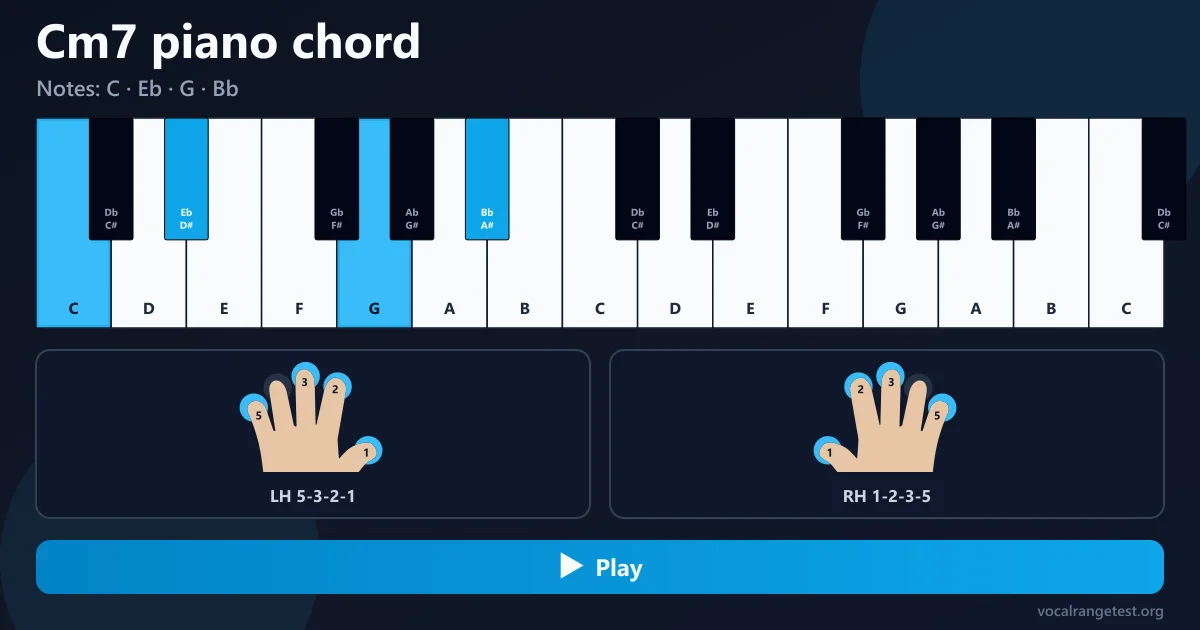
Notes: C · Eb · G · Bb
Voicing: 1 / 7
Fingering
Left hand: 5-3-2-1
Right hand: 1-2-3-5
Root
Chord type
Root position & inversions
Alternate bass
Cm7 chord piano — four tones, one flat seventh, and a colour that wants to keep moving
Cm7 is the C minor triad with Bb stacked on top: C, Eb, G, and Bb. That last pitch is the whole reason players bother naming the chord “m7” instead of plain Cm. Without Bb, the stack sits. With Bb, it leans — soft, a little unfinished, useful under vocals that are not ready to land on a bright major yet. This page is a single-chord workbench for that stack: hear the full voicing, break it into an arpeggio so each tone lights in order, check left- and right-hand fingering, then move through inversions and alternate bass the way real charts actually write the harmony.
Where Cm7 shows up — and what key of cm7 chords piano players usually mean
Writers reach for Cm7 when a bare C minor triad feels too locked. The Bb opens a little space above the triad and nudges the harmony forward instead of parking it. In C minor, Cm7 often works as i7: still home, but warmer and less clenched than three-note Cm. In Eb major it shows up as vi7 under lines that want bittersweet support without tipping into full tragedy. In Bb major it is the classic ii7 — the chord that walks toward Eb7 or F7 and then home. Ab major treats it as iii7. Outside strict Roman-numeral jobs you will also see it as a borrowed colour inside C major bridges, as a pad under R&B vocals, or as the left-hand colour in neo-soul grooves where the right hand frets a melody on top. When people search key of cm7 chords piano ideas, they are usually hunting that neighbourhood: i7, vi7, and ii7 roles around C minor / Eb / Bb, not a literal “key of Cm7” on a theory exam.
Emotionally Cm7 tends to read as dusk with the door still open — minor, yes, but not automatically mournful. Compared with Cm it feels softer and more conversational. Compared with C7 it stays minor (Eb, not E), so it does not pull toward F the way a dominant seventh does. Compared with Cmaj7 it keeps the flat third and flat seventh, so the glow stays shaded rather than glassy. Theory-wise you are stacking root, minor third, perfect fifth, and minor seventh. The interval C–Eb decides the minor quality; G steadies the stack; Bb is the colour note that turns a closed triad into something that wants the next bar. On this site the diagram is tied to real piano samples, so you can prove that Bb by ear before you force a four-note stretch at the bench.
Bb is the job description
C, Eb, and G already spell Cm. Bb is what makes the label Cm7 mean something. Hear the stacked chord once, then arpeggiate until that top flat seventh is as clear as the root — that is the difference between guessing from a screenshot and recognising the sound mid-song.
Same chord name, moving bass
Lead sheets rarely freeze you in root position. Cm7/Eb, Cm7/G, and Cm7/Bb keep the same four chord tones with a new lowest note. Alternate bass marks such as Cm7/Ab or Cm7/F show up when the line walks under a held colour. Preview those shapes here before a rehearsal throws the slash at you cold.
Built to listen, not just label
Static chord posters stop at a mute picture. Here you can click to hear cm7 in piano chord or arpeggio mode, flip left/right fingering, and step through inversions and alternate bass on one page — so practice time goes into your ear and hand, not into decoding a frozen grid.
What this Cm7 page does that a static chart cannot
One chord, real samples, and the voicings charts actually print — so you learn the sound, not just the spelling.

Hear the full stack, then pull it apart
Chord mode plays C–Eb–G–Bb together so the minor-seventh colour is unmistakable. Arpeggio mode walks the tones in order while keys light — useful when Bb still feels optional instead of part of the chord’s identity. That listen-and-split loop is the practical edge over a screenshot you cannot audition.
How to play Cm7 chord piano on this page

1. Hear root position before you stretch
Open the diagram on Cm7 (C–Eb–G–Bb). Play the full chord once so the minor seventh colour lands in your ear. Then switch to arpeggio and listen for Bb against the triad — if that note disappears in the mix, slow the broken pattern until each lit key matches a pitch you can name.

2. Check fingering, then try the inversions
Toggle left- and right-hand fingering and find a grip that does not force your wrist. Move to Cm7/Eb, Cm7/G, and Cm7/Bb and notice how the same four letters change gravity when a different tone sits underneath. That is how learning the chord stops meaning one frozen shape and starts meaning a family of usable voicings.

3. Preview alternate bass the chart might print
Step into slash options such as Cm7/Ab, Cm7/F, or Cm7/D when you want to hear how a walking bass changes the floor under an unchanged upper colour. Use those auditions as a rehearsal shortcut: when the sheet suddenly shows a slash, you have already heard what the low note does to the stack.