
C9 chord
Root position: The most common shape: the lowest note is the root named in the chord, with the other chord tones stacked above it.
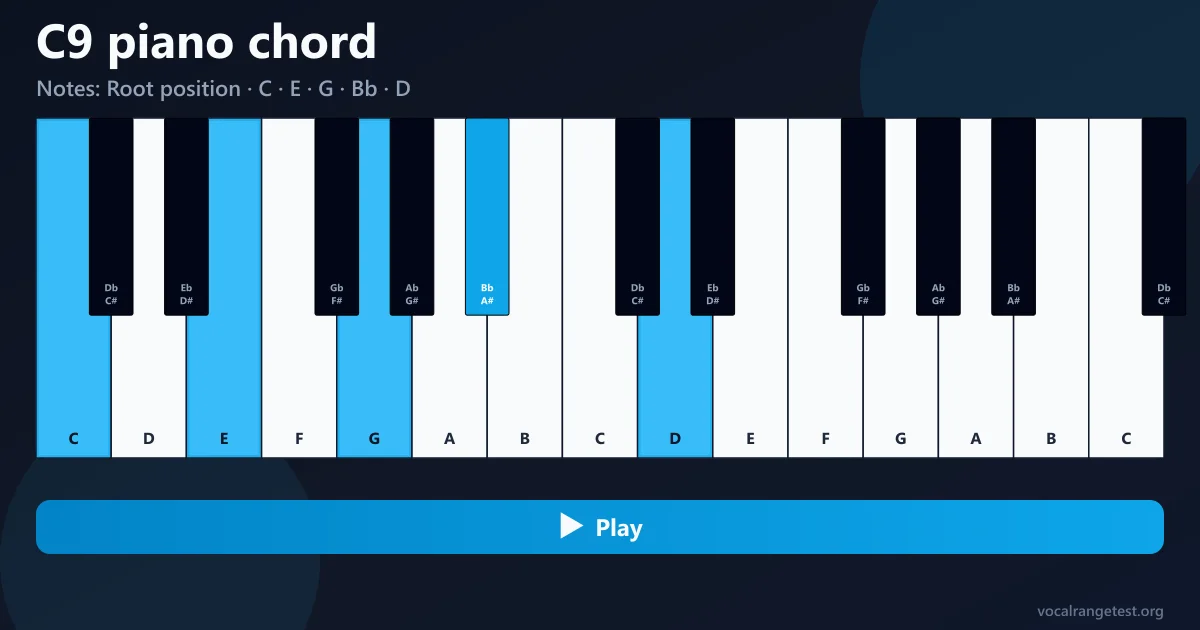
Notes: C · E · G · Bb · D
Voicing: 1 / 4
Root
Chord type
Root position & inversions
Two-hand voicing
C9 chord piano — C7 with the lid left open
The symbol C9 shows up on funk charts, soul lead sheets, and guitar tabs long before most keyboard players have a five-note grip ready. Under the name you still have a dominant seventh — C, E, G, and B♭ — with D stacked above as the ninth. That one extra tone stretches the chord without changing its usual job in F major or in a blues turnaround: push toward F, or sit on a I7 that feels less boxed-in than plain C7. This page stays on that sound only. Listen blocked or broken into an arpeggio, check fingerings, and move between root position, the chart-friendly C9/Bb inversion, and a two-hand spread that most comping parts actually use.
What is a C9 chord on piano?
C9 is a dominant ninth built on C: the four notes of C7 plus D on top. The B♭ is what keeps it dominant — swap it for B natural and you are in a different chord family entirely. The D is what makes arrangers write C9 instead of C7 when they want warmth and width without losing forward motion. If C7 is already in your hands, you are one white key away from the full symbol. If your vocabulary stops at triads, the first real work is owning B♭ in the left hand while the right hand finds D without knocking the third or seventh out of tune.
Cadd9 looks similar on paper but skips the B♭ — pop-sweet, not dominant. Cmaj9 swaps B♭ for B♮ — pastel major-ninth colour. C7 drops the D and sounds leaner. On a keyboard those swaps are often a single key, which is why a static diagram fails: you cannot tell from a picture whether B♭ spoke or you hit B by habit, or whether the ninth is missing. Sampled piano and stepwise arpeggio playback are here so your ear signs off before your hand copies the wrong screenshot.
B♭ is the line between C9 and «almost C9»
Block mode lets you compare C9 against C7 and Cmaj9 in one click. Arpeggio mode is the fastest way to catch B natural creeping in, or a D that never quite rings — the two mistakes that make a chart symbol lie.
Root, C9/Bb, and a comping-friendly two-hand shape
Root position answers «what are the five notes.» C9/Bb matches slash charts where the flat seventh sits in the bass. The two-hand layout — left C and G, right B♭, D, and E — spreads the chord so mid-range mud is less likely in soul and jazz comping.
Fingerings track the layout you select
Switch voicing and the hand diagrams update. On the two-hand spread, arpeggio highlights run low to high — left hand first, then right — matching pitch order, not both thumbs on beat one.
A C9 page you can hear — not just look at
Note names on a JPEG do not tell you if B♭ landed or if the top D is speaking. Here you trigger block chord or arpeggio on sampled piano, flip voicings, and read left- and right-hand finger numbers — the same interactive stack across our chord pages because guessing from pictures burns practice time.

One keyboard for stacked chord and arpeggio
Tap for the full C9 wash in whatever voicing is selected. Flip to arpeggio when B♭ bleeds to B natural, when D is buried under a loud C, or when muscle memory still shapes C7 without the ninth. Keys light in play order; on the two-hand layout, finger highlights march from the bass notes through the right-hand cluster in the sequence you would actually play.
- Sampled piano — block or arpeggio, free in the browser
- Root, C9/Bb, and a practical two-hand voicing
- Left- and right-hand fingerings that follow the voicing
- Thumbnail grid to audition shapes before you commit
- Five pitch classes: C, E, G, B♭, and D
How to play C9 chord on piano

1. Name the five tones — C, E, G, B♭, D
Run the arpeggio on this page and say each name once. B♭ is the black key between A and B; it is not optional for a dominant ninth. D sits a whole step above C in the stack — the ninth the symbol promises. Guitar players: do not paste a six-string grip literally; the piano wants its own spacing. Middle C is a fair home for the right-hand cluster until you move bass notes to the left.

2. Try the two-hand voicing before you cram one hand
Left hand C and G (root and fifth). Right hand B♭, D, and E (seventh, ninth, third). That open spacing is what funk and soul keyboard players use when five keys in one fist would turn the mid range to mud. Follow the page fingering — typically left 5–1, right 1–2–3 — and run arpeggio slowly once: bass notes first, then the right-hand cluster.

3. Root position when theory asks for the full stack
The diagram runs C up through D — useful for homework and for hearing how the ninth floats above the seventh. Few players sustain that thick block on a gig, but it is the reference when someone asks what is inside the chord. Train your ear here; take songs to C9/Bb or the two-hand layout.

4. C9/Bb when the flat seventh belongs in the bass
B♭ on the bottom with C, D, E, and G above — common when a bass line or inner voice sits on the seventh while the harmony still reads C9. Select it in the voicing grid, listen block and arpeggio, and notice the slightly darker floor while D still hangs on top.

5. Where C9 replaces C7 in real tunes
In F major, C9 often colours the V chord heading home to F — same function as C7, wider top. Funk verses and neo-soul pads use it when C7 feels too blunt. Loop a passage you know, swap C7 for C9 for a few bars, and listen: does D add air or clutter? If it clutters, thin the voicing — the two-hand layout usually fixes that — or drop the root in the right hand when bass covers it.
6. When the chart shows a new slash, match it here first
Lead sheets jump between root, C9/Bb, and spread voicings bar to bar. Pick the closest layout on this page, run arpeggio once, and let your ear veto what your eyes assumed. That is what the playback is for — not decoration on a diagram export.