
C chord
Root position: The most common shape: the lowest note is the root named in the chord, with the other chord tones stacked above it.
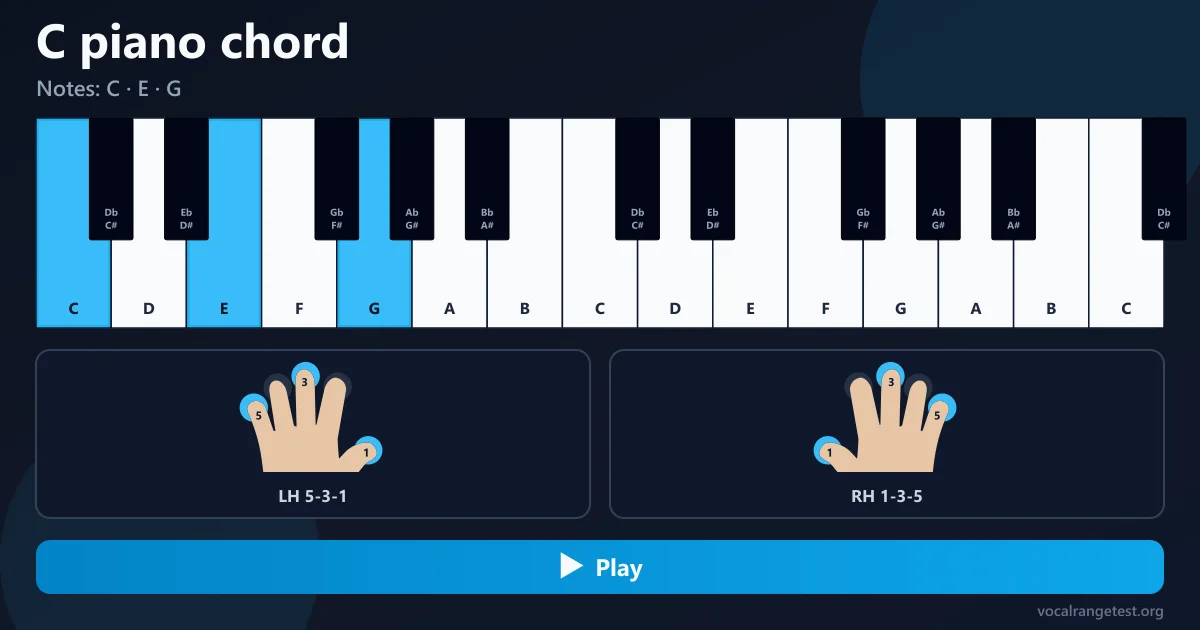
Notes: C · E · G
Voicing: 1 / 6
Fingering
Left hand: 5-3-1
Right hand: 1-3-5
Root
Chord type
Root position & inversions
Alternate bass
C major chord piano — the triad most players learn first
If you have ever sat at a keyboard and wondered where to put your fingers for a plain C chord, you are in the right place. C major is three notes—C, E, and G—and on the piano they fall on white keys in a shape that feels natural for small hands and adult hands alike. This page is built around that one chord: a large diagram, left- and right-hand fingering, and sound you can trigger without leaving the page.
Why C major still matters once you know the notes
Method books open with C major for a reason. There are no black keys to negotiate in root position, so you can focus on hand shape, even tone, and reading the symbol “C” on a lead sheet. In the key of C, this chord is home—the I chord that songs return to after a walk to G, Am, or F. In other keys it shows up as a borrowed colour or a secondary chord, but the finger map stays the same: root, major third, perfect fifth.
What most static posters skip is the rest of the picture. Real music rarely stays in root position forever. Bass lines move, left hands take inversions, and slash chords like C/E or C/G appear in hymnals and pop charts. Above the fold on this page you can step through those voicings, hear them online, and switch between a solid chord hit and a broken (arpeggio) playback so each tone lights in order. That is the difference between memorising a picture and actually recognising the sound under your hands.
One chord, room to breathe
The keyboard here is sized for the bench, not for a poster grid. You see C major clearly before you jump out to neighbouring keys on the full chart.
Hear it, then play it
Click the diagram to check the major colour by ear. Chord mode hits all tones together; arpeggio mode walks them so you can match each blue key to a pitch.
Beyond the basic triad
Root position is only the start. Inversions and alternate-bass voicings sit on the same page, so you learn how C still sounds like C when the lowest note changes.
C major in piano practice: what this page does differently
Plenty of sites show a frozen picture of C–E–G. Here the diagram stays linked to sound, fingering, and the voicings you actually meet in songs—so practice time goes into listening and moving your hands, not guessing from a screenshot.

Listen online, then break the chord apart
Tap once for a block chord when you want the full major colour. Switch to arpeggio (broken chord) when you need to hear root, third, and fifth in order—the keys light with each note, which helps if you are still connecting letter names to pitches. The same playback follows you when you change voicing: an inversion or slash shape plays the notes you see, not a generic root-position C.
- Large keyboard diagram with C, E, and G marked in blue and labelled on the keys.
- Left- and right-hand fingering that updates with the voicing you select.
- Inversions such as C/E and C/G, with a short plain-language note on what the slash means.
- Alternate-bass shapes (C/B, C/A, C/Bb) for the bass lines you see in real charts.
- Chord or arpeggio playback timed to the diagram and fingertip highlights.
- One-click jump to the full piano chords chart when you need every key in one view.
How to play C chord piano — a practical path

1. Find a comfortable C
Start near middle C if that fits your reach; smaller hands can take a C an octave lower. Put the thumb of the right hand on that C (or the pinky of the left hand if you are voicing the chord in the bass). The diagram labels white keys so you are not hunting for letter names while you settle the hand.

2. Stack E and G in the same octave
Skip one white key between C and E, then play G above that. In root position the usual right-hand set is 1–3–5; left hand often uses 5–3–1. Aim for three even tones—no neighbour keys caught under lazy fingers. When it feels stable, click the diagram in chord mode and compare your sound to the reference.

3. Hear the chord as an arpeggio
Switch to arpeggio and tap again. Watching each key light while the pitch rises (C, then E, then G) is one of the fastest ways to lock the shape into memory. If a finger lands late in your own playing, slow down until the broken chord matches what you hear on the page.

4. Try inversions: C/E and C/G
Use the voicing controls to move into first and second inversion. A C/E chord on piano keeps the same three tones but puts E in the bass; C/G puts G underneath. Both still read as C major—they simply smooth bass motion when you move between chords. Listen in both chord and arpeggio modes so the new lowest note is obvious.

5. Meet alternate bass: C/B, C/A, C/Bb
Slash chords with a note outside the triad (C/B, C/A, C/Bb) show up in pop ballads and worship charts when the bass walks while the right hand holds C major. On this page those shapes include the extra bass tone in the diagram and in the audio, so you hear four pitches instead of three. Play them after the plain inversions so you can tell “same chord, new bass” from “new chord quality.”
6. Place C inside the key of C
When you are ready for neighbours, open the full chart tab and stay on the C row: major beside minor, then the sevenths. Practising key of C chords on piano this way—C, Dm, Em, F, G, Am—keeps one tonal centre while you expand vocabulary. Come back to this single-chord page whenever you want the larger diagram and the inversion set again.