
Cdim chord
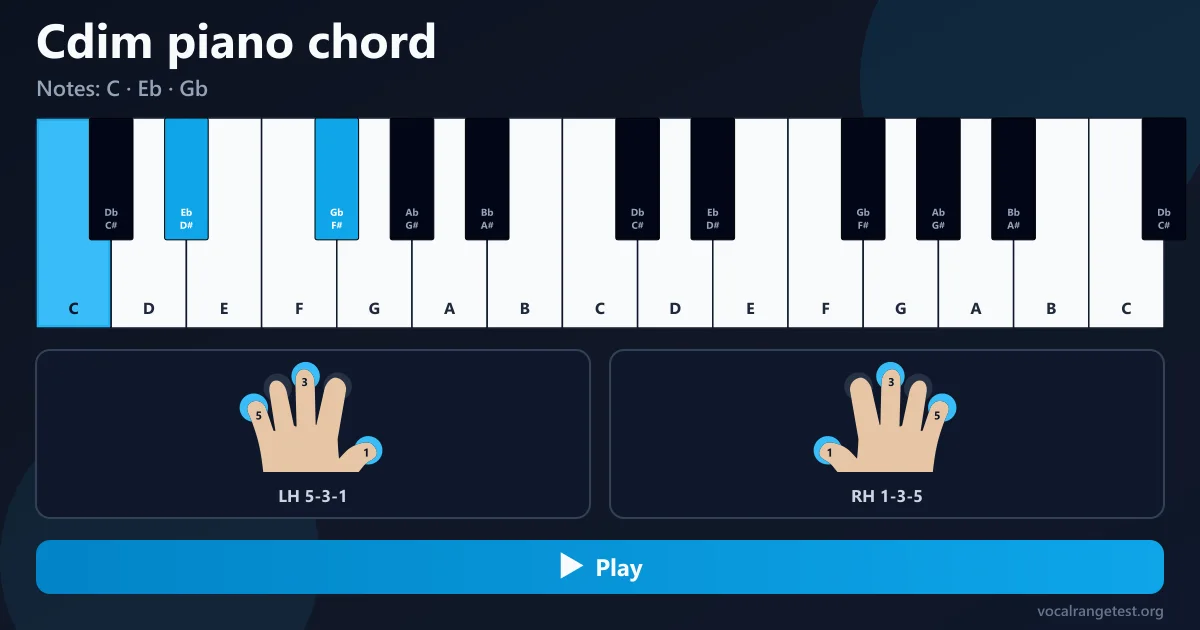
Root position: The most common shape: the lowest note is the root named in the chord, with the other chord tones stacked above it.
Notes: C · Eb · Gb
Voicing: 1 / 3
Fingering
Left hand: 5-3-1
Right hand: 1-3-5
Root
Chord type
Root position & inversions
Cdim chord piano — three notes that refuse to settle
Cdim is a small chord with a sharp edge. On the keyboard it is just C, E♭, and G♭, but that stack of minor thirds pulls against itself. This page is built so you can hear that pull, not just memorize a diagram.
What is a Cdim chord on piano?
A Cdim chord (also written C°, Co, or C diminished) is a triad: root, minor third, diminished fifth. From C you count three half steps up to E♭, then another three half steps to G♭. The outer span is six half steps — a tritone — which is why the c dim piano chord feels unfinished. Your ear expects it to lean somewhere else, often toward a nearby major or minor chord, or into a dominant that finally resolves.
Sheets sometimes spell the same keys as C–D♯–F♯. Both spellings light the same three keys; the E♭–G♭ spelling is the one most teachers use when the chord is labeled Cdim. Do not confuse the plain triad with Cdim7, which adds a fourth note (often written A, or B♭♭ in strict theory). The triad is already tense. The diminished seventh piles on more symmetry and a thicker crunch. Up top you can play Cdim as a block or as an arpeggio, then flip through Cdim/E♭ and Cdim/G♭ so the bass note — not only the top shape — matches what your chart asks for.
Built from equal steps
Every interval in Cdim is a minor third. That even spacing is why the shape can slide and still sound “diminished,” and why bass choices matter so much when you invert it.
Usually a traveler, not a home
Songwriters rarely park on Cdim for a whole verse. It shows up as a bridge between stabler chords, a short scare in a soundtrack, or a classical lead-in that wants the next downbeat.
Listen before you drill
Finger numbers help, but only after you know the color. Play the full hit, then the broken line, so you can tell Cdim apart from Cm or C major by ear alone.
Why this Cdim page is built for practice, not posters
Static charts freeze one grip. Here the same chord can ring as a block, spill note by note, show both hands’ fingerings, and move through inversions and slash-bass shapes you actually see in lead sheets.

Hear the grit, then take it apart
Hit chord mode to feel the full C–E♭–G♭ clash at once. Switch to arpeggio when you need to hear which tone is carrying the tension — often the G♭ against C — before you put it under a melody.
- Real piano samples for Cdim in root position and common inversions
- Left-hand and right-hand fingering suggestions that update with each voicing
- Alternate bass / slash labels such as Cdim/E♭ and Cdim/G♭ when the chart writes them
- Root and quality pickers so you can hop to related chords without leaving the tool
- Free in the browser — no account, no download to start listening
A practical way to learn Cdim on this keyboard

1. Lock the three keys by ear
Play Cdim as a chord first. Then run the arpeggio slowly: C, E♭, G♭. Say the note names out loud once. That tiny habit stops you from grabbing a B♮ by accident when you rush.

2. Match the bass your chart shows
If the music says Cdim/E♭ or Cdim/G♭, step to that inversion instead of forcing root position. The upper color stays diminished; the lowest note is what the band hears as the floor.

3. Place it next to a stable chord
After you can find Cdim cold, play C major or C minor, then Cdim, then back. Or try B♭ major → Cdim → C minor. Hearing the lean into or out of the triad teaches you more than drilling the shape in silence.