
Cm chord
Root position: The most common shape: the lowest note is the root named in the chord, with the other chord tones stacked above it.
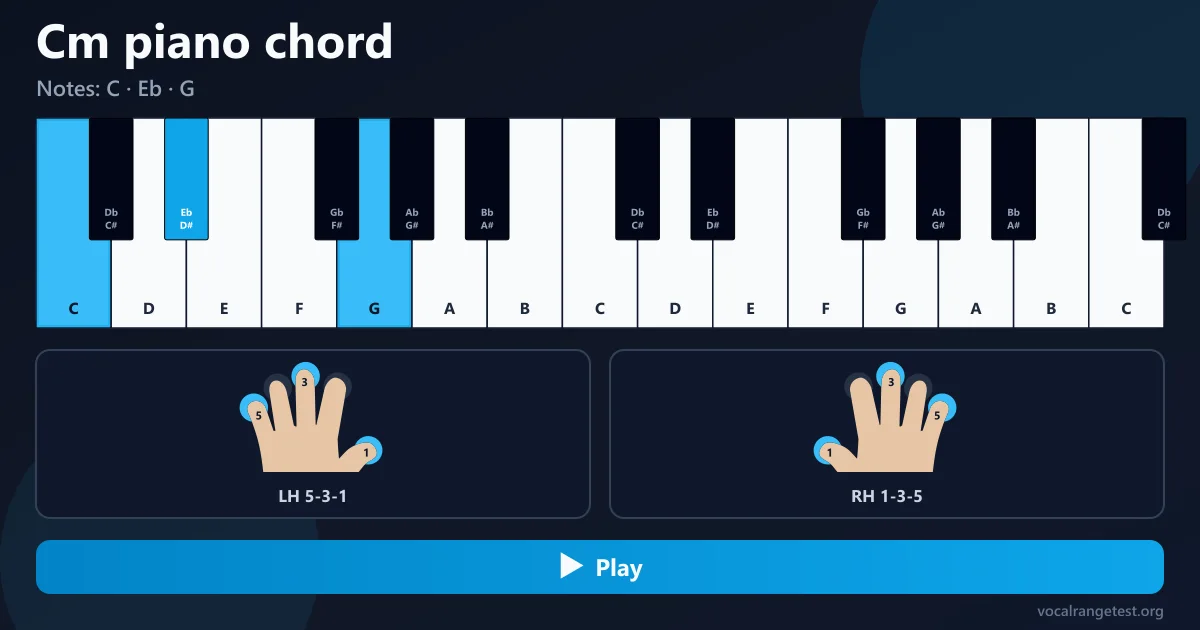
Notes: C · Eb · G
Voicing: 1 / 6
Fingering
Left hand: 5-3-1
Right hand: 1-3-5
Root
Chord type
Root position & inversions
Alternate bass
C minor chord piano — three notes, one flat, a colour that sits under half the ballads you already know
C minor chord piano work starts with a deceptively small shape: C, Eb, and G. Two white keys and one black key. The black key is the whole plot. Leave Eb out or bump it up to E natural and the chord flips into C major before your ear finishes the bar. That is why so many players who “know” C still stumble on Cm in piano practice—they are not fighting a wide stretch; they are fighting one half-step of honesty. This page is built around that single triad so you can hear it online, break it into an arpeggio, check fingerings, and move through inversions and alternate bass without bouncing between random charts.
Where Cm actually shows up (and what it usually feels like)
If you are collecting key of Cm chords piano vocabulary, start with the jobs the triad actually gets hired for. In C minor itself, Cm is home—the i chord. Classical slow movements, film cues, and a surprising number of modern ballads plant the melody on that centre and stay there longer than a cheerful major key would tolerate. In Eb major, Cm is the relative minor (vi): same three flats in the key signature, different centre of gravity. Songs that open warm in Eb often slide into Cm when the lyric turns inward. In Bb major, Cm often works as ii on the way toward F or F7—a soft step rather than a full key change. You will also see it borrowed into C major for a darker bridge, or held as a pedal colour under a vocal while the bass walks. Emotionally it tends to read as quiet resolve, rainy-window focus, or “the verse before anyone smiles.” It is minor, but not automatically tragic; compared with denser jazz stacks it stays lean and singable.
Theory-wise the triad is root, minor third, perfect fifth. The minor third (C to Eb) is the interval that decides the mood. The fifth (G) steadies the stack so it does not feel hollow. When arrangers want more forward lean they write Cm7 and add Bb; when they want brightness they write C. Plain Cm is the middle ground—shade without the extra motion of a seventh. On this site the diagram is tied to real piano samples: you can hear the full chord, then split it so each tone lights in order. That listen-and-break-apart loop is the practical difference between memorising “C–Eb–G” as a label and recognising the sound when a chart suddenly asks for it mid-song.
Eb is the hinge—not decoration
C and G are easy to find. Eb is the note players rush past. If it drifts to E, you are no longer in C minor. Hear the stacked triad once, then arpeggiate until that middle tone is unmistakable.
Same letters, different bass gravity
Root-position Cm is only the starting grip. When the bass moves, the chart may still say Cm while your left hand plays Eb or G underneath. Preview those shapes here before you meet them cold in a rehearsal.
Built as a workbench, not a frozen poster
You get click-to-hear chord or arpeggio, left- and right-hand fingering, inversions, and alternate-bass options on one page—so practice time goes into listening and hand shape instead of decoding a mute screenshot.
Cm in piano practice without the poster-only problem
A still image cannot prove the minor third is speaking. Here the diagram stays linked to piano sound, fingering, inversions, and slash bass—so you can check the colour by ear, then put your hands on a shape you already trust.

Hear the chord, then take it apart
Trigger a full Cm when you want the complete quiet ring. Switch to arpeggio when you need to isolate Eb—the pitch that separates this triad from C major. Playback follows the voicing on screen, so an inversion or alternate-bass shape sounds like the notes you see, not a generic root-position loop. That is the core differentiator of these chord pages: online listening, broken-chord listening, fingerings, inversions, and alternate bass in one place.
- Online piano samples for block chord or arpeggio
- Left- and right-hand fingering that updates with the voicing
- Inversions including Cm/Eb and Cm/G
- Alternate-bass (slash) shapes when the chart puts a different note underneath
- One focused Cm page—jump to the full chart only when you need neighbours
How to play Cm chord piano

1. Plant C and G, then commit to Eb
Find a comfortable C near middle C (or an octave lower if your hands are small). Add G above it, then place Eb between them—on the black key, not the white E beside it. A common right-hand set is 1–3–5; left hand often uses 5–3–1. Do not rush the stretch. The chord is small; the accuracy of Eb is the whole assignment.

2. Match your sound to the page
Play the triad yourself, then tap the diagram in chord mode. Listen for whether Eb sits inside the colour or disappears under a heavy root. If your version suddenly sounds brighter or “major,” stop and re-check the middle finger. Soft fingertips that brush E natural are the usual culprit.

3. Break Cm into an arpeggio until the shape stops blurring
Switch to arpeggio and watch C, then Eb, then G light in order. That broken pattern is how many players finally separate Cm from C major in muscle memory. Slow down until your own broken chord matches the page. Speed is useless if the minor third is wrong.

4. Walk the bass with a Cm/Eb chord piano shape
Open the inversion controls and move into Cm/Eb—Eb in the bass, with G and C above. Charts use this when a bass line rises through the third or when a smoother middle is needed between two chords. Hear it as a block chord and as an arpeggio so the new floor note is obvious before you copy the hand.

5. Try a Cm/G chord piano grip for a lighter floor
Cm/G puts G underneath. The triad tones stay the same; the gravity changes. Second inversion often feels more open and is common when the bass wants to stay high or step down into the next harmony. Compare it side by side with root position until your ear can name the lowest note without looking at the labels.
6. Preview alternate bass, then put Cm in a real key
Some sheets keep a Cm colour in the right hand while the bass walks outside the strict inversion set. Use the alternate-bass options to preview that “same chord, new floor” feeling. Then give the triad somewhere to go: sit on i in C minor, treat Cm as vi in Eb major, or use it as ii in Bb toward F. Context is how key of Cm chords piano study sticks—isolated grips fade; progressions remember.