
Cm9 chord
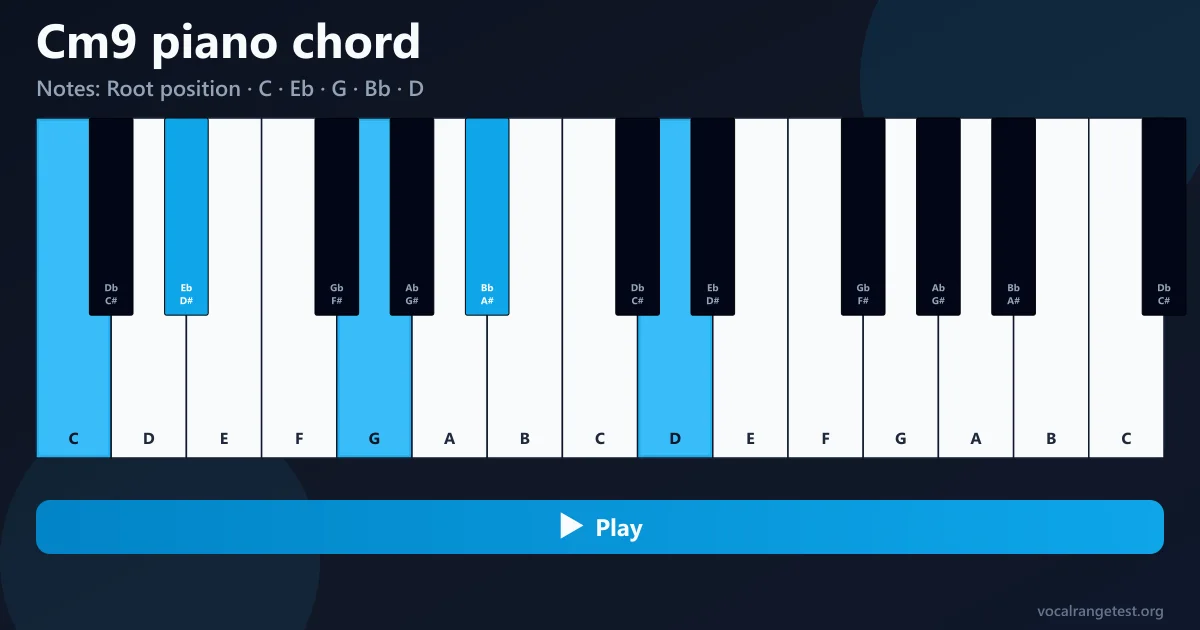
Root position: The most common shape: the lowest note is the root named in the chord, with the other chord tones stacked above it.
Notes: C · Eb · G · Bb · D
Voicing: 1 / 4
Root
Chord type
Root position & inversions
Two-hand voicing
Cm9 piano chord — five notes that turn plain C minor into something you can sit inside
Cm9 stacks a major ninth on top of a C minor seventh: C, Eb, G, Bb, and D. If Cm7 feels like a shaded room, Cm9 opens a window — still minor, still grounded by Eb, but the D on top adds air and a little sweetness that singers love to float over. Five tones is a lot for one cramped hand position, which is why most players either spread the chord across two hands or tuck notes into a tighter inversion. This page lets you hear that full colour on real piano samples, break the stack note by note in arpeggio mode, and step through root position, Cm9/Bb, and a practical two-hand layout without hunting through three different charts.
What people mean when they look up a cm9 chord on piano
Most searches land here for one of three reasons. Some players met Cm9 on a lead sheet and need the spelling before rehearsal. Others heard it in neo-soul, R&B, or a jazz ballad and want to know which extra note turned a familiar Cm7 into something richer. A third group is writing in C minor or Eb major and wonders whether Cm9 is just decoration or a chord that actually does work in a progression. The short answer on spelling: root C, minor third Eb, fifth G, minor seventh Bb, major ninth D. The short answer on use: Cm9 often functions as i9 in C minor, as vi9 in Eb major, or as a colour chord when a songwriter wants minor harmony that still breathes. It is less common than Cm7 in beginner charts, but once you start reading pop and jazz arrangements, it shows up often enough that memorising one frozen grip stops being enough.
Ear training matters more here than on a three-note triad because two extensions compete for your attention. Bb defines the seventh — without it you are back in triad territory. D defines the ninth — leave it out and most listeners still hear Cm7. Play Cm9 next to Cm7 on this page and notice how the top note changes the mood without rewriting the minor identity underneath. Play Cm9 next to Cmaj9 and the flat third and flat seventh tell you immediately why the major-ninth version sounds brighter and less weighted. That comparison is exactly what a static diagram cannot give you: the chord is not only five correct keys, it is a specific blend of weight (Eb), pull (Bb), and lift (D) that you recognise faster once you have heard it broken apart.
Why five notes push you toward voicings
Root-position Cm9 spans C through D across more than an octave on a standard keyboard diagram. Many adult hands can reach it, but not comfortably at tempo. Inversions such as Cm9/Bb cluster the same letters closer together, and the two-hand shape on this page keeps C and G under the left hand while Bb, D, and Eb sit in the right — a layout working pianists actually use when they need the sound without a wrestling match.
The ninth is D, not Db
Cm9 takes a major ninth above C, which is D natural. A flat ninth would be Db and would change the chord family entirely. If your chart says Cm9 and the top note looks like a black key next to C, double-check the key signature and the melody — but the stock symbol Cm9 almost always means D on top. Arpeggiate here once if you want that top pitch locked in before you commit muscle memory.
Made for listening first
We built this tool because chord posters taught spelling but not sequence. Click chord to hear the full Cm9 colour, switch to arpeggio to hear each tone in order, then move to the next voicing and hear how the bass note changes the floor while the harmony name stays the same. That loop — sound, then shape, then fingering — is the whole point.
What you get on this Cm9 page that a PDF chart leaves out
Real piano audio, arpeggio playback, fingerings, and multiple voicings on one screen — built for players who need the chord in their ear, not just on paper.

Play the chord or walk it note by note
Chord mode hits all five tones together so you can compare Cm9 against Cm7 in seconds. Arpeggio mode lights each key in order — C, Eb, G, Bb, D — which is the fastest way to settle arguments about whether the top note is really D and whether Bb is present in the voicing you thought you memorised. Hearing the breakdown beats staring at a screenshot when you are learning a new symbol.
How to play Cm9 chord on piano using this page

1. Lock the sound before you worry about stretch
Start on root-position Cm9 and press play in chord mode. Let C, Eb, G, Bb, and D register as one colour. Switch to arpeggio and name each pitch as it sounds — especially Bb and D, because those two extensions are what separate Cm9 from plain Cm. If you are new to ninth chords, repeat the arpeggio slowly until D feels like part of the chord identity, not an optional decoration.

2. Move to Cm9/Bb when root position feels wide
Open the next voicing slot to see Cm9/Bb: Bb, C, D, Eb, G. Same five letters, different lowest note. Play it in chord mode and notice how the bass anchors the harmony while the upper tones sit closer together. Many players use this shape when the left hand is already walking a line and the right hand needs a dense colour without jumping an octave.

3. Try the two-hand layout for gig-ready comfort
The two-hand voicing puts C and G in the left hand and Bb, D, Eb in the right — a practical cm9 piano chord grip when you need the full extension at a sensible width. Check the fingering numbers, play chord then arpeggio, and compare against root position. Pick the shape that sounds right for the song and feels repeatable at the tempo you actually play.