
Csus chord
Root position: The most common shape: the lowest note is the root named in the chord, with the other chord tones stacked above it.
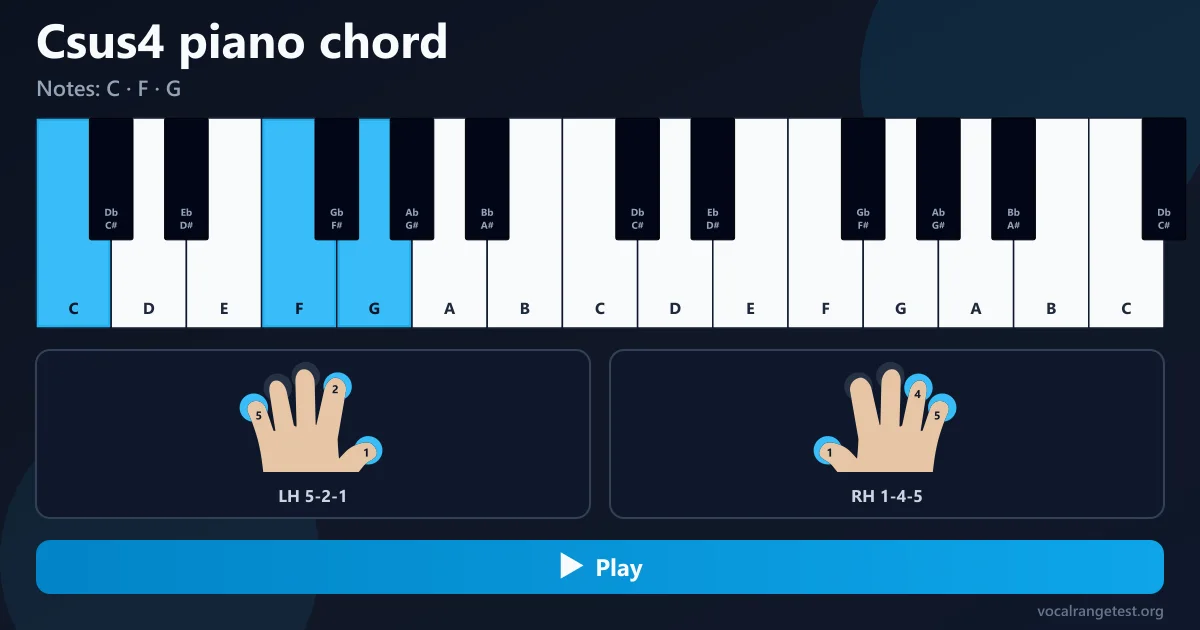
Notes: C · F · G
Voicing: 1 / 6
Fingering
Left hand: 5-2-1
Right hand: 1-4-5
Root
Chord type
Csus4
Csus2
C sus chord piano: the sound that leans forward
A C sus chord on piano is what you get when the middle note of a C triad—the third—steps aside. In its place you hear either the fourth (F) or the second (D). That swap is why the chord feels open, a little unfinished, and ready to move. Players search for it as “c sus chord piano,” “c sus in piano,” or simply Csus; on this page both everyday spellings live together so you can hear the difference without bouncing between tabs.
What “sus” actually changes under your hands
In a plain C major triad you play C, E, and G. The E is the note that tells your ear “this is major.” Pull the E out and park an F there instead, and you have Csus4—often written just as Csus in charts. Swap in a D and you have Csus2. Same root, same fifth, different middle voice. Neither chord is major or minor on its own; both sit in between, which is why songwriters drop them on held pads, pre-chorus builds, and endings that refuse to land too soon.
On paper, “key of C sus chords piano” usually means you are working in C and using that suspended color as a color wash, not as a whole new key. Worship bands, folk strummers, and bedroom producers all lean on it for the same reason: it thickens a C sound without committing to happy or sad. Hold Csus4, then release to C, and the room exhales. Hold Csus2 into C, and the release is softer, almost like a curtain lifting. This page keeps both shapes on one interactive keyboard so you can compare that release in your ears, not only in a theory book.
Csus4 — the classic hang
Notes C–F–G. When a chart says Csus without a number, this is usually what they mean. It wants F to fall to E (toward C) or rise toward something else in the progression.
Csus2 — the softer cousin
Notes C–D–G. Same idea as a “c sus 2 piano chord,” just with the second degree nestled between root and fifth. Often written C2 in lead sheets.
Hear before you memorize
Click the diagram to play the block chord, or switch to arpeggio to walk each tone. Fingerings and inversions sit under the same view so practice stays on one screen.
C sus 4 piano chord and C sus 2 piano chord on one page
Most lookups for a c sus chord piano shape only show one diagram. Here you can flip between Csus4 and Csus2, hear them side by side, then open inversions when you need a smoother left-hand bass.

Why producers and band players keep reaching for C sus
Think of a worship chorus that sits on C for eight bars, or a folk verse that needs air without changing chords every two beats. A suspended C keeps the root planted while the middle voice floats. In film cues and ambient loops, Csus2 especially reads as calm and wide—less “church hang,” more open sky. In rock and pop ballads, Csus4 into C is a stock move before a title line. None of that requires conservatory language: if the plain C chord feels too finished too early, try the sus, listen, then resolve. That habit alone unlocks a lot of songs in the key of C.
- Live piano playback for the full chord or a note-by-note arpeggio.
- Both Csus4 and Csus2 grouped so you can compare the hang, not guess from symbols.
- Left- and right-hand fingering suggestions for root position shapes.
- Inversions so you can put F or G (or D) in the bass without relearning the chord from scratch.
- Works in the browser—no app install, no account wall for a quick check at the bench.
How to play C sus chord piano on this page

1. Start with the default Csus4 shape
Find C, F, and G on the highlighted keys. Play them together in chord mode once, then switch to arpeggio so your ear locks which blue key is which. That is the everyday “c sus 4 piano chord” most charts imply when they write Csus.

2. Switch to Csus2 and resolve both ways
Use the voicing groups to open the Csus2 set (C–D–G). Play Csus2 → C, then Csus4 → C. Notice which release feels sharper and which feels softer. That tiny A/B test teaches more than a paragraph of theory.

3. Try an inversion when the bass needs to move
Root position is fine for learning. When a left-hand line wants to walk, pick an inversion so a different chord tone sits on the bottom. Same three notes, different bass story—useful when you accompany a singer who stays on C for a long stretch.