
C6 chord
Root position: The most common shape: the lowest note is the root named in the chord, with the other chord tones stacked above it.
Notes: C · E · G · A
Voicing: 1 / 4
Fingering
Left hand: 5-3-2-1
Right hand: 1-2-3-5
Root
Chord type
Root position & inversions
C6 chord piano — C, E, G, and A, the major sound that stays open instead of closing the door
A C6 chord on piano is a C major triad with one extra note parked on top of the color: A. Spell it C–E–G–A. Plain C (C–E–G) can feel like a full stop. Cmaj7 swaps in B and leans bright and modern. C6 keeps the major core, then adds A—a major sixth above C—so the harmony softens without tipping into jazz-seventh territory. If you came here searching for a C6 chord piano diagram you can hear, not just stare at, you are in the right place.
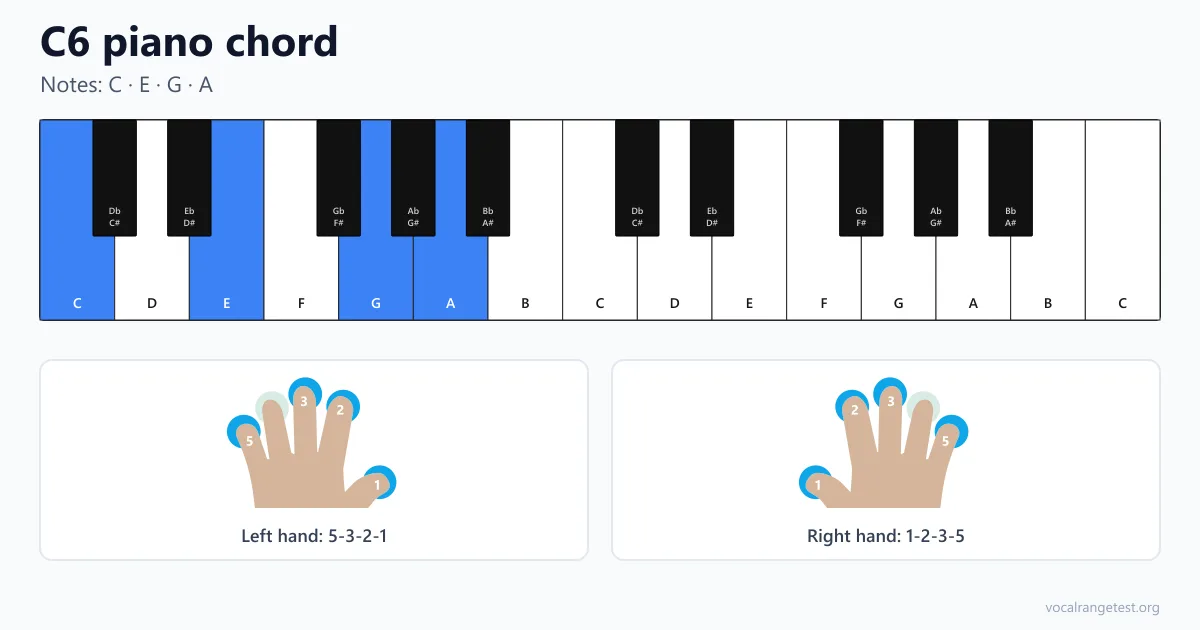
What is a C6 chord piano label hiding in those four notes?
Under the hood, C6 is four pitch classes: C (root), E (major third), G (perfect fifth), and A (major sixth). On a keyboard that usually means middle C, the E and G above it, then A. You do not need every octave of those notes—just one clear stack in a comfortable register. Many beginners first meet C6 in lead sheets for ballads, country, and soft pop, where writers want major warmth that does not punch as hard as a bare triad or sparkle as hard as a major seventh.
Here is a useful mental shortcut: the notes of C6 are the same pitch classes as Am7 (A–C–E–G), only the bass and stacking change. Root-position C6 puts C in the basement. Flip the bass to A and you are hearing something that behaves a lot like Am7. That overlap is why C6 shows up in progressions that slide between C major and A minor colors without needing a brand-new chord vocabulary. Use the tool above to hear the full stack, then arpeggiate C–E–G–A so your ear learns the interval that makes it a sixth chord—not a seventh.
Why add the A?
The sixth sits a whole step above the fifth. Against C major it reads as gentle lift—less “resolved thud,” more “room to breathe.” Songwriters reach for it when a plain C feels too blunt for the lyric.
Not the same as Cmaj7
Cmaj7 uses B, a half step under the octave. C6 uses A, a whole step under that same octave neighborhood. Mix them up on the page and the mood flips from open-sixth to major-seventh shine.
Same letters, different bass story
C–E–G–A can wear a C bass or an A bass and feel like cousins. Learning both positions on this page saves you from treating Am7 and C6 as unrelated animals.
What makes this C6 chord piano page different
Static charts show dots. This page lets you audition the harmony, peel it apart, and walk the inversions you will actually use at the bench.

Listen first, then place your fingers
Click to hear C6 as a simultaneous chord or as a broken arpeggio so you can isolate each tone. Left- and right-hand fingering guides sit next to the keys, and you can move through root position plus the common inversions—C6/E, C6/G, and C6/A—without leaving the page. That combination (live sound + note breakdown + voiced positions) is the point of this tool: learn the color by ear while your hands learn a repeatable shape.
- Play C6 as a full chord or note-by-note arpeggio
- See which keys light up and which fingers cover them
- Switch inversions (C6, C6/E, C6/G, C6/A) and compare the bass
- Free in the browser—no account, no download wall
How to play C6 chord on piano

1. Build root position: C–E–G–A
Put your right-hand thumb on C, then add E, G, and A above it (a common fingering is 1–2–3–5). Left hand can mirror lower: pinky on C, then E, G, A with 5–3–2–1 if that stretch fits your hand. Keep the wrist loose—four white keys in a row can tense beginners who clamp the fifth and sixth together.

2. Hear the sixth, not just the triad
Play C–E–G alone, then add A. That last note is the whole reason this chord exists. Use the page’s arpeggio mode so each tone speaks clearly; if A disappears under a heavy G, lighten the fifth or shift the voicing up an octave until the sixth reads.

3. Try the inversions you will see in real charts
C6/E (E in the bass) smooths stepwise motion when the bass walks through E. C6/G puts G underneath for a fifth-heavy foundation. C6/A leans toward the Am7 flavor and is handy when a chart wants major harmony with a minor-ish bass. Cycle those voicings on this page until your ear can name which note is on the bottom without looking.