
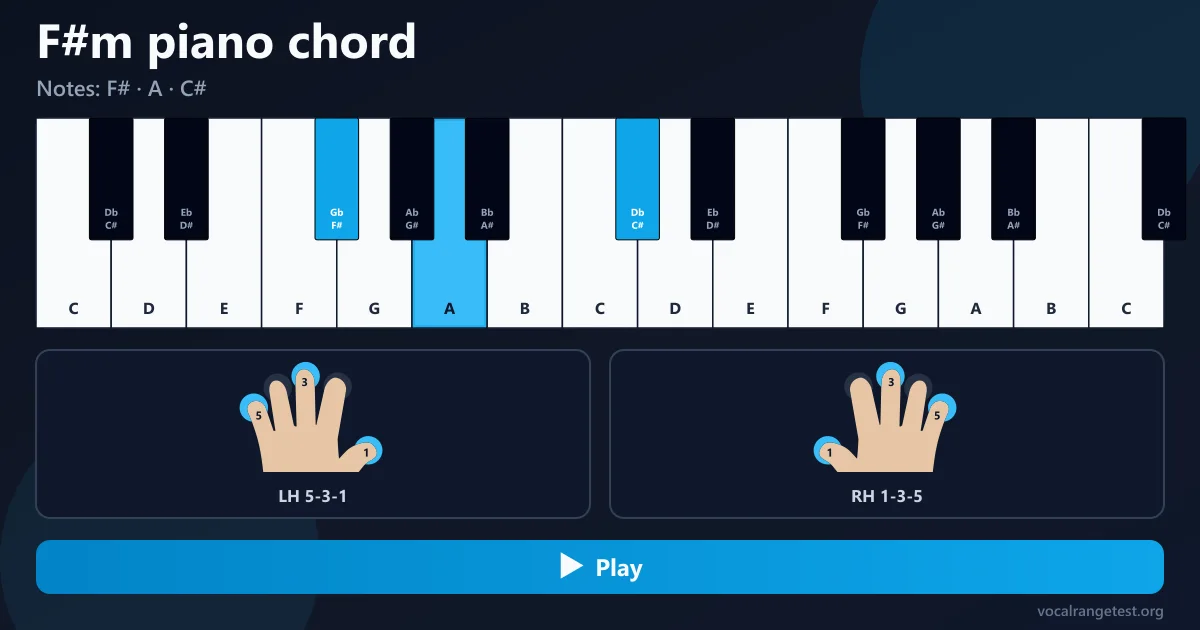
F#m/Gbm chord
Root position: The most common shape: the lowest note is the root named in the chord, with the other chord tones stacked above it.
Notes: F# · A · C#
Voicing: 1 / 6
Fingering
Left hand: 5-3-1
Right hand: 1-3-5
Root
Chord type
Root position & inversions
Alternate bass
F#m/Gbm chord piano — F♯, A, and C♯: a minor colour that sharp-key charts lean on when a major phrase needs shadow without going dark
A F#m/Gbm chord piano grip is three notes: F♯, A, and C♯. Two black keys bracket a white A in the middle — a compact shape that sits comfortably under one hand once you stop treating every black note like an emergency. Lead sheets in E major, A major, and F♯ minor print the symbol constantly; flat-key books may respell the same pitches as Gbm chord piano (G♭–B♭–D♭). The sound does not change — only the accidentals on the page do. Players who search F#m chord piano and players who search Gbm chord piano are hearing the same triad. This page stays on that one minor colour so you can audition F#m in piano context online, break the three tones into an arpeggio, read fingerings for both hands, and step through inversions and alternate-bass shapes before a sharp-key chart moves the bass under you.
Where F#m earns its keep — roles, mood, and the A natural that matters
In E major, F#m is the everyday ii chord — the minor shade that walks toward B and makes a V–I cadence feel earned. Pop hooks, film cues, and worship charts in E lean on it constantly. In A major it often appears as vi, the relative-minor colour under a melody that wants warmth without leaving the bright key. In D major it can work as iii for a softer lateral move. In F♯ minor itself it is simply i: home base, but even there arrangers still respell it Gbm when the rest of the page is drowning in flats. When someone searches key of F#m chords piano, they are usually mapping that neighbourhood — ii in E, vi in A, i in F♯ minor, plus the borrowed minor touches sharp-side writers tuck into bridges — not hunting a literal exam answer called “key of F#m.”
Emotionally the triad reads cool and inward rather than theatrical. Compared with F♯ major it drops the bright third for A natural and the harmony folds inward. Compared with F#m7 it stops before the seventh, so the colour feels simpler and more anchored — less “jazz hallway,” more direct minor statement. Compared with plain F minor in the same register it sits higher and often feels more metallic or anxious, which is why rock and pop in E use it as tension under an otherwise major sky. The theory is compact: root, minor third, perfect fifth. A is the hinge — raise it to A♯ and you are no longer in F#m territory. On this page you prove that A by ear: block chord to lock the stack, arpeggio to isolate each tone, then flip to F#m/A, F#m/C#, or alternate bass such as F#m/E and F#m/D when a chart writes a slash you have never sounded at the bench.
A natural is the whole minor identity
F♯ and C♯ frame the chord; A makes it minor. If the middle note drifts sharp, you are not playing the F#m chord piano charts asked for — you are sliding toward major or augmented colour without noticing.
F#m and Gbm are spelling twins
Guitar-friendly sharp keys keep F#m; brass and flat-key rooms often print Gbm. Match the ink to the measure so your eyes are not fighting the harmony your hands already know.
Hear the triad before you memorise a grid
Real piano samples, arpeggio breakdown, fingering that follows each voicing, inversions plus alternate bass on one diagram — you judge colour and stretch by ear instead of copying a mute poster.
What you can do on this F#m page that a static chart cannot
Three notes looks simple until a slash bass arrives mid-phrase. This diagram is wired for listening and placement, not just labelling.

Audition the minor triad, then pick it apart
Block mode stacks F♯, A, and C♯ so the minor colour lands in one gesture. Arpeggio mode walks the three tones when you need to catch a weak A or a missing C♯ — the notes casual practice most often smears. Playback follows whichever inversion or slash is on screen, so you are not stuck hearing a generic root-position loop while the chart shows F#m/C#.
How to play F#m chord piano

1. Anchor F♯, then place A and C♯ deliberately
Find F♯ on a black key near middle C. Add A on the white key a minor third above — not A♯. Add C♯ on the next black key. Right hand often uses 1–3–5; left hand often 5–3–1. If the chord suddenly brightens, check that A has not crept sharp. If it sounds hollow, confirm C♯ is present — F♯ plus A alone is incomplete, not F#m.

2. Use arpeggio until the minor third is automatic
Switch to arpeggio and let F♯, A, and C♯ speak in order. Slow down if A blurs with G♯ or if C♯ arrives late. That pass is how F#m in piano practice stops being a finger guess and becomes a colour you trust when a chart only prints the symbol above the staff.

3. Step through F#m/A and F#m/C# with both ears open
Open the inversion controls. First inversion (A in the bass) smooths many E-major walks. Second inversion (C♯ in the bass) opens the low register while the minor identity stays intact. Listen in block and arpeggio so the new floor is obvious before you copy fingering — slash chords fail in performance when the hand memorised root shape only.

4. Preview alternate bass before the chart surprises you
Try F#m/E, F#m/D, or F#m/G# when your sheet uses them. Same minor triad above, different gravity below — typical in descending bass lines and pop left-hand patterns. Fingerings update with the voicing you select, so bench time goes into the shape the arrangement demands, not a stock photo grip.

5. Place F#m inside a progression so context sticks
When you explore key of F#m chords piano in real music, loop short moves: F#m to B in E major, F#m to D in A major, F#m to C♯m in F♯ minor. Hold each change long enough to hear why writers pick this triad instead of F♯ major or F#m7. Return here for the large diagram, hear-and-break-down tools, and voicing set whenever the next lead sheet respells F#m as Gbm or drops a new slash.