
F#6/Gb6 chord
Root position: The most common shape: the lowest note is the root named in the chord, with the other chord tones stacked above it.
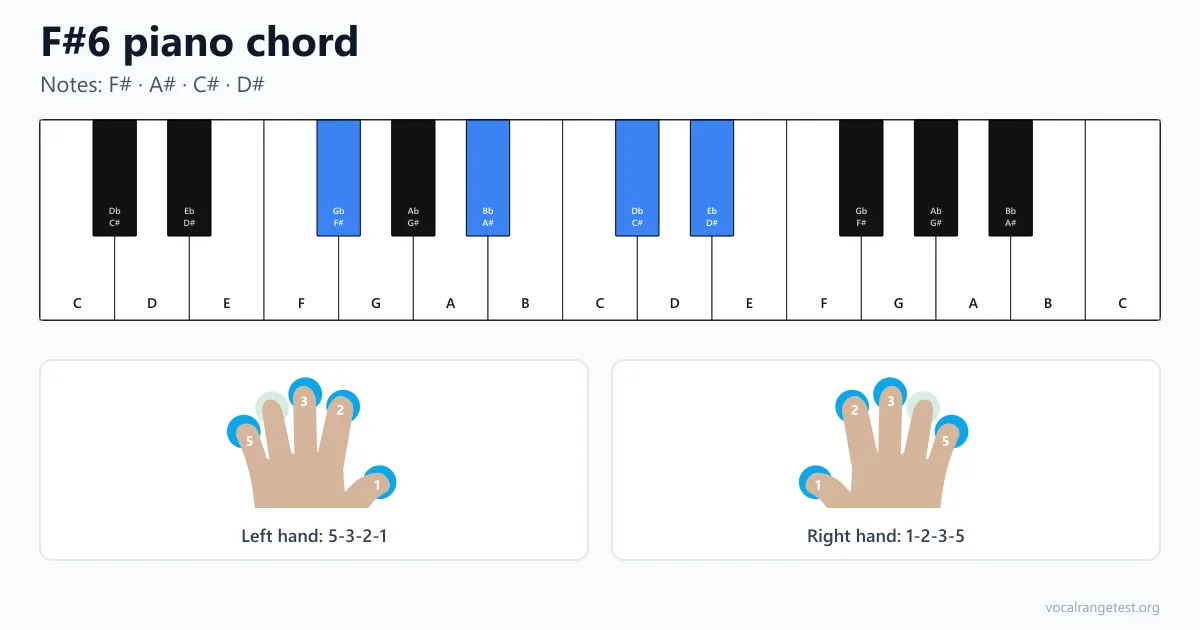
Notes: F# · A# · C# · D#
Voicing: 1 / 4
Fingering
Left hand: 5-3-2-1
Right hand: 1-2-3-5
Root
Chord type
Root position & inversions
F#6 piano chord for players who already feel F# under a capo — now hear the keyboard version before you copy it
Most F#6 piano chord searches come from people who met the symbol on a guitar chart, a worship click track, or a capo’d acoustic set — and then sat down at a keyboard wondering which black keys to mash. The grip is simple once you see it: F#, A#, C#, and D#, four neighbouring blacks that look like a small island. Flat ink calls the same island a Gb6 piano chord (Gb, Bb, Db, Eb). Searching f sharp 6 piano chord or g flat 6 chord piano lands you on that twin. What this page adds is not another mute screenshot: you can hear the F#6 chord on piano as a stack or arpeggio, check fingerings, and flip inversions so the shape earns a place under a vocal instead of guessing from tablature habits.
Why F#6 shows up on guitar-led charts — and what keyboardists usually get wrong
F# major is a favourite of guitar rooms because open-string shapes and capo moves make it friendly. When a writer wants major brightness that still leaves air for a singer, the chart often upgrades from bare F# to F#6. That sixth is D#: not “another sharp to panic about,” but the note that stops the triad sounding like a stamp. Worship pads, soft-rock bridges, and singer-songwriter outros lean on it when F#maj7 would feel too glossy for the lyric. If the band book is already drowning in flats, the same keys arrive as Gb6 so nobody rewrites the whole page into sharps mid-rehearsal. Emotionally the colour is bright and open — more “hands lifted” than “jazz club candle.” Compare it beside a plain F# triad and the triad feels square; compare it beside F#maj7 and you hear maj7 hover on a half-step rub while the sixth sits a whole step down and stays friendly.
Keyboard trap number one: treating F#6 like a barre-chord smear and crushing all four blacks with equal weight. The ear needs D# to speak, not to vanish under a heavy C#. Trap number two: confusing F#6 with F#add9. Add9 wants G# hanging above the triad; the sixth wants D#. Trap number three: seeing D#m7 on a jazz chart and assuming every F#6 “is secretly” that minor seventh. Same pitch classes, different bass job — if the lead sheet says F#6, keep F# (or Gb) as the floor unless the slash says otherwise. Use the tool above to hear the stacked grip, then the broken arpeggio, then F#6/A#, F#6/C#, and F#6/D# so left-hand motion stops being a theory worksheet.
Find the island before you name the notes
Four adjacent black keys — F#, A#, C#, D#. Guitarists used to shapes can learn the geography visually first; the names catch up once the hand already knows the cluster.
F#6 ≠ F#add9
Add9 reaches up to G#. Sixth reaches to D#. Mix them up and the pad either gets sparkly in the wrong place or loses the soft landing the chart asked for.
Hear stretch and balance, not just diagrams
Real piano samples, arpeggio split, left/right fingerings, inversions, and alternate bass — so you decide whether the island sings or clogs before rehearsal burns takes.
Turn an F#6 chord on piano into something you can audition, not just memorize
Tab culture teaches shapes; keyboard pads need balance. Here you preview the full island, peel it into an arpeggio, lock fingerings, then walk inversions and alternate bass without leaving the free page.

Balance the island: let D# speak without punching the triad
Block playback shows whether your thumb is burying the sixth. Arpeggio mode isolates D# (Eb if you are reading Gb6) so you can soft-pedal the top or open the spacing. Fingerings update when you jump to F#6/A# or F#6/C#, which matters when the guitarist’s left hand is free but yours has to cover bass motion too.
- Real piano samples: full chord or note-by-note arpeggio
- Fingerings that follow the voicing you actually selected
- Inversions F#6/A#, F#6/C#, F#6/D# for left-hand paths
- Alternate bass when the slash leaves the basic inversion set
- Gb6 spelling available as the same physical keys
How to play F#6 chord on piano

1. Lock the black-key island by eye
Ignore letter names for ten seconds. Find the group of four blacks that sit together: that is the F#6 geography. Then label them F#, A#, C#, D# (or Gb, Bb, Db, Eb). Guitar-trained players often learn faster this way than by counting intervals from a root they cannot see as clearly on white keys.

2. Weight the sixth like a vocalist’s friend
Play the triad alone, then add D#. If the top note disappears, lighten C# or raise the sixth an octave. Close-position blacks pack dense midrange energy; under a singer that density can mask consonants. The interactive arpeggio helps you hear which finger is the culprit.

3. Drill the Gb6 rename without moving your hand
Keep the same four keys down. Mentally swap to Gb–Bb–Db–Eb. Worship and pop often stay sharp; jazz and film cues may hand you Gb6 mid-set. Renaming in place beats rebuilding the chord from scratch when the MD flips the chart.

4. Practice left-hand paths: A#, C#, then D# in the bass
From root position, walk to F#6/A# for smoother motion toward B or D#m colours. F#6/C# supports a pedal-fifth feel common in pads. F#6/D# puts the sixth underneath — useful, but easy to misread as a minor-seventh vibe until the right hand restates F#. Audition each slash here before the band tempo forces a guess.

5. Stress-test against F#add9 and F#maj7
On this page, compare the F#6 sound in your ear to what you remember of add9 (G#) and maj7 (E#/F). Charts get sloppy in handwritten worship folders. If the room wants “open but not jazz,” you usually want the sixth, not the ninth or the major seventh. Confirm by listening, not by arguing over abbreviations.
6. Place it in a set-list job, not only a scale worksheet
As tonic colour in F# or Gb major; as a lifted IV when the song centres on C#/Db; as a soft V-area cushion in B major when a hard dominant would stomp the chorus. Loop a short progression from your Sunday or gig list and swap plain F# for F#6 — if the vocal smiles, keep it; if the groove gets muddy, thin the voicing or invert.