
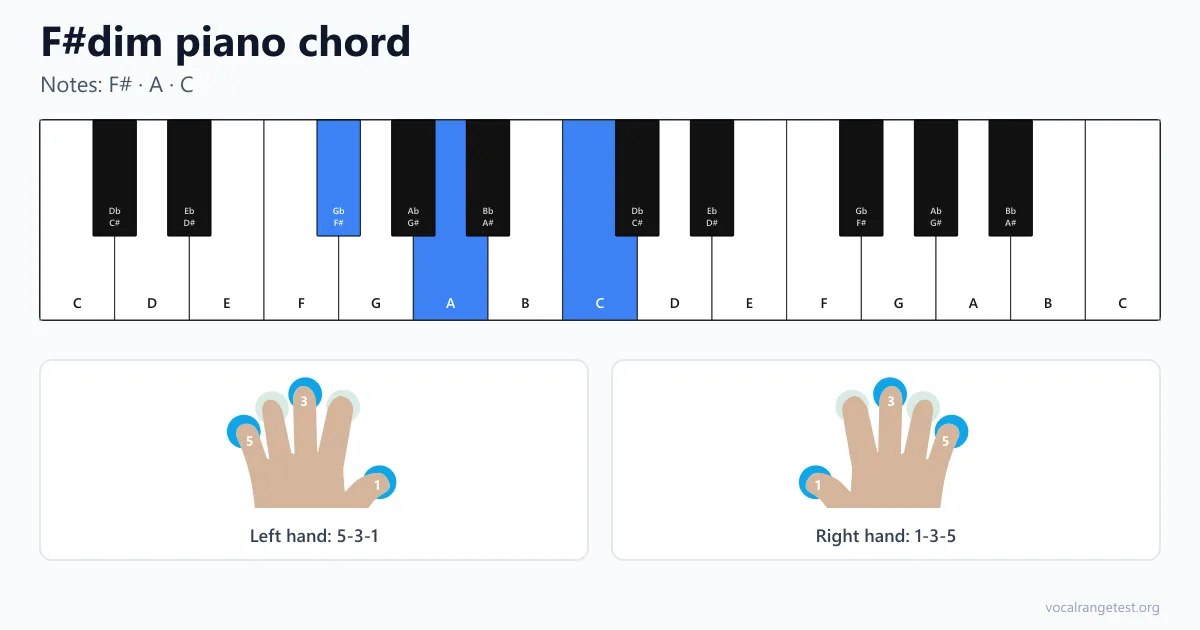
F#dim/Gbdim chord
Root position: The most common shape: the lowest note is the root named in the chord, with the other chord tones stacked above it.
Notes: F# · A · C
Voicing: 1 / 3
Fingering
Left hand: 5-3-1
Right hand: 1-3-5
Root
Chord type
Root position & inversions
F#dim piano chord
F#dim is a three-note chord built from stacked minor thirds: F#, A, and C. On the keyboard that means one black key and two white keys, spaced evenly by three half steps each. Compared with F# minor (F#–A–C#), the fifth is lowered by a half step from C# down to C. That tiny move is what gives the chord its unfinished, leaning quality—it sounds like it wants to resolve somewhere else rather than sit still as a “home” sound.
Where F#dim actually shows up in music
If you play a lot of songs in G major, you already know this chord even if the chart never spelled it out. In G major, F#dim is the leading-tone triad (vii°): F# wants to rise to G, A sits as a shared tone with the tonic chord, and C pulls toward B or hangs as tension depending on the line. Classical hymn cadences, school-band arrangements, and plenty of folk tunes use that short F#dim (or a broken F#–A–C shape in the left hand) right before landing on G. In E minor, the same three notes show up as ii°—a darker neighbor chord that often slides toward B or Em. Jazz charts and older sheet music written in flats may label the exact same keys as a Gbdim piano chord; on the instrument you press the same three pitches either way.
People reach for F#dim when they need a brief spike of unrest without committing to a full diminished-seventh sound. Think of a verse that suddenly tilts, a film cue that raises an eyebrow for half a bar, or a bridge that needs a hinge between two stable chords. It is not a “happy” triad and it is not pure minor sadness either—it is more like a musical question mark. If a chart says F#° or F#dim, play F#–A–C. If you only remember shapes, plant your thumb on F#, skip a key-cluster to A, then to C, and listen for that hollow, tightly wound color before you resolve it.
The three notes, plainly
Root position is F#, A, and C. First inversion starts on A (A–C–F#). Second inversion starts on C (C–F#–A). Same chord, different bass note—and the bass choice changes how strongly it pulls toward G or Em.
F#dim vs F#m vs F#dim7
F# minor keeps a perfect fifth (C#). F#dim flattens that fifth to C. F#dim7 adds another minor third on top (usually written D# or Eb), which stretches the tension further. If a pop lead sheet just says “dim,” start with the triad on this page before you stack the seventh.
Spelling: F#dim or Gbdim
Sharp-key music usually writes F#dim. Flat-key pages may print Gbdim. Search results also show phrases like f sharp dim chord piano or g flat dim piano chord. They point at the same three piano keys; the spelling follows the key signature and the voice-leading on the page.
Hear F#dim, then pull it apart
Most chord pages only show a static diagram. Here you can listen, break the triad into single notes, and flip through inversions with fingerings—so the shape on the page matches what your ears expect.

Online chord and arpeggio playback
Trigger the full F#dim sonority or hear F#, A, and C one after another. That split view is the fastest way to lock the interval pattern before you try it on a real piano.
How to play F#dim piano chord

1. Find the three keys
Locate F# (the black key between F and G), then A, then C. Keep the spacing even—each step is a minor third. Play them together softly first; diminished triads get harsh if you dig into the keys.

2. Listen before you memorize
Use the player above to hear the chord, then the arpeggio. Match that sound on your instrument. If your version feels brighter or “minor-ish,” you probably still have C# in the mix instead of C.

3. Practice inversions with a target chord
Play F#dim, then resolve to G major or E minor. Next, try F#dim/A into G/B, or F#dim/C into G. Training the resolve teaches your hands why the chord exists, not just where the dots are.