
Bm chord
Root position: The most common shape: the lowest note is the root named in the chord, with the other chord tones stacked above it.
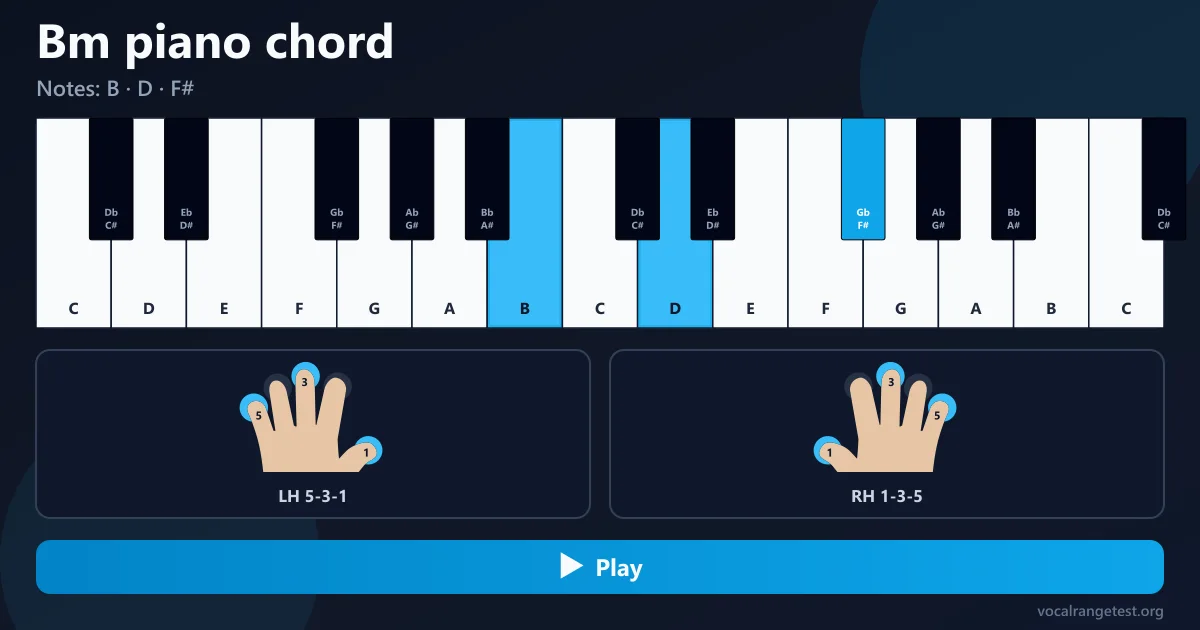
Notes: B · D · F#
Voicing: 1 / 6
Fingering
Left hand: 5-3-1
Right hand: 1-3-5
Root
Chord type
Root position & inversions
Alternate bass
B minor on the piano — three notes, one black key, and a colour that won’t brighten on its own
B minor is B–D–F♯: a minor triad with F♯ parked on a black key between the whites. It is the relative minor of D major, so the same pitch collection can feel sunny as D or shadowed as Bm depending on which tone sits in the bass and how the melody leans. Players open b minor chord piano shapes for ballads that need weight without going fully tragic, rock verses that sit under a vocal on the edge of grit, film cues that want dusk instead of midnight, and classical or pop progressions that pivot between D major brightness and B minor shade. This page stays on that one triad — diagram, playback, fingering, and the inversions and slash marks lead sheets actually print — so you can hear why Bm feels darker than Am before you stretch for F♯.
When charts ask for Bm — and what the colour usually feels like
Writers drop B minor into songs when they need minor warmth that still has a hard edge. As the home chord (i) in the key of B minor, it carries the whole emotional centre of the tune. As vi in D major, it is the soft turn under a chorus that just left a brighter D. You will also meet it as iii in G major, or as a borrowed colour when a progression wants a darker neighbour to A major or E minor territory. Emotionally Bm tends to read cool, introspective, a little stubborn — less fragile than F♯ minor’s thinness, less “open window” than Am on all whites. Compared with B major it flips the third to D and drains the daylight; compared with Bm7 it stays leaner, three notes instead of four, which is why so many rock and ballad charts still print plain Bm.
Learning b minor in piano practice means owning a stretch that mixes whites and one sharp. F♯ sits between E and G, so thumb placement and hand shape matter more than on an all-white minor like Am. You choose: stack B–D–F♯ in the right hand, park the root in the left, or thin a doubling while the ear still hears “B minor.” Charts rarely freeze you in root position. Bass lines walk through Bm/D and Bm/F♯; slash marks like Bm/A put a non-chord tone underneath and change the gravity without renaming the harmony above. Hearing the block triad next to an arpeggio turns those marks into something your ear can approve — which is how Bm stops being a label on a chart and becomes the colour you recognise under a vocal that refuses to smile.
Zoomed on Bm — not every minor on the board
The diagram stays close on B–D–F♯ so you can judge the black-key stretch and how D sits between the outer tones. When you need neighbouring qualities or other roots, the full piano chord chart is one jump away without losing the voicing you were hearing.
Prove F♯ before you force the span
Chord mode stacks the triad so the minor third is unmistakable against B and F♯. Arpeggio mode walks the tones so each lit key matches a pitch — especially useful while that black-key F♯ still feels like the note that makes or breaks the shape.
Bass moves; the name can still read Bm
Root position is home. The same tools surface inversions and alternate bass — including slash shapes such as Bm/A — so the harmony still functions as B minor when the lowest note is no longer B. That is the situation most lead sheets throw at you first.
A B minor bench you can hear — not a mute photo of B and F♯
Printed charts freeze one grip. Here the diagram stays tied to piano samples, left- and right-hand fingering, inversions, and alternate-bass shapes like Bm/A — so practice time goes into listening for the dark triad colour, not decoding a still image.

Hear the shade, then split the triad open
Tap once for a solid Bm when you want the full cool ring. Switch to arpeggio when you need to isolate whether F♯ is truly speaking as the fifth, or whether a soft finger has thickened D and muddied the minor third. Playback follows the voicing you selected, so an inversion or a slash like Bm/A sounds like the notes on screen rather than a generic root-position loop. That listen-and-compare loop is how a three-note picture becomes a chord you trust under a vocal that needs weight without melodrama.
- Click-to-hear chord or arpeggio on real piano samples
- Left- and right-hand fingering that updates with the voicing
- Root position plus Bm/D and Bm/F# inversions
- Alternate-bass (slash) shapes such as Bm/A when the bass sits outside the triad
- Diagram first — less lecture, more sound and hand shape
How to play B minor chord piano on this page

1. Lock B–D–F♯ on the diagram
Confirm the three tones before you stretch — especially F♯ on the black key. Bm mixes two whites with one sharp; crowding the thumb onto the wrong neighbour is the usual miss. Use the lit keys as a map, not a speed drill.

2. Hear the block triad, then the arpeggio
Play the stacked sound once so your ear catches the cool minor colour. Then switch to arpeggio and walk B–D–F♯ slowly. If the minor third disappears into the fifth, lighten F♯ or rebalance the hands until D reads clearly.

3. Match left- and right-hand fingering
Open the fingering view and fit the suggestions to your span. Small hands often split the chord — root in the left, D and F♯ in the right — and that is still legitimate Bm if the pitches are right.

4. Step through inversions and slash bass
Move from root position into Bm/D and Bm/F♯. Listen for how the mood shifts when D or F♯ sits on the bottom — same triad tones, different bass gravity. Then try alternate-bass options such as Bm/A chord piano shapes when a chart writes a slash that is not a chord tone.

5. Put Bm in a key (including the key of B minor)
In the key of B minor, chords piano players meet as i — the home sound under the melody. In D major, treat Bm as vi and walk a short D–Bm–G–A line so your ear hears the shade next to the bright tonic. Context beats drilling the grip in silence.