
F#m9/Gbm9 chord
Root position: The most common shape: the lowest note is the root named in the chord, with the other chord tones stacked above it.
Notes: F# · A · C# · E · G#
Voicing: 1 / 4
Root
Chord type
Root position & inversions
Two-hand voicing
F#m9(Gbm9) piano chord — the minor seventh that grew a ninth on top
An F#m9(Gbm9) piano chord is five notes: F#, A, C#, E, and G#. Read that stack from the bottom. F#–A–C# is a plain minor triad. Add E and you get F#m7 — already soft and finished. The last piece, G#, is the ninth. That top tone is what people are hunting when they type this chord: minor warmth with a little open air above the seventh, not a bare triad and not a dominant that wants to resolve. Flat-key charts write the same sound as Gbm9 (Gb–Bbb–Db–Fb–Ab). Same keys under your fingers; messier accidentals on the page. If you only ever practiced four-note grips, this page exists so you can hear the full five-note colour, break it apart, check positions, and try the F#m9/E inversion plus a two-hand layout before a lead sheet throws the symbol at you mid-rehearsal.
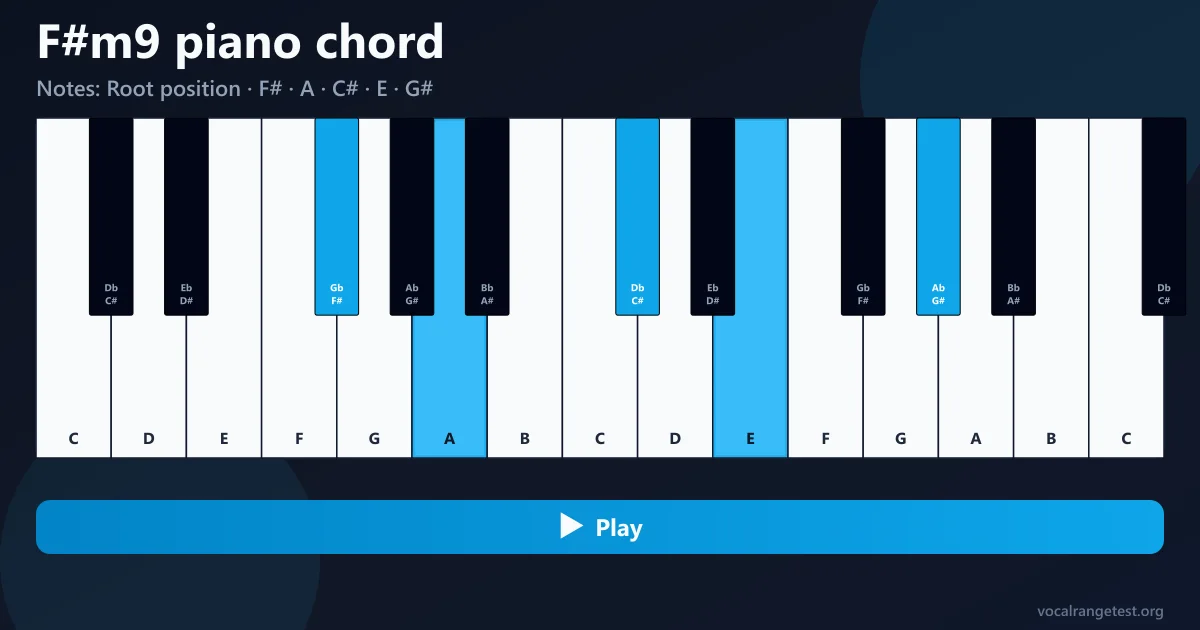
What people mean when they search for an F#m9(Gbm9) chord on piano
Most searches are not theory homework. Someone saw F#m9 on a chart, or Gbm9 in a flat-key book, and needs three practical answers: which keys, how to reach them without cramping, and what the chord is supposed to feel like once it speaks. The ear job is simple once you name it. Compared with F#m7, you are adding G# — a whole step above the root’s octave, sitting a major ninth above F#. Leave that G# out and the chart is lying. Play A# instead of A and you have stepped out of minor into something brighter that does not match the symbol. Play F#9 (with A#) and you have flipped into dominant territory entirely. The ninth on a minor chord is colour, not push; it floats. Neo-soul pads, quiet R&B hooks, jazz ballads in sharp keys, and a lot of bedroom-producer loops lean on that float when the track wants minor shade without sounding empty.
Spelling trips people up more than the hand shape. Sharp-side writing loves F#m9 because the notes stay readable next to E major, A major, B major, or F# minor. Flat-side writing reaches for Gbm9 when the bar is already thick with flats — think Db or Ab neighbourhoods — even though Bbb and Fb look hostile on paper. On a standard piano those two labels press identical keys. We built this tool because mute diagrams fail five-note chords hardest: you cannot tell from a static picture whether the ninth is speaking, whether the seventh is buried, or whether a one-hand crush is making you drop a tone. Here you can audition the F#m9(Gbm9) piano chord online, split it into an arpeggio, flip through available positions and the F#m9/E inversion, and use the two-hand voicing when five notes refuse to sit under one palm. That listen-first loop is the point of the product — less guessing, more sound you can trust before practice.
G# is the reason this is not just F#m7
F#, A, C#, and E already make a solid minor seventh. The ninth (G#) is the extra shimmer. If your grip sounds closed and “complete but flat,” you probably never landed that top tone.
Five notes fight for one hand — split when you need to
Close-position F#m9 is a stretch. Many players keep the root and fifth in the left hand and park the seventh, ninth, and third in the right. Same chord, less clawing.
Hear it, break it down, then move the bass
Real piano samples as a block or arpeggio, fingerings that follow the voicing on screen, plus F#m9/E and alternate layouts — so you judge colour by ear instead of hoping a printed grid is honest.
Practice the F#m9(Gbm9) piano chord with sound, positions, and inversions
A five-note diagram on paper cannot prove the G# is alive. These keys play real samples, update fingerings with each layout, and let you compare root position, F#m9/E, and a two-hand split in one place.

Stack the full minor ninth, then peel it apart
One click gives you the whole F#m9 colour — cool minor triad, settled seventh, and the G# that opens the top. Switch to arpeggio when a tone goes missing under soft fingers; A (the minor third) and G# (the ninth) are the usual casualties. Playback follows whatever position you selected, so F#m9/E and the two-hand voicing sound like the shape on screen, not a generic root-position loop. That is the difference between memorizing a picture and knowing the chord when a singer cues the next bar.
- Click to hear the full chord or a note-by-note breakdown on real piano samples
- Fingerings update with the voicing you pick
- Root position plus F#m9/E (seventh in the bass)
- Two-hand open layout when one hand cannot hold all five tones cleanly
- Same sound whether the chart says F#m9 or Gbm9
How to play F#m9(Gbm9) chord on piano

1. Know the five pitches before you invent a stretch
Say them out loud: F#, A, C#, E, G#. Root, minor third, fifth, minor seventh, major ninth. On the keyboard that means three black keys (F#, C#, G#) wrapped around two white keys (A, E). If you only remember “minor plus some extras,” you will invent wrong neighbours. Gbm9 players: you are still aiming at those same five keys, even if the page wrote Bbb and Fb.

2. Try a compact right-hand shape near middle C, then admit when it hurts
A close stack often starts with the thumb on F# and builds upward through A, C#, E, and G#. Some hands manage it; many do not, especially at soft dynamics. If the pinky collapses or a middle finger ghosts a neighbour, stop treating pain as technique. Switch to the two-hand layout on this page: left hand on F# and C#, right hand on E, G#, and A. You keep every chord tone without turning the grip into a claw.

3. Balance A and G# so the chord stays minor and open
The mood lives between those two tones. A keeps the stack minor; G# is the air on top. Slam the root and fifth while thinning the ninth and you get a dull F#m7 with a polite afterthought. Bury A under a loud G# and the colour turns oddly bright for a minor ninth. Aim for five even attacks, then compare with the block playback here until the blend matches what you meant.

4. Arpeggiate until F#–A–C#–E–G# is automatic
Arpeggio mode lights each key in order. Watching the rise is the fastest way to catch a missing ninth, a flipped third (A# by accident), or a seventh that never arrived. Slow down until the sequence feels boring — boring means reliable. This is usually the moment how to play F#m9(Gbm9) chord on piano stops being a diagram problem and starts being muscle memory you can take into a song.

5. Move into F#m9/E and listen to the new floor
Use the inversion control for F#m9/E. The seventh sits in the bass while the other tones stack above. Bass lines and quiet left hands love that move: same chord identity, thicker bottom, slightly different gravity. Play it as a block, then as an arpeggio, so your ear locks onto E as the lowest note before your hands copy the shape in a progression.
6. Drop the colour into a real line, not an isolated drill
F#m9 shows up as a lush i9 in F# minor, as a dressed-up vi in A major, or as a long pad under a vocal that needs minor warmth without a dominant shove. Hold the chord, walk into the next harmony, and notice why the writer wanted the ninth instead of stopping at F#m7. When the next chart respells the grip as Gbm9, come back here, audition the layout again, and trust your ears over the accidentals.