
C#m/Dbm chord
Root position: The most common shape: the lowest note is the root named in the chord, with the other chord tones stacked above it.
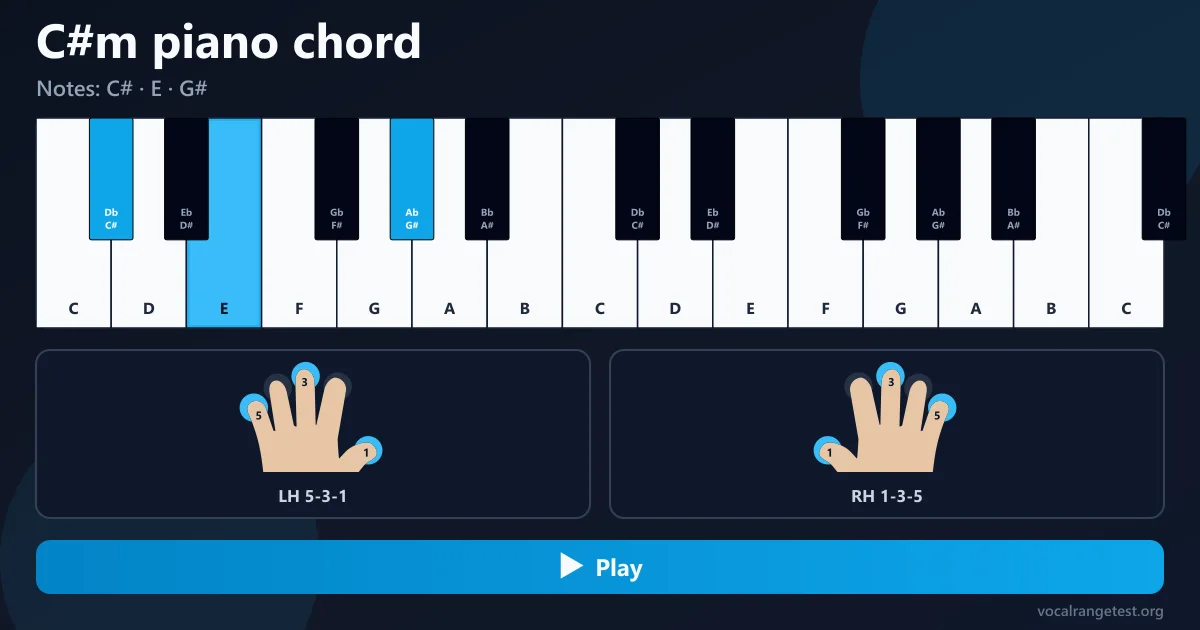
Notes: C# · E · G#
Voicing: 1 / 6
Fingering
Left hand: 5-3-1
Right hand: 1-3-5
Root
Chord type
Root position & inversions
Alternate bass
C#m on the sharp side of the keyboard — three notes, one white key, and a twin spelling called Dbm
C#m is C#, E, and G#. Two black keys and one white key in the middle. That layout is why the chord feels different under the hand than a white-key minor like Am: the thumb often lands on E while the outer fingers sit on sharps. The same three pitch classes can be written as Dbm (Db–Fb–Ab) when a chart lives in flat keys — same sound, different ink. This page stays on that triad so you can hear the stack online, split it into an arpeggio, check fingering, and move through inversions and alternate bass without bouncing between random screenshots.
When charts ask for C#m — and what “key of C#m chords piano” usually means
Players meet C#m most often as the relative minor of E major: same four sharps in the key signature, different centre of gravity. In E, C#m is vi — the place verses go when the lyric turns inward without leaving the neighbourhood. In A major it shows up as iii. In B major / F# major progressions it can sit as ii or as a borrowed colour under a vocal that wants cool shade, not tragedy. Guitar charts love sharp-side keys, so piano players inherit C#m from capo’d songs and band pads more often than theory textbooks admit. When people browse key of C#m chords piano ideas, they are usually collecting that E-major / A-major neighbourhood — i, iv, V around C# minor itself, plus the vi and iii jobs in related majors — not hunting a rare exam question labelled “key of C#m only.”
Emotionally C#m tends to read cooler and more modern than white-key Am: night-drive minor, sleek rather than folk-sad. It is still a plain triad — root, minor third, perfect fifth — so it can sit under a melody without the forward lean of C#m7. The interval C#–E is the hinge; if E drifts up to E#, you have left minor for something brighter and wrong for the label. Compared with C# major, the middle tone is the whole plot. Compared with Dbm chord piano spellings, nothing changes in the ear — only whether the rest of the bar is written in sharps or flats. On this site the diagram uses real piano samples, so you can prove that middle E by ear before you argue about whether the chart should have said Db minor instead.
E is the hinge between black keys
C# and G# are easy to see as a pair of sharps. E is the note players rush past. Hear the stacked triad once, then arpeggiate until that white key in the middle is unmistakable — that is how C#m in piano practice stops being three letter names and becomes a grip your ear trusts.
Same triad, new bass gravity
Root-position C#m is only the starting shape. C#m/E and C#m/G# keep the same three tones with a different lowest note. Alternate bass marks such as C#m/B, C#m/A, or C#m/D# show up when the line walks under a held colour. Preview those here before a rehearsal throws the slash at you.
Sharp ink or flat ink — one sound
If the chart says Dbm, you are still playing the same three pitches as C#m. Use this page to lock the sound, then match the spelling to whatever the rest of the key signature is doing. Listening first beats memorising two unrelated posters.
What you get here that a mute C#m screenshot cannot give you
One triad, real samples, and the inversions and slash basses lead sheets actually print.

Hear the stack, then walk the three tones
Chord mode plays C#–E–G# together so the minor colour is obvious against neighbouring majors. Arpeggio mode lights each key in order — especially useful while the black-key outer tones still distract you from the white E in the middle. That listen-and-split loop is information a frozen chart never delivers.
How to play C#m chord piano on this page

1. Lock the sound before you chase spellings
Open the diagram on C#m (C#–E–G#). Play the full triad once. Switch to arpeggio and listen for E between the two sharps — if that middle tone disappears, slow the broken pattern until each lit key matches a pitch you can name. Only then worry about whether a flat-key chart would have written Dbm.

2. Check fingering, then move the bass
Toggle left- and right-hand fingering and find a grip that does not twist the wrist on the black keys. Step into C#m/E and C#m/G# and notice how the same three letters change gravity. That is how learning the triad becomes a small family of shapes, not one frozen poster.

3. Audition alternate bass the sheet might print
Try slash options such as C#m/B, C#m/A, or C#m/D# when you want to hear a walking low note under an unchanged upper colour. Use those previews as a rehearsal shortcut: when the chart suddenly shows a slash, you have already heard what the floor does to the triad.