
Ebm/D#m chord
Root position: The most common shape: the lowest note is the root named in the chord, with the other chord tones stacked above it.
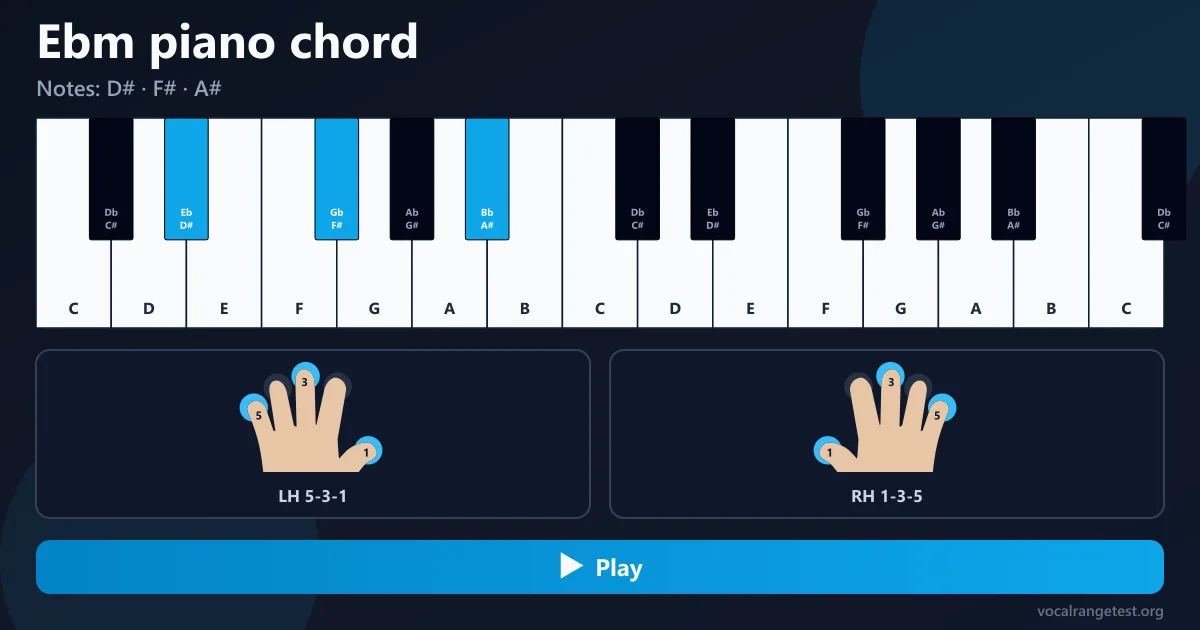
Notes: D# · F# · A#
Voicing: 1 / 6
Fingering
Left hand: 5-3-1
Right hand: 1-3-5
Root
Chord type
Root position & inversions
Alternate bass
Eb minor on the piano — three black keys, one dark colour, and a twin named D#m
Ebm and D#m are the same three pitches wearing different clothes. Spell it Eb–Gb–Bb and you are in flat country; spell it D#–F#–A# and you are reading a sharp-key chart. On the keyboard both land as an ebm chord piano shape built almost entirely on black keys — a compact, shadowy triad that feels colder than Am and denser than a sparse power fifth. Writers reach for it when a verse needs weight without going fully tragic, when a film cue wants dusk with a hard edge, or when a rock or R&B progression sits next to Gb major / F# major and needs its relative minor. Guitar tabs often print D#m chord piano players still hear as Eb minor; classical and jazz charts lean Ebm. This page stays on that one sound: diagram, click-to-hear playback, fingering, inversions, and alternate bass — so you can hear the dark minor colour before your hand decides which black-key cluster to own.
When charts ask for Ebm or D#m — and what the shade usually feels like
Eb minor shows up wherever a progression wants shadow with a firm floor. As the home chord (i) in the key of Eb minor, it carries the whole emotional centre — rare on beginner pop sheets, common in dramatic film writing, neo-soul ballads, and metal or progressive rock that lives in flat minors. As vi in Gb major (or F# major if the chart thinks in sharps), it is the soft turn under a melody that just left a brighter Gb / F#. You will also meet it as iii relative to Cb/B territory, or as a borrowed colour when a song in Eb major or Bb major wants a darker neighbour for a bridge. Emotionally Ebm tends to read cold, cinematic, a little heavy — less “open window” than Am on whites, less stubborn swagger than some natural-minor rock shapes, more like low light with pressure. Compared with Eb major it flips the third to Gb and drains the daylight; compared with Ebm7 it stays leaner, three notes instead of four, which is why so many rock and film cues still print plain Ebm or D#m.
Learning ebm in piano practice means owning a black-key triad that still needs clear voicing. Eb, Gb, and Bb sit close; beginners often mash them into a muddy cluster or grab the wrong neighbour white by accident. The useful skill is hearing which tone does the work: Eb anchors the name, Gb carries the minor third (the whole mood), Bb fills the fifth. Charts rarely freeze you in root position. Bass lines walk through Ebm/Gb (or Ebm/F#) and Ebm/Bb (or Ebm/A#); slash marks park non-chord tones underneath when a producer wants a pedal or a passing bass. Guitarists writing D#m in piano arrangements are not asking for a different chord — they are asking for the same dark triad under sharp-key spelling. Hearing the block triad next to an arpeggio turns those twin labels into one sound your ear can approve, which is how Ebm stops being a confusing enharmonic debate and becomes the colour you recognise under a vocal that refuses to brighten.
Zoomed on Ebm — not every flat minor on the board
The diagram stays close on Eb–Gb–Bb so you can judge the black-key spacing and how the minor third sits between the outer tones. Neighbouring qualities and other roots live on the full chart; this page is for hearing this dark triad cleanly first.
Prove Gb before you crush the cluster
Chord mode stacks the triad so the minor third is unmistakable against Eb and Bb. Arpeggio mode walks the tones so each lit key matches a pitch — especially useful while that middle black key still decides whether the shape sounds minor or just thick.
Bass moves; the name can still read Ebm (or D#m)
Root position is home. The same tools surface inversions and alternate-bass (slash) shapes, so the harmony still functions as Eb minor when the lowest note is no longer Eb. Lead sheets throw that at you whether they spell the chord Ebm or D#m.
An Ebm workbench you can hear — not a mute photo of three black keys
Printed charts freeze one grip. Here the diagram ties to piano samples, left- and right-hand fingering, inversions such as Ebm/Gb and Ebm/Bb, and alternate-bass shapes — so practice time goes into hearing the dark minor colour, not decoding a still image or arguing about flats versus sharps.

Hear the shade, then take the triad apart
Tap once for a solid Ebm when you want the full cold ring. Switch to arpeggio when you need to isolate whether Gb is truly speaking as the minor third, or whether a soft finger has thickened Bb and muddied the colour. Playback follows the voicing you selected, so an inversion or a slash bass sounds like the notes on screen rather than a generic root-position loop. That listen-and-compare loop is how three black keys become a chord you trust under a cinematic verse, a neo-soul pad, or a rock bridge that needs weight without melodrama — whether the chart wrote Ebm or D#m.
- Click-to-hear chord or arpeggio on real piano samples
- Left- and right-hand fingering that updates with the voicing
- Root position plus inversions such as Ebm/Gb and Ebm/Bb
- Alternate-bass (slash) shapes when the chart puts a different note underneath
- Diagram first — less lecture, more sound and hand shape
How to play Ebm chord piano on this page

1. Lock Eb–Gb–Bb on the diagram
Confirm the three tones before you mash the black-key span. Ebm lives on flats; if your chart says D#m, aim for the same pitches spelled D#–F#–A#. Crowding a soft finger onto the wrong white neighbour is the usual miss. Use the lit keys as a map, not a speed drill.

2. Hear the block triad, then the arpeggio
Play the stacked sound once so your ear catches the cold minor colour. Then switch to arpeggio and walk Eb–Gb–Bb slowly. If the minor third disappears into the fifth, lighten Bb or rebalance the hands until Gb reads clearly — that note is the whole mood.

3. Match left- and right-hand fingering
Open the fingering view and fit the suggestions to your span. Small hands often split the chord — root in the left, Gb and Bb in the right — and that is still legitimate Ebm if the pitches are right. Clarity on black keys beats a crushed cluster every time.

4. Step through inversions and slash bass
Move from root position into first and second inversion (Ebm/Gb or Ebm/F#, Ebm/Bb or Ebm/A# depending on spelling). Listen for how the mood shifts when Gb or Bb sits on the bottom — same triad tones, different bass gravity. Then try alternate-bass options when a chart writes a slash that is not a chord tone.

5. Put Ebm in a key (and decode “key of Ebm chords piano” searches)
People searching “key of Ebm chords piano” usually want Eb minor as a home key, or Ebm as a chord inside Gb / F# major — not a mystery scale named after the symbol alone. In Eb minor, treat Ebm as i under the melody. In Gb major, treat it as vi and walk a short Gb–Ebm–Db–Cb (or the sharp-key twin) so your ear hears the shade next to the brighter tonic. Context beats drilling the grip in silence.