
F#/Gb chord
Root position: The most common shape: the lowest note is the root named in the chord, with the other chord tones stacked above it.
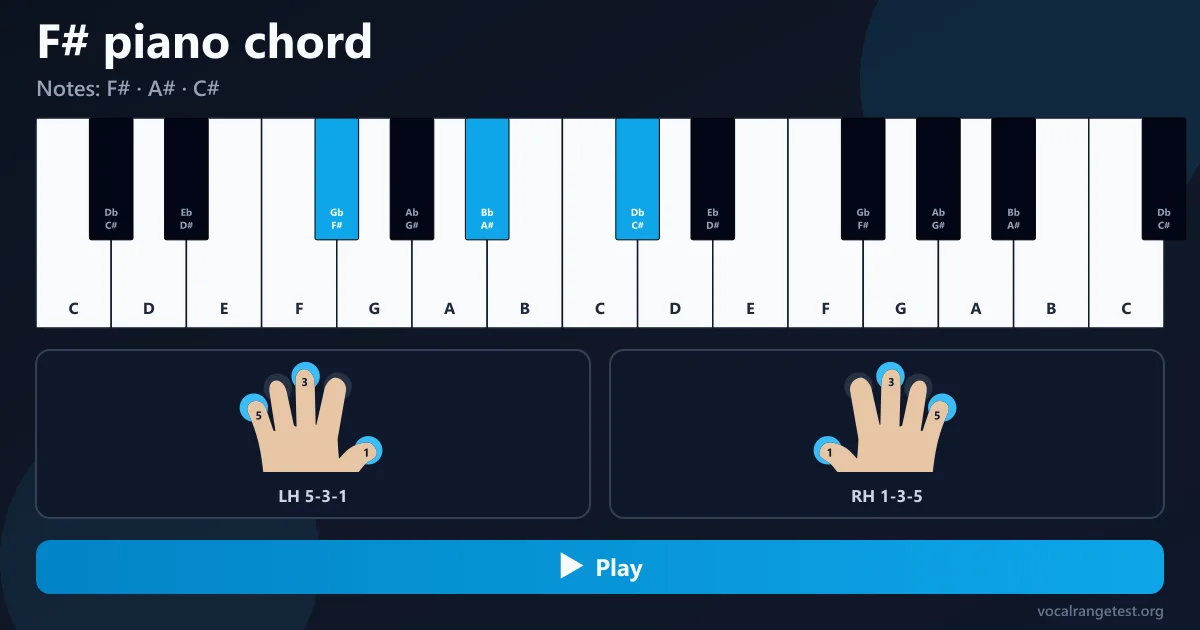
Notes: F# · A# · C#
Voicing: 1 / 6
Fingering
Left hand: 5-3-1
Right hand: 1-3-5
Root
Chord type
Root position & inversions
Alternate bass
F# chord piano — F#, A#, and C# stacked as a sharp-side major triad
An f# chord piano shape is three notes: F#, A#, and C#. On a real keyboard that means three black keys in a row of the same cluster pattern—no white key sits inside the triad itself. That is unusual for beginners who learned C, G, or F first, and it is exactly why people search this page: they want the sound and the hand shape of F# major, not a lecture about enharmonic theory. The same pitches can be written as a Gb chord piano triad (Gb–Bb–Db). The keys under your fingers do not change; the spelling on the page does. Sharp-key charts and guitar-led sheets usually keep F#. Flat-key jazz, brass books, and some hymnals prefer Gb. This page stays on one colour so you can hear F# as a full chord, break it into an arpeggio, check fingerings, and move through inversions without bouncing between spellings.
Where F# shows up—and what it tends to feel like
In the key of F# major, this triad is home: I. Worship charts, synth-pop hooks, and guitar arrangements that already live on sharps park here when neighbouring chords refuse to flip into flats. In B major, F# often works as V—the door that wants to open back toward B. You will also meet F# as a bright borrowed lift inside otherwise darker sharp-key songs, or as a pad under a vocal while the bass walks. Relative to all-white C major, F# major usually reads a little denser and more metallic: still major, still open, but with more edge—like light off chrome rather than porch sunlight. If you are building key of F# chords piano vocabulary, start by owning I in F# and hearing how V in B leans toward home; those two jobs explain a large share of the sheets that bother to print the symbol.
Theory-wise the triad is root, major third, perfect fifth. The span from F# to A# is the major third that keeps the colour bright; C# locks the fifth. Flatten the third and you tip into F# minor. Add a flat seventh and you get dominant pull toward B. Plain F# is the clean landing pad. On this site the diagram is wired to piano samples: click to hear the full stack, then switch to arpeggio so each black key lights in order. That listen-and-split loop matters here because soft fingertips drift toward neighbouring whites and blur the posts. Left- and right-hand fingering update with the voicing; inversions such as F#/A# and F#/C#, plus alternate bass options, stay on the same page so practice time goes into sound and placement—not collecting mute screenshots.
F# and Gb share the same keys
Sharp charts say F#; flat charts often say Gb. Learn the bright triad once, then read whichever spelling your sheet prefers.
All three posts are black keys
If any finger slides onto a white neighbour, the triad stops reading as F# major. Chord mode proves the colour; arpeggio mode makes each post unmistakable.
Tools a static chart cannot give you
Hear chord or arpeggio on piano, check left/right fingering, then flip through inversions and alternate bass without leaving the page.
What you can do with F# on this page
Built for hearing and hand placement—not another dead PNG of black keys.

Hear the full chord, then tear it apart
Play F# as one block, or switch to arpeggio so F#, A#, and C# sound and light one by one. That is how you catch a finger that wandered onto a white key.
How to play F# chord piano

Find the three black keys
Locate F# (the black key above F), then A# and C# in the same neighbourhood. Plant them together first without rushing the stretch. If your hand is small, drop an octave; the identity of the chord does not change.

Hear chord mode, then arpeggio
Click the diagram to hear the full F# major colour. Switch to arpeggio and watch each key light as it sounds. If one note feels soft or wrong, you almost always drifted onto a neighbouring white key.

Check inversions when the chart asks
Root position is fine for learning. When a lead sheet writes F#/A# or F#/C#, flip to that voicing here, hear it, and keep the same left/right fingering guide—so f# in piano practice stays tied to real chart spellings.