
F#sus/Gbsus chord
Root position: The most common shape: the lowest note is the root named in the chord, with the other chord tones stacked above it.
Notes: F# · B · C#
Voicing: 1 / 6
Fingering
Left hand: 5-2-1
Right hand: 1-4-5
Root
Chord type
F#sus4
F#sus2
F# sus chord piano without drowning in sharps
F♯ already looks crowded on paper—sharps everywhere—and then a chart adds “F#sus.” An f# sus chord piano shape is simpler than it looks: keep F♯ and C♯ as the outer posts, and change only the middle note to B (F#sus4) or G♯ (F#sus2). This page puts both versions on one live keyboard so you can hear the hang instead of counting accidentals in your head.
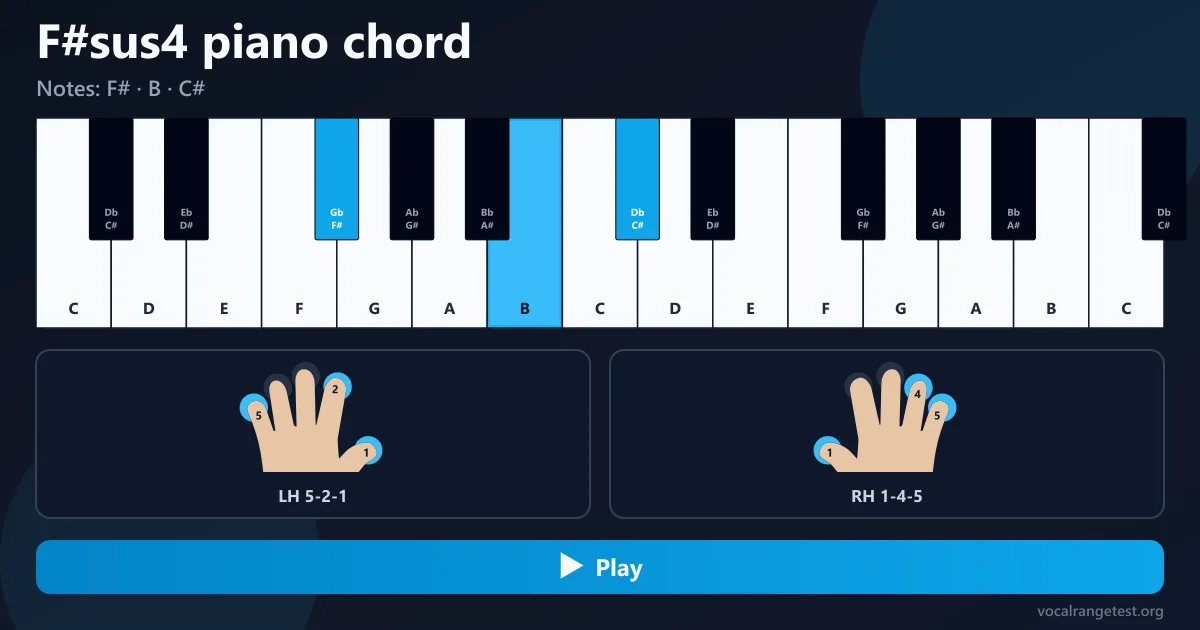
What “sus” removes from an F♯ triad
Plain F♯ major is F♯, A♯, and C♯. A♯ is the bright major third—the note that makes the chord sound finished and major. Suspended F♯ takes that brightness out on purpose. Put B in the middle and you have the chart-default f# sus 4 piano chord: F♯–B–C♯. Put G♯ in the middle and you have the softer f# sus 2 piano chord: F♯–G♯–C♯. The skeleton stays: F♯ underneath the idea, C♯ a fifth above. Only the filler moves. With no clear major or minor third, the chord will not tell a happy/sad story by itself. It holds the door open.
Searches for “f# sus chord on piano” or “key of f# sus chords piano” usually mean you are already in sharp territory—R&B and pop keys that favor F♯, guitar charts after a capo math problem, or a singer who lives a half step above F. Some players prefer to think in G♭ for flats; the sounding chord is the same neighborhood either way, but band charts often print F#. On the keys, a useful landmark is that B (for sus4) is a white key sitting between black-key posts. G♯ (for sus2) stays in the black-key cluster. Your ear’s job is to hear B wanting to settle toward A♯ (into F♯ major), or G♯ sitting like a closer, calmer color—then pick the one that fits the line.
F#sus / F#sus4 — the usual shorthand
Bare “F#sus” on a lead sheet almost always means F♯–B–C♯. B is the fourth; releasing to F♯ often feels like that white key giving way to A♯ again.
F#sus2 — same posts, gentler middle
F♯–G♯–C♯ keeps the outer frame but pushes less hard. Handy for pads, soft builds, and verses that need width without a dramatic resolve.
Hear it, name it later
Play the full chord, break it into an arpeggio, check fingerings, then move the bass with inversions when the left hand needs to walk.
Why bother with F# sus—and what this page does differently
A static sharp-key diagram can freeze beginners. Here you listen online, split the tones, see hand positions, and explore alternate bass plus inversions in one view.

Where the hang actually gets used
Picture a chorus that has already planted F♯ several times. Another plain F♯ feels like flipping a bright light back on. Hold F#sus4 for a bar—B in the middle—and the light dims without leaving the room; resolve to F♯ and the brightness returns with purpose. Modern pop and R&B progressions that sit in F♯ (or move through C♯m–B–F♯ neighborhoods) use that breath all the time. Guitar-driven sets transpose into F♯ after a capo and the pianist inherits the same symbols. Quieter beds and ambient layers often prefer F#sus2 because G♯ hugs the chord more tightly and feels less like a big “church” release. Plain rule: if F♯ feels finished too early, borrow the hang; if the hang overstays, land on F♯ or tip into D♯m for a minor shade.
- Live piano playback for the full stack or a note-by-note arpeggio.
- F#sus4 and F#sus2 grouped separately so you compare hangs, not decode one abbreviation.
- Fingering guidance aimed at comfortable root-position shapes.
- Inversions and alternate bass for smoother left-hand motion.
- Runs free in the browser—no install, no account gate for a quick check.
How to play F# sus chord piano on this page

1. Lock F♯ and C♯ before you choose a middle note
Ignore the suspended tone for one pass. Find F♯, then C♯ above it. If those posts drift, no middle note will make the chord feel like an F♯-family sound.

2. Add B for the chart default, then try G♯
Place B between F♯ and C♯ for F#sus / F#sus4. Play the block once, then switch to arpeggio so each glowing key matches a tone you can hear. Open the F#sus2 group (F♯–G♯–C♯) and resolve both shapes into plain F♯ major. Notice which landing feels like a stronger drop (often sus4) and which feels softer (often sus2). That listen teaches more than another row of accidentals on a worksheet.

3. Shift the bass with inversions when the groove needs motion
Root position teaches the spelling. When you accompany a long stretch in F♯, flip an inversion so C♯, B, or G♯ can sit underneath—alternate bass without inventing a new chord name. Same three tones, different floor under the vocal. Use the on-page inversion controls instead of rebuilding the shape every time the left hand wants a step.