
Dm7 chord
Root position: The most common shape: the lowest note is the root named in the chord, with the other chord tones stacked above it.
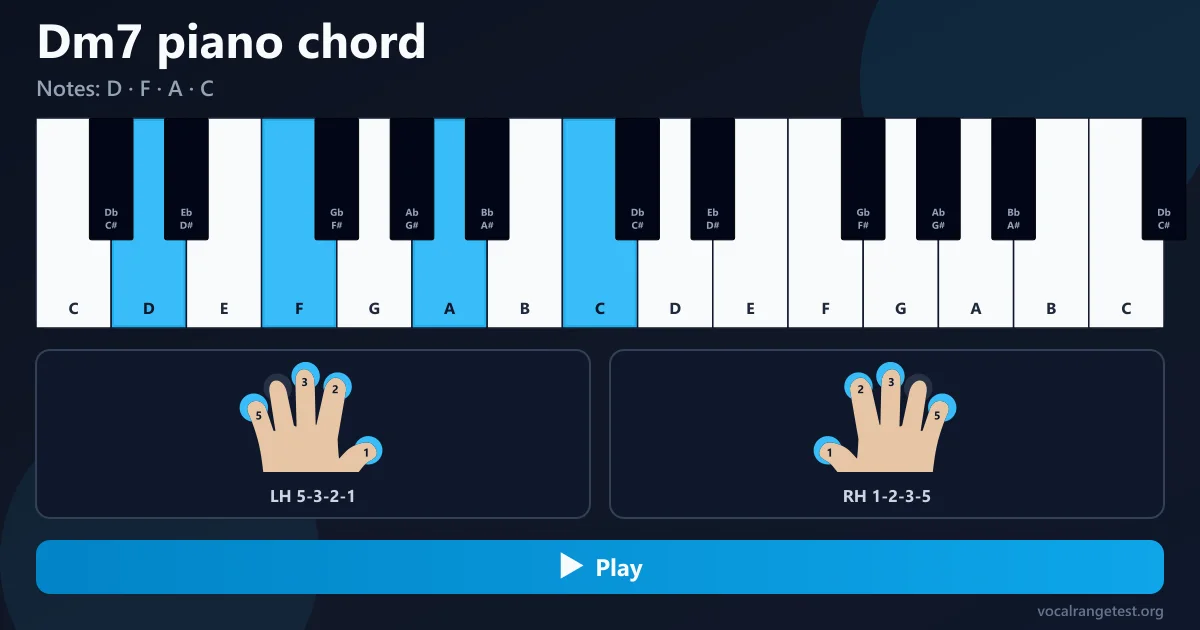
Notes: D · F · A · C
Voicing: 1 / 7
Fingering
Left hand: 5-3-2-1
Right hand: 1-2-3-5
Root
Chord type
Root position & inversions
Alternate bass
Dm7 on the piano — four notes that sound unfinished on purpose
A plain D minor triad (D–F–A) can feel closed and heavy. Add C on top and you get Dm7 — D, F, A, and C — a minor seventh that keeps a little air in the room. Players reach for dm7 chord piano shapes when a chart wants minor colour without the clenched feeling of a bare triad: jazz ii–V lines, F-major ballads that sit on vi7, neo-soul grooves, and singer-songwriter verses that lean forward instead of resolving. This page stays on that one chord — diagram, playback, fingering, and the inversions lead sheets actually print — so you can hear why the seventh matters before you force a stretch at the bench.
When charts ask for Dm7 (and what the colour usually feels like)
Writers drop Dm7 into songs when they need minor warmth that still wants to move. In C major it is the classic ii7 — the chord that walks into G7 and then home to C. In the key of F, Dm7 chords piano players see most often sit as vi7 under a vocal that wants bittersweet support without going full tragic. You’ll also meet it as iii7 in B♭, or as a borrowed colour when a pop progression hangs on D minor longer than a triad can carry. Emotionally Dm7 tends to read as rainy-window, slightly wistful, a little open at the top — softer than Dm, leaner than a thick jazz stack with 9ths and 11ths piled on. Compared with Dmaj7 it stays minor; compared with Dm9 it stays playable for small hands and sparse arrangements.
Learning dm7 in piano practice also means facing four white keys honestly. The hand has to choose: stack them tightly in the right hand, park the seventh in the left, or leave a tone out while the ear still hears the chord’s identity. Real charts rarely freeze you in root position. Bass lines walk through Dm7/F and Dm7/A; third-inversion Dm7/C shows up when the seventh itself sits underneath; slash marks appear when the line keeps moving under a held right-hand colour. Hearing block chords and broken patterns here turns those marks into something your ear can approve before your fingers copy them — which is how Dm7 stops being a theory label and becomes a sound you recognise mid-song.
Built around Dm7 — not a dump of every minor seventh
The diagram stays zoomed so you can judge spacing across D–F–A–C and how the C blends with the triad. When you need a wider grid for neighbouring qualities or other roots, the full piano chord chart is one jump away without losing the voicing you were hearing.
Prove the C before you force the stretch
Chord mode stacks the four tones so the minor seventh is unmistakable against D–F–A. Arpeggio mode walks them so each lit key matches a pitch — especially useful while that top C still feels optional instead of part of the chord’s job.
Bass moves; the name still reads Dm7
Root position is home. The same tools surface inversions and alternate bass so the harmony still functions as Dm7 when the lowest note is no longer D — the situation most lead sheets throw at you first.
A Dm7 workbench you can hear — not a mute photo of four white keys
Printed charts freeze one grip. Here the diagram stays tied to piano samples, left- and right-hand fingering, inversions, and the alternate-bass shapes lead sheets print — so practice time goes into listening and placement instead of decoding a still image.

Hear the soft seventh, then split it open
Tap once for a solid Dm7 when you want the full bittersweet ring. Switch to arpeggio when you need to isolate whether C is truly speaking as the seventh, or whether a soft finger has thickened F or A and muddied the stack. Playback follows the voicing you selected, so an inversion or slash shape sounds like the notes on screen rather than a generic root-position loop. That listen-and-compare loop is how a four-note picture becomes a chord you trust under a vocal.
- Click-to-hear chord or arpeggio on real piano samples
- Left- and right-hand fingering that updates with the voicing
- Root position plus Dm7/F, Dm7/A, Dm7/C inversions
- Alternate-bass (slash) shapes when the bass note sits outside the triad stack
- Same chord page for English and other locales — diagram first, fluff last
How to play Dm7 chord piano on this page

1. Find D–F–A–C on the diagram
Confirm the four tones before you stretch. Dm7 is all white keys — easy to see, easy to misplay if two fingers crowd the same pitch. Use the lit keys as a map, not as a speed challenge.

2. Hear the block chord, then the arpeggio
Play the stacked sound once so your ear locks the colour. Then switch to arpeggio and walk D–F–A–C slowly. If the seventh disappears in the wash, lighten the triad tones or rebalance the hand until C reads clearly.

3. Check fingering for each hand
Open the fingering view and match left and right suggestions to your span. Small hands often split the chord — root or seventh in the left, the rest in the right — and that is still legitimate Dm7 if the pitches are right.

4. Step through inversions and alternate bass
Move from root position into Dm7/F, Dm7/A, and Dm7/C. Listen for how the mood shifts when F or C sits on the bottom — same chord tones, different bass gravity. Then try any alternate-bass options the page lists when a chart writes a slash you have not practised yet.

5. Put it in a key context (especially F major)
In the key of F, Dm7 chords piano players meet as vi7 — often under a verse that wants soft minor colour before returning to F or moving toward B♭. In C major, treat Dm7 as ii7 and try a short Dm7–G7–C line so your ear hears why charts keep asking for it. Context beats isolated drilling.